Kitchen6 min read
Seaweed Butter: The Two-Ingredient Upgrade Everything Else Needs
Beyond the basic recipe: which seaweeds to blend into butter, five flavour variations, and a cook's map of where seaweed butter transforms a dish.
Sofia Andersson ·
A complete seaweed flatbread recipe built on Nordic coastal baking tradition — flour choice, hydration, dough handling and three ways to bake it.
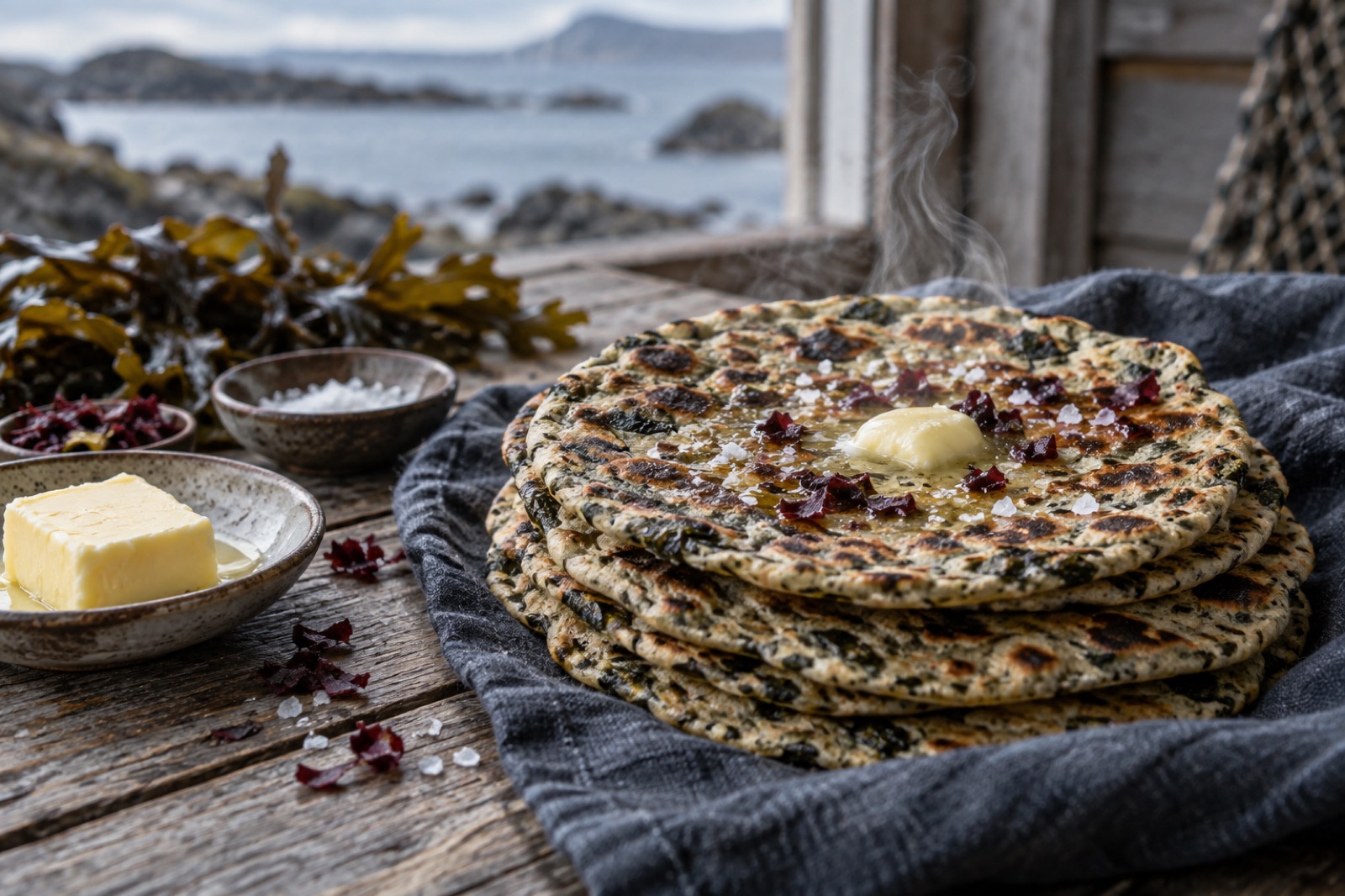
Along the coasts of Norway, Iceland and the Faroe Islands, flatbread was never a side dish — it was the architecture of a meal. Rye and barley breads cooked on a griddle, torn and used to carry fish, butter and cured meat. The version in this recipe borrows that architecture and adds the ingredient those same coasts have been drying for centuries: seaweed. The result is a soft, blistered flatbread with a mineral, savory depth that makes butter taste like more than butter.
This is not a novelty bake. Done right, seaweed flatbread tastes like bread first and ocean second — the way a good rye tastes of grain, not of the field. The seaweed (dulse, kelp or a blend) seasons the crumb from within, the way anchovy melts into a sauce. If you are new to baking with seaweed, start with the primer on breads, crackers and focaccia, then come back here for the masterclass.
The single most important decision is which seaweed goes into the flour, and in what form.
Dulse is the traditional choice for baking. It toasts beautifully, turns almost bacony at the edges, and grinds into a coarse brick-red flake that disperses evenly through dough. Use 15–20 g dried dulse per 500 g flour. See the full dulse profile in Cooking with Dulse.
Sugar kelp or kombu powder gives a quieter, more umami-forward bread — think broth, not bacon. Use less: 8–10 g per 500 g flour, because kelp powders concentrate glutamates and iodine. More than 2% by flour weight and the bread starts tasting like soup stock.
Nori works in a pinch but burns faster than it should. If you use it, add it as flakes into an oil-brushed dough rather than mixed into the flour, where it scorches on the griddle.
Laverbread (the Welsh cooked-and-puréed Porphyra) is a different animal entirely — a wet ingredient, not a dry one. It makes a wonderful flatbread but changes hydration by 10–15%, so treat it as an advanced variation, covered below.
Whichever you choose, buy from a supplier that tests for heavy metals and iodine — the checklist in How to Buy Seaweed Sustainably applies to baking as much as to snacking.
This makes eight flatbreads, roughly 20 cm across. It is a direct dough — no preferment — because the griddle method rewards speed and the seaweed brings enough flavor that a long ferment adds little.
Ingredients:
Method:
Heat a dry cast-iron skillet or griddle over medium-high until a drop of water skitters. Lay in a rolled flatbread. Bubbles should form within 30–45 seconds; when the underside is spotted brown, flip and cook 60–90 seconds more. Total: about 2½ minutes. This gives the traditional spotted, chewy result — closest to Norwegian flatbrød's softer cousins.
Preheat your oven as hot as it goes — 250–275 °C — with a pizza stone or inverted sheet pan inside for at least 45 minutes. Bake flatbreads directly on the stone, two at a time, 2–3 minutes until puffed and blistered. This approach gives the most dramatic puff and the widest blistering, and it scales well when you're cooking for a crowd.
Lay rolled dough directly on a clean grill grate over medium coals or a gas burner. Thirty seconds a side. You get char, smoke and the best flavor of the three — but you must not walk away, because seaweed flecks scorch fast. Save this for when you've made the recipe twice already.
A few adjustments separate good flatbread from great:
If your dough tears when rolling, it is under-hydrated or under-rested. Add water 10 ml at a time, or rest the balls a full 20 minutes.
Rye percentage: up to 20% rye flour adds the Nordic sourness and pairs deeply with kelp. Past 25% rye the dough gets fragile on the griddle; blend with bread flour, never go majority-rye for griddle work.
Laverbread variation: replace 100 ml of the water with 120 g laverbread, reduce oil to 15 ml, and add 1 teaspoon of malt vinegar. The dough will be stickier and the crumb darker, almost pumpernickel-toned, with an intense savory-sea character. Cook it slightly longer at slightly lower heat — wet doughs need time to dry at the center.
Sourdough variation: replace the yeast with 100 g of ripe starter and drop the water to 300 ml; ferment 4 hours at room temperature. The acidity flatters dulse enormously.
Seaweed flatbread is a carrier, and it wants fat. The single best pairing is a thick swipe of seaweed butter on a warm round — doubling down on the ocean note in a way that's rich rather than repetitive. Beyond that:
For seasoning at the table, a pinch of seaweed salt over the buttered bread is the move that makes people ask for the recipe.
Cooked flatbreads keep two days wrapped at room temperature, or three months frozen with parchment between each one. Reheat from frozen directly on a dry skillet, 60 seconds a side — they come back nearly perfect. The raw dough, divided into balls, holds 24 hours in the fridge; let it come back to room temperature for 30 minutes before rolling.
Dulse flakes and kelp powder should live in airtight jars away from light; the full rundown is in Storing Seaweed.
You can, but it's a different recipe. Fresh kelp or dulse is 80–90% water, so it must replace part of the liquid, be chopped very fine, and be added at roughly 60–80 g per 500 g flour. Blanch it first for 30 seconds to tame the slime, squeeze it hard, then proceed. Dried seaweed is far more predictable, which is why every traditional recipe uses it.
Nearly always one of three causes: the dough was too dry (add water next time), the balls didn't rest before rolling (gluten stayed tense), or they were overcooked on a griddle that wasn't hot enough, which dries the bread instead of blistering it. Hot, fast cooking is what keeps flatbread soft.
A true flatbread needs gluten-like structure, but a workable version uses a blend of buckwheat and a rice-tapioca mix with 2% psyllium husk and a longer rest — 30 minutes — before rolling. Expect a more fragile, griddle-only bread. The seaweed itself is naturally gluten-free; it's the structure you have to rebuild.
With 15 g of dulse across eight flatbreads, each bread carries well under a typical adult's daily iodine intake — dulse is one of the moderate-iodine seaweeds. Kelp powder is far more concentrated, which is exactly why the recipe caps it at 2%. If you monitor iodine for thyroid reasons, read Iodine and Seaweed: How Much Is Too Much? and prefer dulse over kelp in baking.
Look for Atlantic dulse from the North Atlantic or Pacific sugar kelp from tested waters, with a harvest or test date on the pack. Whole leaf that you toast yourself beats pre-ground powder almost every time — the volatile aromatics survive about eight weeks after grinding, and no longer.
Beyond the basic recipe: which seaweeds to blend into butter, five flavour variations, and a cook's map of where seaweed butter transforms a dish.
Sofia Andersson ·
Seaweed belongs in the bread oven: it seasons dough from within. Recipes and ratios for kelp focaccia, nori crackers, dulse rolls and soda bread.
Sofia Andersson ·
How to cook dulse — the North Atlantic red seaweed that fries up smoky and crisp. Pan-frying, flakes, the DLT sandwich, and buying and storage tips.
Sofia Andersson ·