Atlas9 min read
Kelp Forests of the Firth of Clyde: Scotland's Once-and-Future Sea
A coastal atlas guide to the Firth of Clyde: where kelp still grows, what a century of trawling took out, and why Arran's no-take zone matters.
Dr. Mara Ellison ·
A coastal atlas guide to East Lothian: Bass Rock gannets, Firth of Forth estuary water, wolf-fish reefs, and where the kelp grows clear of the bight.
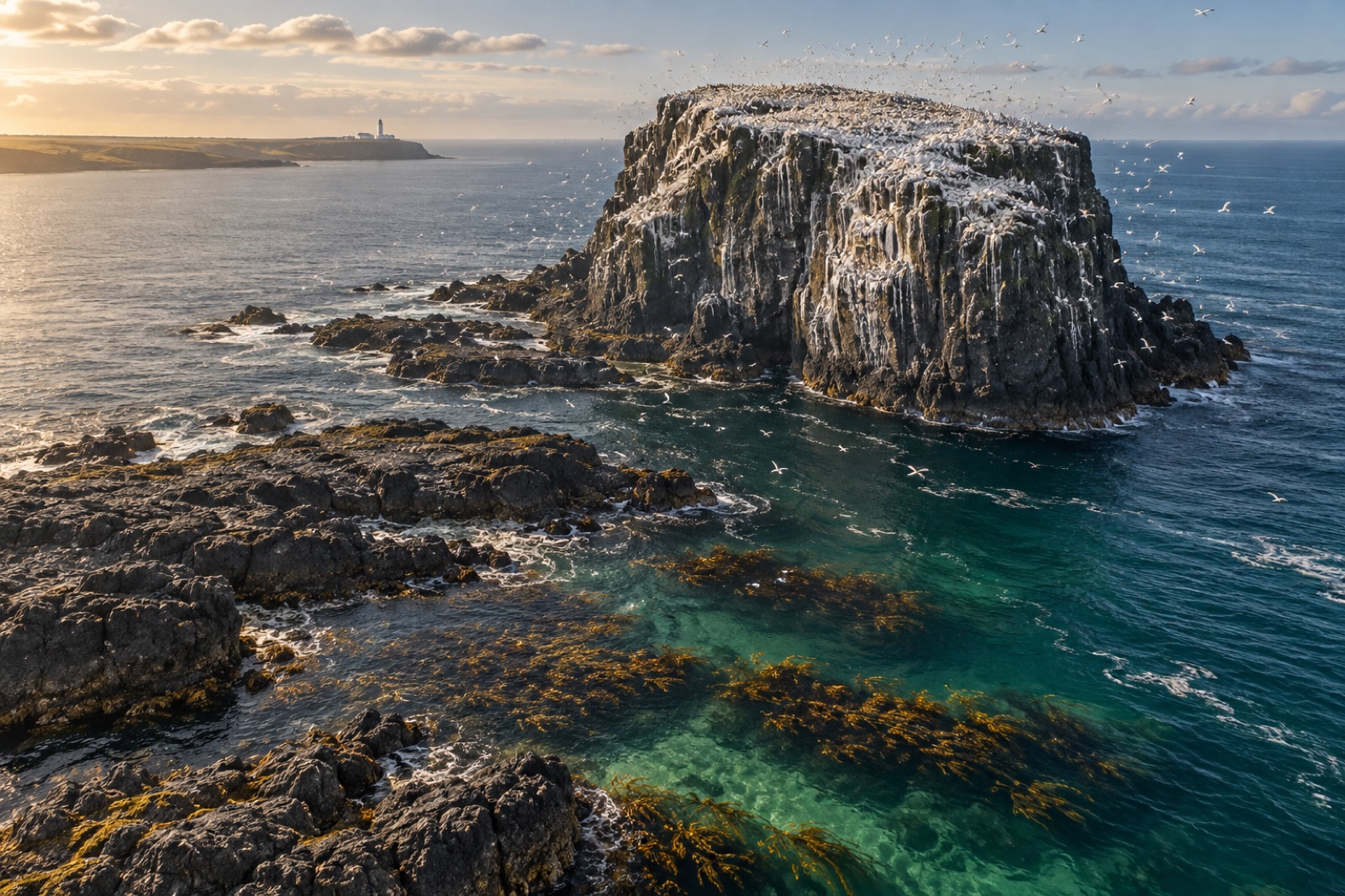
An hour east of Edinburgh, Scotland's coastline turns a corner and changes its character. West of that corner lies the Firth of Forth — a working estuary, deep-dredged, turbid, busy with ships. East of it lies East Lothian: fifty kilometres of sandstone cliffs, basalt islands, dune-backed bays and creel-boat harbours, where the water progressively clears and the rocky reefs grow their summer kelp beneath what may be the most famous seabird colony in Britain. This guide covers that coast as kelp country: where the forest grows, what the Forth's estuary water does to it, the gannet engine overhead, and how to visit well.
East Lothian's marine story is a story of a gradient. The Forth pours out fresh water, silt and a century's worth of industrial history along the coast's western flank. Near the firth mouth — around Yellowcraig and North Berwick — the sea is still estuary-touched: greener, cloudier, richer in nutrients. By Dunbar and Barns Ness at the county's eastern edge, open North Sea water dominates, and on a settled day the clarity over the reefs can be startling. Our explainer on estuaries and kelp describes how this fresh-to-salt gradient sorts seaweed communities; East Lothian lets you walk the experiment in an afternoon.
The physics underneath is tidal. The Forth's big tide range drives strong streams around the headlands and islands — Fidra slap of the Yellowcraig shore, the Lamb, and Bass Rock itself — and those currents keep the rock scoured and clean. Silt is the kelp-killer in estuary mouths; current is the cure. You can read the result directly from the shore: where the tide runs hard around a point, the rock below carries kelp and its red-algal retinue; where the water slackens and the estuary settles, weed gives way to sediment-tolerant communities.
East Lothian is not a subtidal-kelp cathedral like Scotland's west coast — the Forth's turbidity caps the forest's depth — but it holds proper, characterful kelp habitat in three settings.
Below the spring-tide line, divers and the occasional snorkeller on July's milky-calm days find a classic east-Scotland reef assemblage: tangle kelp canopy over anemone-carpeted rock, with cold clear water when the wind has been kind.
You cannot write about East Lothian's sea without writing about its birds, and the birds start with Bass Rock. The 107-metre volcanic plug — a speck on the chart two kilometres offshore — hosts around 150,000 northern gannets at the season's peak, making it the largest single-rock gannet colony on Earth. From late winter the birds arrive from West African waters; through spring and summer the rock turns white with birds and their careful daubing, and the air above the Forth carries the colony's bass-drum roar for miles.
The kelp connection is more than poetic adjacency. Gannets plunge-dive on the shoals of sandeels, sprats and young mackerel that concentrate where Forth water meets North Sea water over shallow, structured ground. The same rocky, kelp-draped seabed that shelters juvenile fish and feeds crabs is the base of a food web topped out by the birds — and by the guillemots, razorbills, puffins and kittiwakes crammed onto the surrounding islands. The common murre — the guillemot — is a good emblem: a pursuit diver that swallows its fish whole underwater, dozens of metres below the surface, working the same water column the kelp fringes.
Two honest caveats close the bird story. First, highly pathogenic avian influenza struck Bass Rock hard in 2022, killing many thousands of gannets and turning stretches of the colony quiet for a season; the birds have returned in strength since, with the black "tears" of stained plumage marking survivors, but the episode showed how fast a super-colony can be wounded. Second, the colony depends on small schooling fish, and those fish depend on well-managed seas — the islands' glamour should not excuse any coast from the harder work of habitat care.
East Lothian's harbours are small and old and still in business. Dunbar, where the cliffs end, keeps a creel fleet landing lobster and crab from the sandstone reefs; North Berwick, Cromwell Harbour and tiny Cove (just over the county line, beneath the cliffs that lead to St Abb's Head) work the same creel-and-line pattern. This coast also carries layered industrial history: the coal-ports at Prestonpans and Cockenzie to the west, the wide quarries above Dunbar, the Torness nuclear station's cathedral-like bulk at the county's edge, and, further up the firth, the refineries and terminals of Grangemouth — all of it written into the estuary's water quality record, which has been improving for decades.
That history matters to kelp precisely because the trend is good. The Forth is cleaner now than at any time since the 19th century: sewage treatment, the closure of heavy industry and decades of estuary management have returned dissolved oxygen and clarity. Kelp and other seaweeds are patient opportunists; give the water back its light and they reclaim the rock. The East Lothian reefs sit down-drift of that recovery, and their continuing kelp fringe is one of its quiet dividends — the same dynamic we charted in the Moray Firth guide, where a recovered coast readmits its forest.
Below the tideline the reefs hold a cast list that catches visitors off guard. Atlantic wolffish — the great shell-crusher of cold reefs, with its crushed-stone face and reputation among wreck divers — dens in the boulder ground toward Dunbar and the St Abbs volcanic reef complex just to the south. Ballan wrasse lurk in the kelp's shadow; lobsters and edible crabs work the crevices that the creel boats know by name; grey seals haul on the skerries, and bottlenose dolphins from the Forth's resident population patrol the firth mouth in hour-long passes visible from any of the harbour walls.
The shallow soft ground inside the rocky coast has its own quiet treasures: seagrass beds off the dune flats, maerl-like coralline gravel in scoured channels further out, and the wintering flocks of Aberlady Bay — Britain's first Local Nature Reserve, designated in 1952, where the estuary mud feeds tens of thousands of waders and pink-footed geese on the fields behind.
Season. May to July for the seabirds at full pelt and the clearest settled water; September brings calm seas and thinning crowds; winter storms make the headland walks dramatic but shut the water down. Sea temperatures run 6–14°C.
Reading the shore. Yellowcraig gives the gentlest introduction — dune grass above, weed-graded rock below, Fidra offshore. North Berwick's East and West Bays frame the harbour reefs; Barns Ness is the connoisseur's rock-pooling shore, limestone platforms full of urchins and beadlet anemones with the Bass looming down the coast. Boat trips from North Berwick circle the Bass Rock in season — a genuine wonder of the natural world, whatever your sea-legs.
In the water. This is real North Sea: cold, tidal, and short of convenient exits. Experienced snorkellers can enjoy the headland fringes on calm neap days; divers tend to go further east, to the St Abb's marine reserve across the county line, where the famous clear-water kelp reefs and wolf-fish dens lie in 10–20 metres — our wider Scottish west coast and Firth of Forth guides cover kit and site choice.
With respect. Land nowhere on the islands in season without permission, give hauled-out seals fifty metres, and treat the creel lines you see at the harbour mouth as somebody's livelihood — because they are.
Watch the water quality and the birds; the kelp will follow. The Forth's improving clarity should inch the kelp line westward year by year, and rising sea temperatures will slowly tilt the community toward its southern species, as elsewhere in the North Sea. The resilience factors here are real: hard volcanic reef, strong cleaning currents, an engaged local fishing fleet, and one of the best-loved wildlife spectacles in Europe to keep attention — and protection — focused on this corner of coast.
Yes. Oarweed bands the lower shore at Yellowcraig, North Berwick, Dunbar and Barns Ness, and divers find low tangle-kelp forest on the island and headland reefs within a few metres of low water. The Forth's suspended silt keeps the forest shallow compared with Scotland's west coast, but the rock below is genuinely kelp-clad where the tide runs clean.
The colony is occupied from roughly February to October, peaking in early summer when around 150,000 gannets crowd the rock. Boat trips run from North Berwick harbour in season; from the shore, the rock and its birds are visible from most of the county's beaches, especially with binoculars at dawn or dusk when the feeding flights are heaviest.
Yes, with cold-water experience and the right day. Sheltered shore entries exist at North Berwick and around Dunbar; the finest clear-water diving in the region lies just south of the county line through St Abb's Head, where the marine reserve's kelp reefs and wolffish dens are the local legend. Sea temperatures run 6–14°C and tides are meaningful — treat this as real North Sea water.
Carboniferous limestone, rare on this mostly volcanic coast, carved into flat pavements that catch and hold life: urchin-pitted pools, beadlet anemones, floating fringes of oarweed and sea spaghetti. It is one of Scotland's most instructive rock-pooling shores — and quiet with it.
Directly, through light. Sediment suspended in the estuary plume shades everything below a few metres; as the plume thins eastward — and as estuary management has improved the water for decades — the kelp grows deeper and denser. Cleaner estuary water is, for the reefs down-current, the single biggest kindness the land can do the sea.
A coastal atlas guide to the Firth of Clyde: where kelp still grows, what a century of trawling took out, and why Arran's no-take zone matters.
Dr. Mara Ellison ·
Scotland's Moray Firth is famous for its resident bottlenose dolphins, but its quiet kelp fringes, salmon rivers and tide races reward a closer look. A coastal atlas guide.
Jack Callum ·
Sea lochs, tidal sound races and a kelp-burning past: a guide to the kelp forests of Scotland's west coast and the Hebrides, and where the industry is heading next.
Dr. Mara Ellison ·