At the bottom corner of New South Wales, where the state rubs against Victoria, Twofold Bay opens to the Tasman Sea between two red-rock headlands. It is one of the deepest natural harbours in the southern hemisphere, and it carries one of the strangest marine histories in the world: for the better part of a century, whalers working from Eden hunted humpbacks in an active partnership with a pod of killer whales, who herded the giants into the bay and accepted the tongue and lips as their fee. Today the bay's kelp forests — beds of golden kelp on rocky reef, sheltering weedy seadragons in alarming density — are the best diving in southern NSW and the most history-sodden in Australia. This is the atlas entry for Eden and Twofold Bay.
Where Eden is, and how the coast stacks
Eden sits on the northern shore of Twofold Bay, at roughly 37° south — the Sapphire Coast's deep south, six hours from Sydney and about as far as you can drive along the NSW coast before crossing into Victoria. The coast around it is a compromise of landforms: the folded red Devonian sandstone cliffs that give Australia's "red point" geology its most dramatic plunge into sea, alternating with long white-sand beaches and real wilderness national park. Ben Boyd National Park wraps both sides of the bay, protecting a coast that for a decade in the 1830s held the largest shore-whaling operation in the southern hemisphere.
Underwater, the topography inherits the same pattern: expansive red sandstone platforms and boulder fields, clean sand channels, and kelp. The reefs are offshore-sheltered enough to hold fine sediment-free conditions, and the East Australian Current this far south delivers subtropical influence in pulses — the same mixed warm-temperate chemistry that makes the Leeuwin capes special on the west coast.
The kelp of Twofold Bay
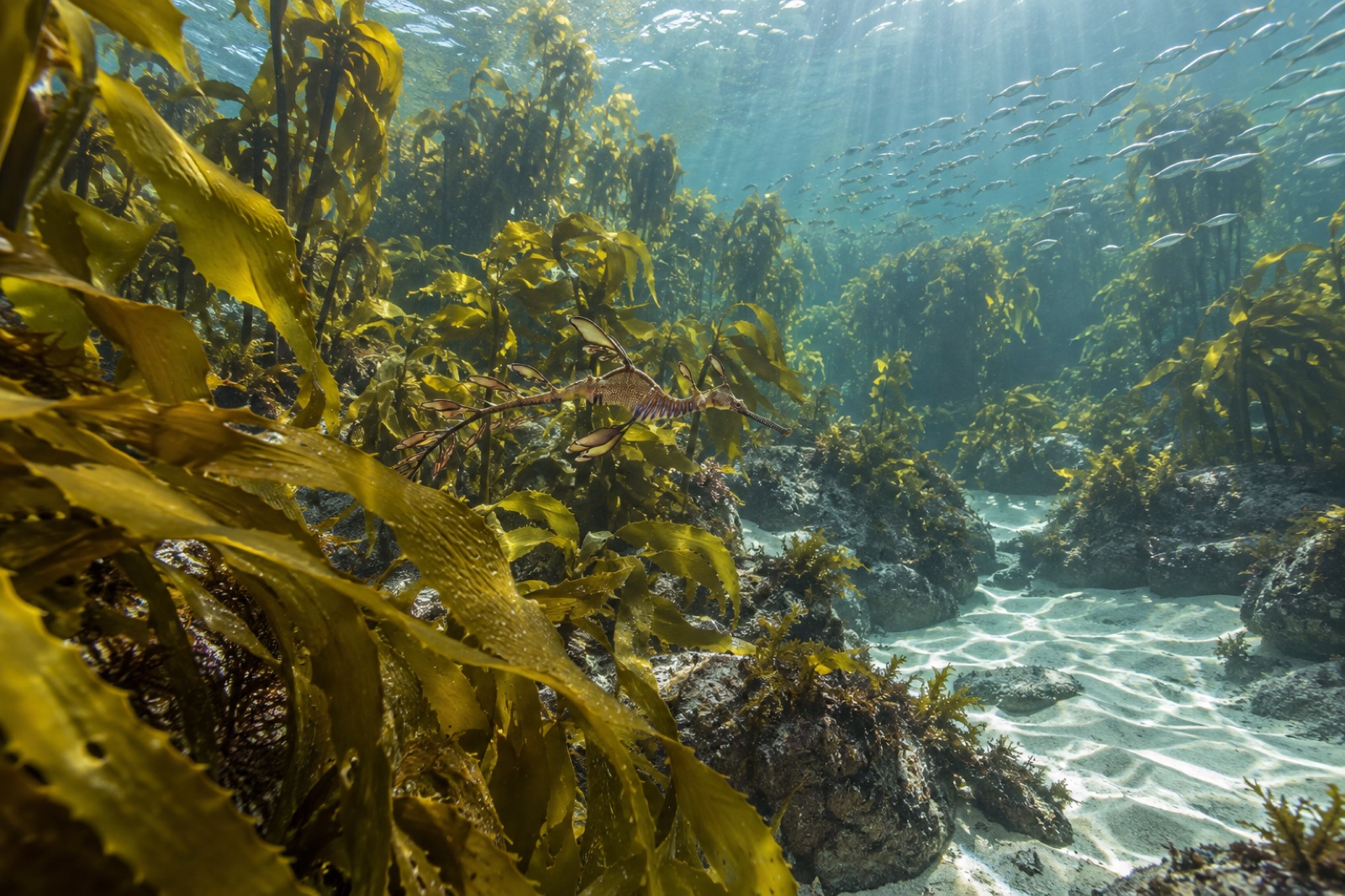
Twofold Bay's kelp community is classic temperate southern reef, structured mainly by golden kelp, Ecklonia radiata — the sturdy, low-dome forest former whose whole biology we survey in our golden kelp profile. On the more exposed rocky points the canopy thickens into a real subtidal forest; on sheltered inner reefs it thins to a turf-like scrub. Crayweed (Phyllospora comosa) and various turfing browns fill in between, and red algae underlay the whole in the familiar layered architecture of the southern reef.
The bay occupies an important historical location for the Sydney-region facet of Australia's kelp story. Sydney's famous loss of crayweed in the 1980s — and its celebrated modern return, told in our Sydney coast guide — was a water-quality story, not a harvest story. Twofold Bay's kelp largely escaped both calamity and cure: the urban pressure simply isn't there, and the forest has never had to be regrown. What the local divers watch to this day is a healthy, original canopy — which makes Eden's reefs an important reference against which the recovering reefs north and south can be compared.
The whales the whalers came for, and the orcas who helped them find them
Every autumn and spring, Twofold Bay is walked by whales — literally, on the headland-count sense: the great humpback migration passes within sight of the shore, and southern right whales still sometimes come right into the bay. In the nineteenth century, whalers based at Eden — including the Imlay brothers and later Benjamin Boyd, whose name the national park now bears — built the continent's largest shore-whaling station on the back of that migration.
The part of the story that has made Eden famous beyond Australia is the orcas. From at least the 1840s until about 1930, a pod of killer whales — best known through the patriarch "Old Tom" — accompanied the whalers into the hunts, surrounding the humpbacks and driving them toward the boats, and accepting the tongue and lips of the kill as their reward before human crew towed the body home. The accounts are well documented, the partnership lasted for nearly a century, and it ended not with human betrayal but with the pod's disappearance in the 1930s, before commercial shore whaling itself died in 1931.
It is easy to romanticise, and tempting to go too far. What the Eden orcas undoubtedly show is that the cooperation between odontocete and human can emerge, and persist, and be valuable to both sides — an evolutionary naturalist's case study in its own right.
Kelp, seadragons and the modern reef
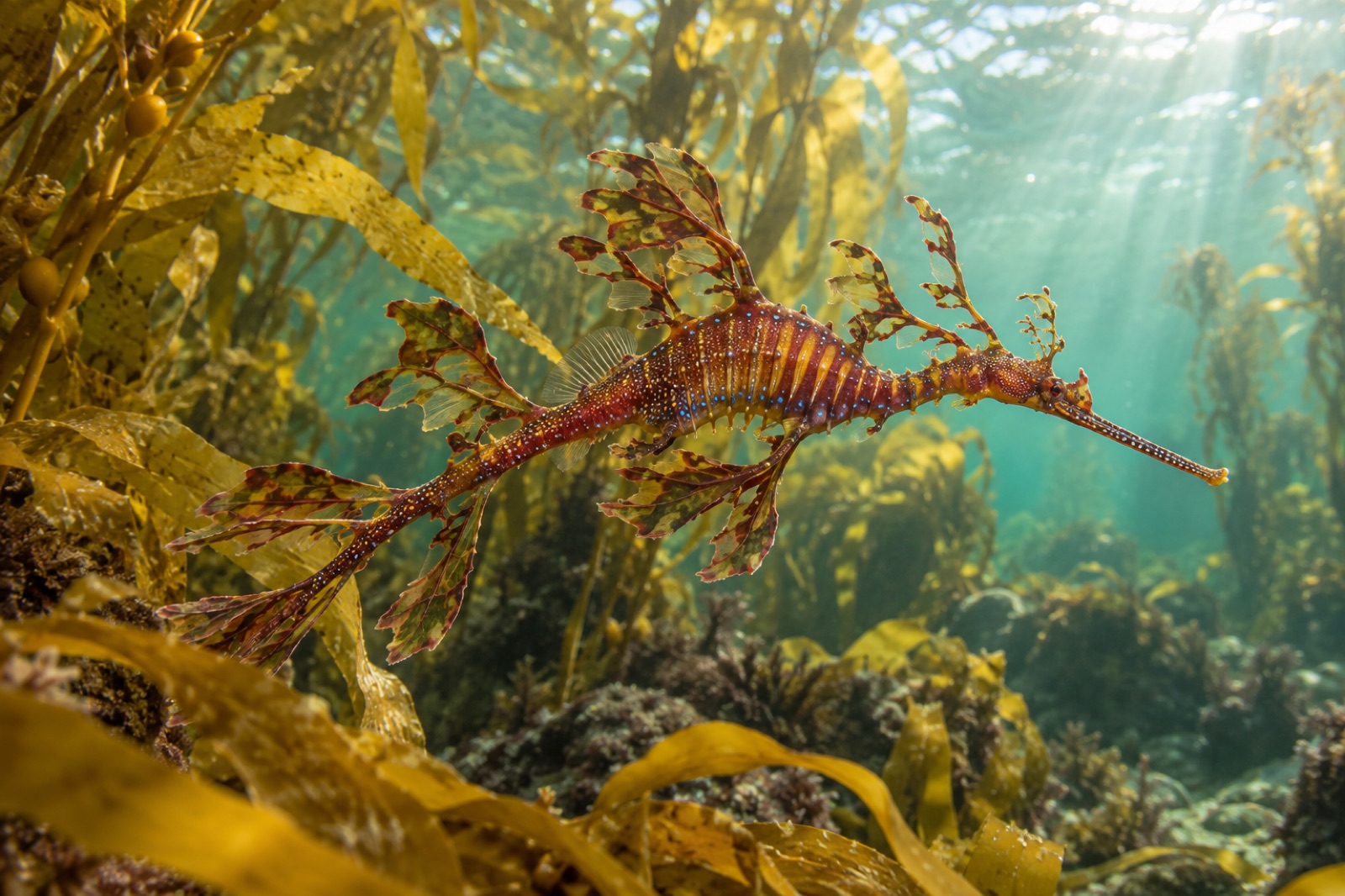
The modern Twofold Bay reef carries one of the best weedy seadragon populations on the open NSW coast. The dragons — the splendid, slowly-drifting leaf-mimics celebrated in our weedy seadragon profile — are reliably found among the kelp fringe at Kianinny Bay near Tathra and around the wharf structures at Eden, arguably the most reliable land-based seadragon watching on Australia's east coast. Blue groupers, kelp perch and striped surfperch patrol the canopy edges; fur seals haul out on the offshore reefs and occasionally push past shore. Around the bay, the penguin colony at nearby Montague Island — a boat trip out of Narooma — supplies the full cast-list of a temperate southern reef at its most alive.
The bay has its modern industrial edge. The port of Eden has carried a woodchip terminal since the late 1960s, and the controversy that industry caused on the south coast marked one of the first conservation flashpoints in modern Australian history. The harbour's working waterfront remains; the kelp on the surrounding reef, outwardly untouched, is the silent answer to the question of whether coexistence is possible on the south coast. The forest doesn't argue. It just stays.
Visiting Eden's kelp
- Seadragons. Kianinny Bay near Tathra and the sheltered fringes near Eden's wharf are the premier land-based seadragon spots on the coast: tide-slack snorkelling or calm-water shore diving, patience above all.
- The cliffs. Ben Boyd National Park's Red Cliffs and the lighthouse at Green Cape supply the above-water experience: whale-watch platforms from May through November.
- Diving. The bay's own reefs and wharf dives are best for the kelp fringe; offshore reefs around Montague Island are where the kelp forest opens fully.
- Season. Cool and clear in winter; mild and busy in summer. Autumn for the southbound whales.
Key takeaways
- Twofold Bay is one of the deepest natural harbours in the southern hemisphere, on NSW's far south coast within sight of Victoria.
- The bay's kelp community is classic temperate golden kelp reef that never needed restoring — and so serves as the reference canopy for the recovering reefs both north and south.
- Eden shore-whaling operated from the 1820s to 1931, and for nearly a century worked in active documented partnership with a pod of killer whales.
- Today the bay holds one of the most reliable land-based weedy seadragon habitats in Australia, plus seasonal humpback and southern right whale migrations close to shore.
- The modern port's working identity and the intact reef outside are both parts of Eden's ambiguous and interesting coast.
FAQ
Did the whalers and orcas really cooperate at Eden?
Yes — the record is exceptionally well documented. For nearly a century, killer whales actively herded humpbacks toward the whaling boats at Twofold Bay and were given the tongue and lips of each kill as their fee. The partnership disappeared with the pod around 1930 and is the most fully chronicled example of human–cetacean cooperation ever recorded.
What kelp grows at Eden?
Golden kelp (Ecklonia radiata) forms the main canopy on the more exposed reefs, with crayweed, mixed turfing browns and red algae beneath — classic temperate southern-reef architecture, and notably intact compared with the kelp forests nearer Sydney.
Is Twofold Bay good for seeing weedy seadragons?
One of the best places on the open NSW coast: Kianinny Bay near Tathra and the Eden wharf fringes hold reliable populations among the kelp and weed, accessible by calm-weather shore swimming or diving.
Can you see whales at Eden?
Yes — the humpback migrations pass close to shore in the autumn and spring seasons, and southern right whales sometimes enter the bay. Headland lookouts in Ben Boyd National Park and Green Cape Lighthouse are the primary viewing points.
Is the Eden coast suitable for beginner snorkellers?
Twofold Bay is a working port with busy approaches, but sheltered inside coves — Kianinny Bay, Snug Cove fringes — are calm and shallow at slack tide and well suited to confident swimmers. Divers should organise with local operators for the offshore reefs and Montague Island.