Blue Carbon10 min read
Inside a Blue Carbon Verification Audit: What Actually Gets Checked
What happens when a third-party auditor arrives at a blue carbon project — the documents, the field visits, the math checks and the verdicts.
Priya Raman ·
A kelp restoration project's first carbon verification, told from the inside — what auditors tested, what they found, and what makes kelp credits unusual.
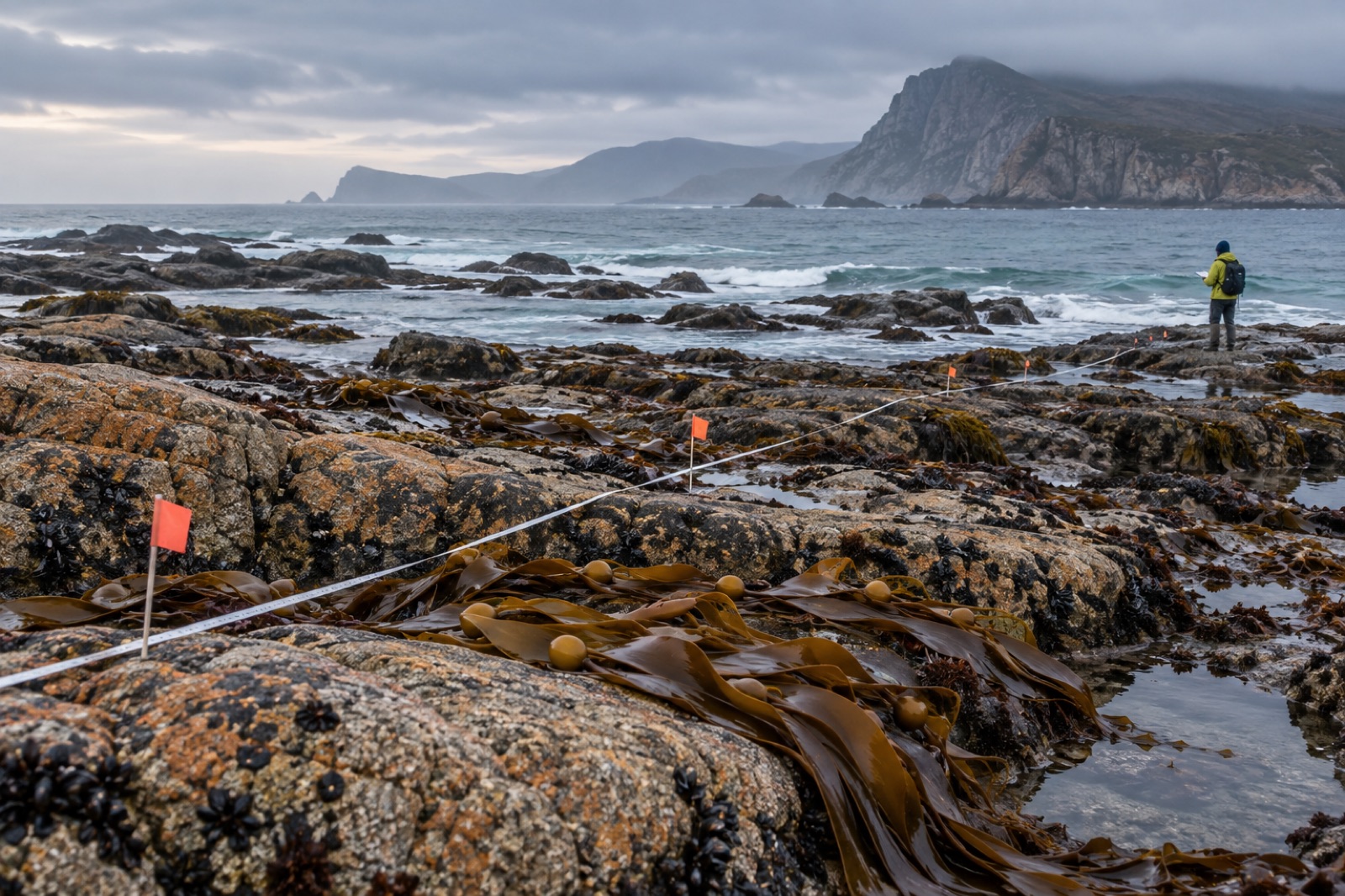
A carbon verification is the moment a project stops being a promise and starts being an audited fact. For coastal wetlands the process is now well-trodden: auditors check sediment cores, accretion stakes, maps and ledgers. But what happens when the ecosystem under audit is a kelp forest — an ecosystem that grows metres of new tissue in a season, exports much of its carbon as drifting fragments, and can lose a third of its canopy to a single storm week? That is a different audit. This article walks through what independent verifiers actually check at a kelp restoration project, told through the fictional-but-representative first verification of a Tidewright restoration site in Tasmania.
A note on framing: the general mechanics of any carbon audit — validation versus verification, accreditation, corrective action requests — are covered in Inside a Blue Carbon Verification Audit. This piece is about what is different when the forest sways. Details below describe Tidewright's fictional operations and are illustrative, but every verification challenge described is one a real kelp carbon project would face.
Blue carbon verification for mangroves and salt marshes leans on a comfortable fact: most of the credited carbon sits in soil, metres of it, accumulating measurably for centuries. A kelp forest on a rocky reef has no such pool. Its carbon case rests on subtler claims: enhanced sediment trapping around the restored forest, and the export of kelp detritus to deep or buried sinks. Both are real pathways — the evidence is summarised in Where Kelp Carbon Actually Ends Up — and both are exactly where auditors concentrate their scepticism. The open question of whether kelp belongs in blue carbon accounting at all is aired honestly in the rocky reef blue carbon debate; a verification is where that debate gets resolved, hectare by hectare, with receipts.
At our fictional Tasmania site, the audit team arrived for a four-day field visit after six weeks of desk review. Here is what they checked.
Wetland auditors ground-truth maps of trees and marsh. Kelp auditors face a moving target: canopy extent that expands and contracts seasonally, and can crash after marine heatwaves or storm swells.
The auditors compared three independent lines of evidence against the project's claims:
The conservative convention that survived audit: credited canopy is computed from the lower bound of the seasonal cycle, not the summer maximum. A forest that audits well in March but auditorially vanishes in October is treated as its October self.
This is the heart of a kelp verification, and where the auditors spent most of their desk hours. A mangrove project measures tonnes-in-place. A kelp project must demonstrate fate: what fraction of the fixed carbon persists, and where.
The audit tested the project's claims pool by pool:
The lesson generalises: verification rewards the project that claims less than it believes.
Kelp restoration credits often rest on reversing an urchin barren — so the baseline is "the reef stays a barren," and the auditors interrogate exactly that. At our site they checked historical aerial and satellite imagery covering more than a decade, commercial urchin-fishery records, and dive-operator logs to confirm the barren was persistent rather than a transient phase of a naturally cycling forest. A project whose baseline is "the forest was dying anyway, and would have recovered on its own" has no credible carbon case; the construction and defence of baselines is its own craft, covered in Kelp Carbon Baselines.
Additionality followed the standard logic — no legal requirement to restore, no funding pathway absent carbon revenue — but with a kelp-specific twist the auditors pressed on: would the expanding commercial urchin harvest have done the restoration for free, making the carbon project redundant? The project's answer required evidence about fishery economics, not ecology. The general concept is unpacked in What Is Additionality?; the kelp version is a reminder that additionality is an argument about every alternative future, including profitable ones.
Every tonne that leaves the forest must come off the claim. Because the fictional site sits alongside a Tidewright Harvest farm, the auditors required a full accounting of harvested biomass: weighbridge records, moisture corrections, and reconciliation against seeded-line inventories. Any kelp removed for food or biostimulant is carbon that did not sink or get buried — the accounting discipline is the same one described in Kelp Farm Carbon Accounting.
Leakage got a marine treatment: did urchin culling at the site simply displace the fishery's effort onto neighbouring reefs (which would be a legitimate livelihood shift), or did it displace urchins — reduced harvest elsewhere prompting effort into previously untouched barrens? The monitoring plan's control reefs answered this; the auditors walked them.
Finally, the project's buffer-pool contribution was recalculated against the standard's risk tool — storm exposure, heatwave history, tenure security. The contribution came out at the upper end of the band, which the auditors accepted without argument because the project had sized it for honesty rather than marketing. Why that matters is explained in Permanence and Buffer Pools.
Modern verification is as much a data audit as a field audit. The auditors traced a single month of monitoring end to end: raw echosounder files with calibration certificates, drone imagery with version history, canopy classification model version and training-data provenance, the transformation scripts that turned pixels into hectares, and the ledger entry those hectares produced. Every hand-off needed to be reconstructible by a stranger — which, functionally, is what an auditor is.
This is precisely the trail Tidewright's fictional Canopy Ledger platform exists to produce: continuous observation turned into an auditable record, rather than a binder assembled the month before the auditors arrive. The architecture behind such systems is described in MRV Explained.
The first verification did not pass clean, and no honest one does. The fictional finding list included one corrective action: a sediment reference stratum whose boundary did not match the registered monitoring plan, resolved with resurvey and documentation. There were several clarifications — mostly "show your working" requests on classification accuracy statistics — and one observation recommending denser coring in the site's most heterogeneous depositional zone before the next audit.
The issued first vintage came in roughly a third below the forecast the project had carried internally for two years. The reaction around the fictional office was instructive: disappointment for a day, then something closer to relief. A credit issued conservatively under hard questioning is worth more than a larger number issued softly, because the number is the only thing a buyer is actually paying for. That asymmetry — credibility as the product — is the same conclusion reached by the audit process walkthrough from the wetland side.
Only partially. No major standard yet offers a mature, kelp-specific crediting methodology, so kelp projects generally verify through adjacent frameworks — sediment-focused methodologies, bespoke project approaches, or research partnerships — and claim conservatively. That gap, and why it exists, is the subject of The Kelp Carbon Policy Gap.
From the end of a monitoring period to issuance, typically three to six months: desk review, field visit, findings and closure, registry review. Kelp projects sit toward the longer end while methodologies and auditor experience mature.
Fewer credits are issued — that is the entire point of independent checking. Well-run projects forecast conservatively precisely so that verified numbers land close to, or above, expectations rather than below them.
No, if the monitoring design handles it. Auditors expect natural variability; what they reject is accounting that quietly upgrades a seasonal canopy to a permanent one. Conservative lower-bound conventions and buffer-pool contributions exist exactly for this.
Commonly every two to five years over a crediting period of decades. Each cycle re-opens the questions above, which is why continuous, audit-grade monitoring beats heroic pre-audit data assembly every time.
What happens when a third-party auditor arrives at a blue carbon project — the documents, the field visits, the math checks and the verdicts.
Priya Raman ·
Measurement, Reporting and Verification stripped to plain language: where MRV came from, what each step demands, and how to read the quality of any carbon project.
Priya Raman ·
Follow kelp carbon from frond to terminus: grazing, decomposition, export, burial, and deep-sea pathways — and the tracing science that reveals the routes.
Priya Raman ·