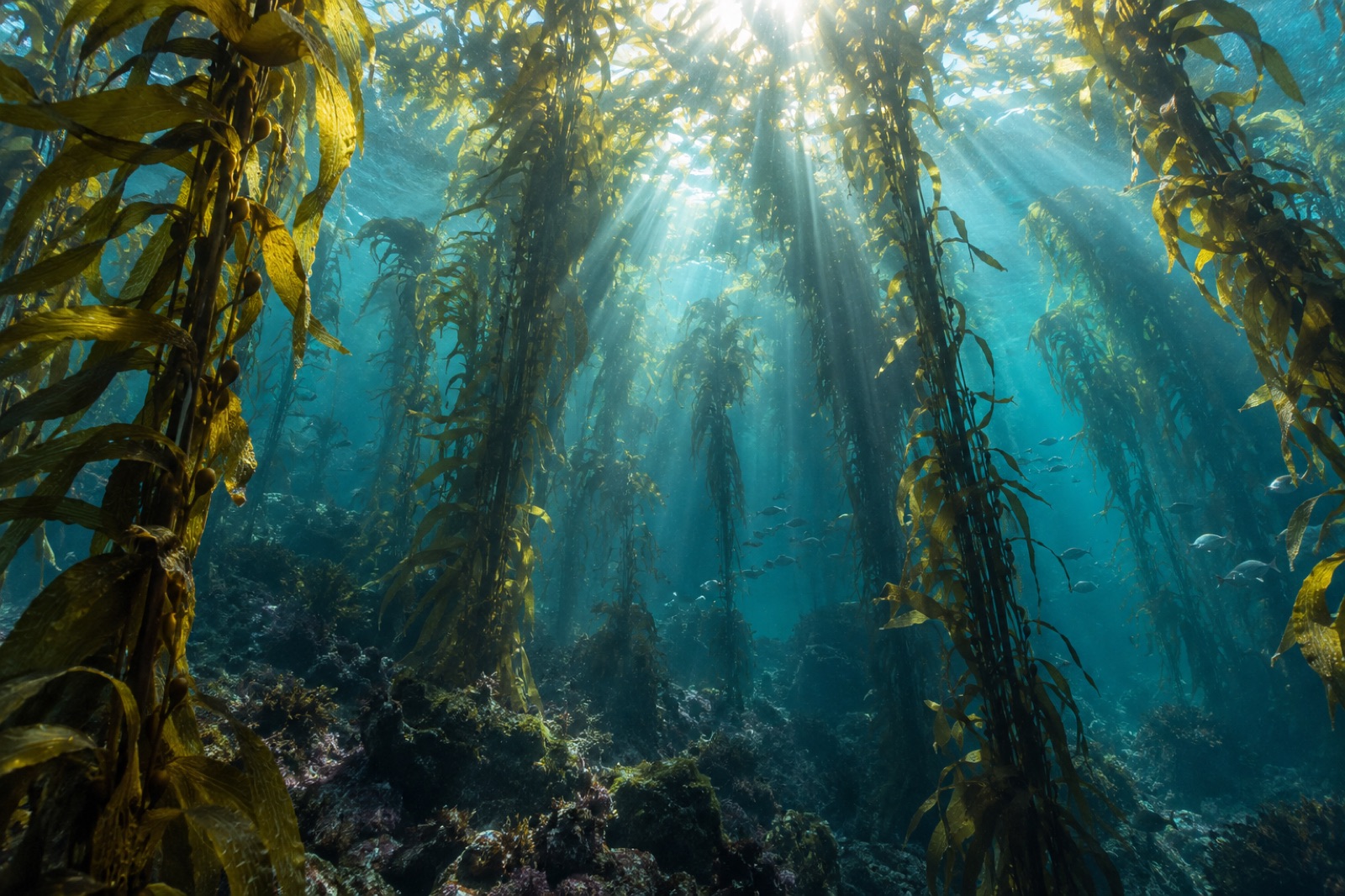
Ask a blue-carbon project developer what keeps them up at night and most will give you the same answer: not the biology, not the financing, but the question of permanence. Credits represent carbon that is supposed to stay out of the atmosphere. Kelp forests, however, live in a hotter, stormier, more volatile ocean than the one they evolved in. A single marine heatwave can strip a canopy in weeks.
The industry's structural answer to this problem is the buffer pool — a shared, non-tradeable reserve of credits that exist only to be cancelled when something goes wrong. It is not glamorous. It does not appear on marketing decks next to the light-through-the-canopy photography. But if you are buying or issuing kelp carbon, the buffer pool is the mechanism that turns an honest admission of risk into a credible credit. This guide explains how buffer pools work, how contributions are sized for ocean projects specifically, what a reversal event actually triggers, and the questions a serious buyer should ask. For the broader concept of permanence in carbon accounting, see our explainer on permanence and buffer pools.
What a buffer pool actually is
A buffer pool is a collective insurance fund denominated in carbon credits. Every project in a program contributes a percentage of the credits it issues — typically somewhere between five and thirty percent, depending on assessed risk — into a common, ring-fenced account. Those pooled credits can never be sold or retired for offsetting. They sit in reserve. If any participating project suffers a reversal (stored carbon is lost to the atmosphere), an equivalent number of credits is cancelled from the pool, so the program's total issued credits never exceed total verified climate benefit.
Three features matter for understanding the design:
- Mutualisation. Risk is pooled across many projects, geographies and vintage years. One bad season in one bay does not bankrupt anyone.
- Non-retireability. Buffer credits cannot be used for claims. This is what distinguishes them from regular inventory.
- Automatic, not discretionary. Cancellation follows a defined reversal-event procedure, not a negotiation. Buyers do not have to litigate whether a heatwave "counts."
That last point is worth dwelling on. The alternative to a buffer pool is some form of per-buyer guarantee — the developer promises to replace lost credits later. That promise is only as good as the developer's balance sheet and future existence. A buffer pool converts counterparty risk into a visible, pre-funded asset.
Why kelp carbon needs its own risk profile
Terrestrial buffer pools were designed around forests, whose dominant reversal risks are fire, logging, conversion and pests. Blue-carbon ecosystems face a different risk menu, and kelp faces a distinctive subset even within that family.
Marine heatwaves
The defining reversal driver for kelp. A sustained ectothermic stress event can kill sporophytes outright or halt growth and reproduction long enough for grazers to finish the job. Unlike a wildfire, a heatwave leaves no ash and no line on a fire map — the loss is visible on satellite canopy data and diver transects, but attribution and measurement take time. Programs that write reversal protocols for kelp should define triggers in terms of verified canopy and biomass change, not temperature thresholds alone. We have written separately about how marine heatwaves drive kelp loss.
Storms and detachment
Kelp is built to flex, but extreme wave events rip out whole stands — sometimes tens of metres of forest at once. Storm loss is partially interannual noise: fronds regrow, and some uprooted biomass is exported to the deep sea, where it may or may not count as durable sequestration depending on the methodology. A well-run program measures post-storm standing stock rather than assuming loss equals reversal.
Biotic regime shifts
Urchin barrens are the slow-motion reversal: not a weather event but a trophic flip that can persist for decades. For a restoration project, an urchin outbreak on the reseeded site is the carbon-security equivalent of arson — preventable with management (culling, predator recovery), but requiring active surveillance. This is precisely why monitoring platforms such as Canopy Ledger matter to credit integrity: you cannot manage a reversal risk you cannot see.
Each of these has a different time signature: heatwaves are acute, storms are pulsed, urchins are chronic. Sizing a buffer against only the acute risks underinsures the portfolio against the slow ones.
How buffer contributions are sized
Contribution rates are not plucked from thin air; good programs run a structured risk assessment per project category, scoring sub-factors such as exposure to ocean warming trends, historical storm frequency, urchin pressure, harvest interactions and the project's own management capacity. The scores map to a percentage of issuance withheld.
A few principles that separate rigorous sizing from theatre:
- Risk differs by methodology family. A project claiming credit for restored standing stock is exposed to reversal of that stock. A project claiming credit only for carbon exported and buried in deep-sea sediment is exposed mainly to monitoring failure — the carbon, once sunk, is not coming back. Export-based removals should, in principle, carry small buffers; standing-stock credits should carry larger ones. (Our piece on where kelp carbon ends up explains why the distinction is real and not rhetorical.)
- Buffers should be periodic, not lifetime-fixed. A project that survives five years of monitoring without reversal has demonstrated something; one in year one hasn't. Reassess.
- The pool is only as strong as its weakest project class. Cross-subsidy is fine in principle, but a pool that mixes standing-stock forestry at 10% with novel ocean CDR at 25% under a single 12% blended rate is quietly transferring money. Program-level transparency on composition is a buyer's friend.
At Tidewright, our restoration projects currently contribute a double-digit percentage of issued credits to a pooled buffer we co-manage with our verification partners, with the rate per site set by a documented risk assessment that includes heatwave exposure indices and urchin-pressure data from our own monitoring. The exact rates, the assessment criteria and the pool balance are published on our impact methodology page — as with everything we say about ourselves, those numbers are illustrative of how a fictional program publishes, not a real-world precedent to copy.
What a reversal event actually triggers
The machinery behind the scenes matters more than the policy paper. A defensible reversal protocol has five stages:
- Detection. Monitoring (satellite, sonar, diver transects, eDNA) flags a statistically significant stock decline beyond background variability or a defined threshold.
- Confirmation. An interim verification confirms the loss is real, quantifies tonnes of CO₂ equivalent lost relative to the credited baseline, and documents the cause.
- Cancellation. Credits equal to the quantified loss are cancelled from the buffer pool. Not "marked" — cancelled, permanently.
- Remediation. The project either re-establishes the lost carbon (re-seeding, grazer control) within a defined window, or the loss stands and future issuance is re-baselined to the smaller stock.
- Disclosure. The whole event — detection, quantification, cancellation, remediation status — appears in the public registry against that project's record.
Buyers should note stage four carefully. Reversal of a credited unit does not mean "your offset failed"; it means the program already covered it. If a kelp project loses 5,000 tonnes of credited stock and the buffer pool cancels 5,000 tonnes, the buyer's claim remains whole without any intervention. That is the entire point.
Buffer pools versus the alternatives
Buffers are not the only tool, and honest projects combine them with:
- Private insurance. Emerging parametric policies pay out on defined triggers (e.g., sea-surface-temperature anomalies). Useful, but the payout is money, not carbon — someone still has to procure replacement credits.
- Tonnes held by the project. Self-insurance via unsold inventory. Better than nothing; invisible to buyers and dependent on the developer's survival.
- Time-bounded crediting. Issuing credits only for carbon that is durably stored (e.g., export-and-burial pathways), avoiding reversal exposure altogether. The cleanest answer where the science supports it — and the reason many kelp programs are steering toward ex-situ or export accounting rather than standing-stock claims. Our analysis of the seaweed carbon debate covers why the field is drifting this way.
The sensible default today is a hybrid: a program-level buffer pool sized to standing-stock exposure, plus methodology designs that minimise that exposure over time, plus monitoring that catches losses early enough to remediate.
What buyers should ask before signing
A short due-diligence checklist, distilled from our buyer's guide to blue carbon credits:
- What percentage does each project contribute, and what risk assessment justifies it?
- Is the pool shared across project types, and if so, is composition disclosed?
- Can buffer credits be retired, lent against, or reclaimed by the project? (All three answers should be no.)
- What is the documented reversal procedure, and who signs off on quantification?
- Has the pool ever paid out? (An empty claims history over many projects is a mild red flag — the ocean does not run a decade without incident.)
- What happens to my claim if the pool is exhausted? Is there a second layer?
Programs with mature answers to those questions tend also to have mature monitoring, honest baselines and conservative issuance. Risk disclosure is a proxy for quality, not a confession of weakness — something we unpack further in our explainer on how blue-carbon prices reflect quality.
Key takeaways
- A buffer pool is a shared, non-tradeable reserve of credits cancelled automatically when credited carbon is lost — it is pre-funded insurance, not a promise.
- Kelp's reversal risks (heatwaves, storms, urchin regime shifts) differ in kind and timescale from forest risks; buffers must be sized against that specific menu.
- Standing-stock credits need larger buffers than export-and-burial removals; methodology choice and buffer size are two halves of the same permanence strategy.
- A credible reversal protocol has defined detection, confirmation, cancellation, remediation and disclosure stages — ask to see it before you buy.
- Programs that publish buffer composition and claims history are showing you integrity, not weakness.
FAQ
If the buffer pool covers a reversal, did my credit still "work"?
Yes. The pool cancellation is the system working as designed: the total climate benefit claimed by the program remains constant, and your retirement remains valid. What breaks a claim is an uncovered reversal — exactly what the pool exists to prevent.
Are buffer pools big enough for a bad ocean decade?
An honest answer: nobody knows yet. Programs stress-test their pools against historical event rates, but a truly widespread, multi-region marine heatwave ocean could exceed those assumptions. This is why monitoring, adaptive management and conservative sizing matter so much, and why diversified pools across coasts and currents are safer than single-region ones.
Why don't kelp projects just avoid standing-stock credits entirely?
Many are moving that way via export-based or ex-situ pathways. But standing-stock restoration also delivers biodiversity, fisheries and coastal-protection benefits that markets and communities care about beyond carbon. The pragmatic path is to credit only what is demonstrably durable and buffer the remainder, rather than abandon co-benefits.
Can I insure my own purchases independently?
You can — parametric products exist for large buyers — but it should complement, not replace, the program buffer. Your private policy does nothing for the integrity of the overall registry; a broken pool undermines the value of every credit issued alongside yours.
Where does Tidewright publish its buffer details?
Tidewright is a fictional demonstration company, and our open methodology documentation — including example risk-assessment criteria and pool rules — lives on the impact methodology page. The structure of disclosure it shows is what we would encourage real buyers to expect from real projects.