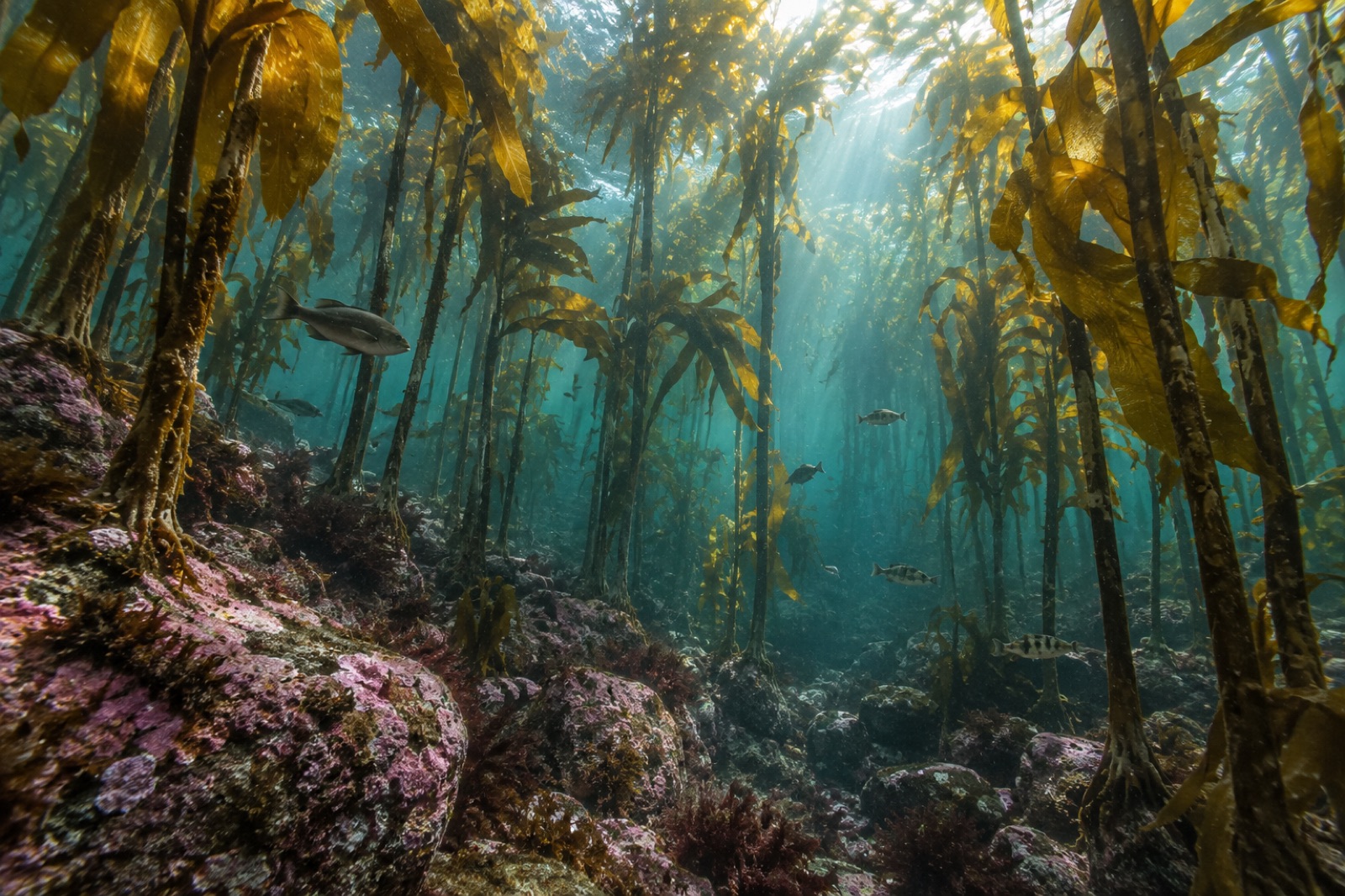
Ocean alkalinity enhancement (OAE) and kelp forest restoration are increasingly proposed for the same stretches of coastline — sometimes by the same organisations. That raises a fair question: are they allies? Adding alkalinity to seawater is a carbon-removal technique that could, in principle, store atmospheric CO₂ as stable dissolved bicarbonate while locally counteracting acidification. Kelp forests, meanwhile, are living habitat that no chemical intervention can replace. Done carelessly, dosing alkalinity near a forest could cloud the water, coat blades and substrate with precipitate, or shift pH faster than larvae can cope with. Done carefully, it could one day pair carbon storage with measurable relief from corrosive water. This article maps both sides: what the chemistry offers near kelp habitat, the risks specific to that habitat, and the safeguards any credible project should carry. For the fundamentals, start with our Ocean Alkalinity Enhancement 101.
Why kelp coasts attract OAE attention
Kelp forests grow exactly where near-shore OAE is most practical to run. They live in shallow, sunlit, well-mixed water within easy reach of ports, power connections and monitoring crews — conditions that open-ocean deployments can only dream of. Three further factors make the pairing tempting for researchers:
- Mixing does part of the job. Kelp zones are usually exposed to swell and tidal currents, so a dosed alkaline pulse disperses and re-equilibrates with the atmosphere over weeks to months rather than lingering as a concentrated plume.
- The baseline is already measured. Restoration coastlines tend to have unusually rich monitoring: canopy maps, water-quality sensors, temperature and pH records. That is precisely the baseline infrastructure credible carbon accounting requires.
- There may be a local co-benefit. Many kelp regions sit beside upwelling systems that episodically deliver low-pH, corrosive water to the coast. A modest, sustained alkalinity addition could blunt those events — a buffer against the "other CO₂ problem" described in ocean acidification, explained.
None of that makes kelp habitat a free laboratory. It makes it a place where the experiment, if it happens at all, can be measured properly — and that cuts both ways.
What the chemistry actually does near a forest
The acidification buffer
Raising alkalinity increases seawater's capacity to hold dissolved inorganic carbon without dropping pH. In a kelp forest, the organisms this matters most for are not the kelp blades themselves but the calcifying understorey: crustose coralline algae, bryozoans and juvenile shellfish that share the reef. Crustose corallines are ecological linchpins — they are settlement cues for abalone, urchins and other reef fauna — and their calcification is among the first processes to suffer when carbonate chemistry sours. The shellfish industry's encounter with corrosive water, told in ocean acidification and shellfish, shows why a local buffer is worth studying. Whether it can be delivered at ecological scales without side effects remains the open question.
The growth question — and an accounting trap
Does extra alkalinity make kelp grow faster? Not obviously, and the honest answer matters. Kelp is well adapted to draw on bicarbonate as well as dissolved CO₂, and in healthy coastal water its growth is more often limited by nitrogen, light or warm water than by carbon availability. More importantly, OAE's climate job is to pull carbon into the dissolved pool, where it stays out of the atmosphere for millennia — not into kelp biomass, which is released again within seasons unless some fraction is buried or exported, the accounting challenge we walk through in how much carbon kelp really stores.
This creates a trap worth naming: a project that claims OAE credits for the atmospheric drawdown and kelp credits for the same stimulated carbon is double counting. The two interventions may share a cove; they may not share a tonne.
The risks specific to kelp habitat
Every delivery route for alkalinity — mineral dissolution, dissolved dosing, electrochemical — has failure modes that are amplified near a structured, light-hungry ecosystem.
Carbonate precipitation ("runaway"). Push alkalinity too high, too fast, in one place and seawater passes a threshold where calcium carbonate precipitates out spontaneously. That reversed chemistry sheds the intended benefit, clouds the water and can deposit mineral crusts on rock and on kelp blades themselves. Dose design must sit well below local saturation thresholds, which is why responsible trials pulse gently and monitor in real time.
Trace-metals load. Crushed silicate rock is the cheapest alkalinity source, and some feedstocks — certain olivines in particular — carry nickel and chromium. Kelp is a prodigious concentrator of dissolved metals (it needs tiny amounts of nickel as an enzyme cofactor, but excess is toxic), traces can transfer to grazers, and sediment near a deployment can accumulate them. Feedstock certification and tissue monitoring are non-negotiables near a food web.
pH spikes at the point of addition. Adult kelp tolerates chemistry swings; the microscopic gametophytes and young sporophytes that determine whether a forest recruits another generation are more delicate, and coralline algae can bleach under abrupt high-pH exposure as well as low. Discharge engineering — diffuser design, flow rates, timing around spawning and sporulation seasons — is an ecological decision, not just an engineering one.
Light. Spreading any solid material, however slowly dissolving, dims the water column. Kelp blades live off photons; a deployment that trades away light for alkalinity in an already turbid season is taking from the forest with one hand and giving to the ledger with the other. Seasonal and siting choices should respect the forest's light budget.
The safeguards a credible project should carry
Near kelp habitat, the burden of proof belongs to the intervention. A responsible coastal OAE project should be able to show all of the following:
- A chemistry baseline covering at least two full seasonal cycles — temperature, pH, total alkalinity, dissolved inorganic carbon and turbidity — before any dosing begins.
- A sensitive-stage map of the reef: where crustose corallines grow, when resident kelp species sporulate, when shellfish larvae settle, so dosing avoids the forest's most vulnerable weeks.
- Staged dosing with trigger thresholds — pre-agreed pH and alkalinity ceilings that pause or stop the trial automatically, not after a committee meeting.
- Independent ecological monitoring, including metal concentrations in kelp tissue and sediment, calcification rates on settlement plates, and canopy surveys that would detect either harm or benefit.
- Published results, including negative ones. OAE's social licence depends on the research community reporting what went wrong with the same energy as what went right.
- Separated carbon accounting with an explicit statement of what is and is not being credited, and — in sea-country waters — consent, governance and benefit-sharing agreed with traditional owners before the first tonne of material moves.
The governance layer that decides who may run such trials, and where, is itself still being written; we map it in who governs ocean carbon removal.
Where this leaves restoration
Tidewright's position, stated plainly: there are currently no OAE deployments at any Tidewright project site, and none of the canopy carbon monitoring we publish is used to support an OAE credit. What our coastlines do hold is exactly what this young field needs most — long, honest ecological baselines — and our science team treats that data as something that should raise the evidentiary bar for anyone proposing to add chemistry to a living forest. That is our fictional company's stance for this demonstration site, but the logic is very real: measure first, dose later, and never let a carbon ledger outrank the forest.
Key takeaways
- Kelp coasts are attractive to OAE researchers because they are shallow, well-mixed and already well-monitored — which also means harms will be visible and countable.
- The most plausible co-benefit is buffering of low-pH events for calcifying reef species, not faster kelp growth; kelp is rarely carbon-limited.
- Habitat-specific risks include carbonate precipitation, trace-metal loads from mineral feedstocks, pH shocks to microscopic life stages, and shading during turbid deployments.
- Credible projects need multi-season baselines, sensitive-stage maps, automatic stop thresholds, independent ecological monitoring, published negatives and separated carbon accounting.
- OAE and kelp restoration can share a coastline, but never a credited tonne of carbon.
FAQ
Is ocean alkalinity enhancement happening near kelp forests right now?
At research scale, yes — a small number of coastal OAE trials and mesocosm studies operate in kelp-bearing regions, run by universities and startups under research permits. Climate-relevant commercial deployment near kelp habitat does not yet exist anywhere, and most serious programs plan to spend years in monitored pilot mode before proposing it.
Could alkalinity enhancement replace kelp restoration?
No. OAE addresses atmospheric carbon and, potentially, local acidification. It does not build habitat, restore food webs, shelter juvenile fish or reverse urchin barrens. The strongest version of the idea is complementary: restoration rebuilds the forest, chemistry may protect the water it lives in. A company that offered OAE instead of habitat restoration should be read as a red flag.
Does adding alkalinity make kelp sequester more carbon?
The creditable carbon from OAE is the carbon drawn into seawater's dissolved pool by the alkalinity itself — not extra fixed in kelp biomass. Kelp's own sequestration depends on burial and export pathways that are uncertain and separately accounted. Any scheme that merges the two into a single claim is inflating both.
Who regulates dosing the sea on a coastline?
Coastal OAE generally requires national or sub-national environmental permits, and often marine consent from the authority that manages the seabed and water column. At the international level, the London Convention and London Protocol govern the deliberate placement of matter at sea, and where specific OAE activities sit within their remit is an active legal discussion. In Indigenous sea country, project proponents should expect consent processes to run alongside formal permits — as they should.