Climate disclosure taught companies to count carbon. Now a second count is arriving: nature. The Taskforce on Nature-related Financial Disclosures (TNFD) published its final recommendations in 2023, and thousands of companies and financial institutions have signalled intent to report against them. For any business that touches the coast — seafood, shipping, tourism, ports, coastal property, offshore energy — this framework changes what "environmental reporting" means. The ocean is no longer scenery in the annual report; it's a set of dependencies and risks that belong on the balance sheet's doorstep.
This article explains what TNFD is, how it treats marine and coastal ecosystems, why it matters even if you never buy a credit, and what a first ocean-aware disclosure actually involves.
What TNFD is — and isn't
TNFD is a voluntary disclosure framework: a structured way for organisations to report how nature affects them (risks) and how they affect nature (impacts). It was deliberately modelled on its climate predecessor, the TCFD, so the architecture feels familiar — the same four pillars: governance, strategy, risk management, and metrics & targets.
Three clarifications prevent most confusion:
- TNFD is not a standard for being "good." It doesn't certify performance. It standardises how you describe your relationship with nature, so investors and stakeholders can compare and judge.
- TNFD is not only about credits or offsets. Most of a TNFD disclosure concerns operational dependencies and impacts — water use, habitat disturbance, supply-chain pressures — not market instruments.
- Voluntary is a moving word. Climate disclosure began voluntary and is now mandatory in many jurisdictions. Nature-related disclosure is widely expected to follow the same arc, and is already being referenced by regulators and incorporated into incoming sustainability reporting regimes. Preparing early is cheaper than catching up.
Why the ocean needed its own attention
Nature frameworks grew up thinking about land: forests, farms, watersheds. The ocean posed harder problems — ecosystems that are mobile, three-dimensional, poorly mapped, largely outside property boundaries, and connected to businesses through long, opaque chains. TNFD responded with dedicated guidance for marine and coastal realms, and the implications are significant:
Dependencies are real even when invisible. A seafood company depends on fish stocks, nursery habitats and water quality. A coastal hotel depends on beach stability, living reefs and amenity value. A port depends on sediment dynamics and storm protection. These are balance-sheet dependencies flowing from ecosystems most balance sheets never mention.
Footprints cross jurisdictions. Marine impacts don't respect cadastral maps. Plumes, noise, entanglement and pollution move. TNFD's lens forces companies to trace impacts into areas they don't own or lease — a genuinely new discipline for many.
Data is the bottleneck. Baselines for ocean ecosystems are thinner than for forests. This is where monitoring infrastructure — satellite canopy mapping, eDNA surveys, fixed sensors — becomes commercially important rather than scientifically nice-to-have. It's the same measurement stack that underpins credible blue carbon MRV, and it's why we built Canopy Ledger the way we did: you cannot disclose what you cannot measure.
The LEAP approach, applied to the shoreline
TNFD's core analytical method is LEAP: Locate, Evaluate, Assess, Prepare. Here's how it plays out for a coastal or ocean-linked business.
Locate
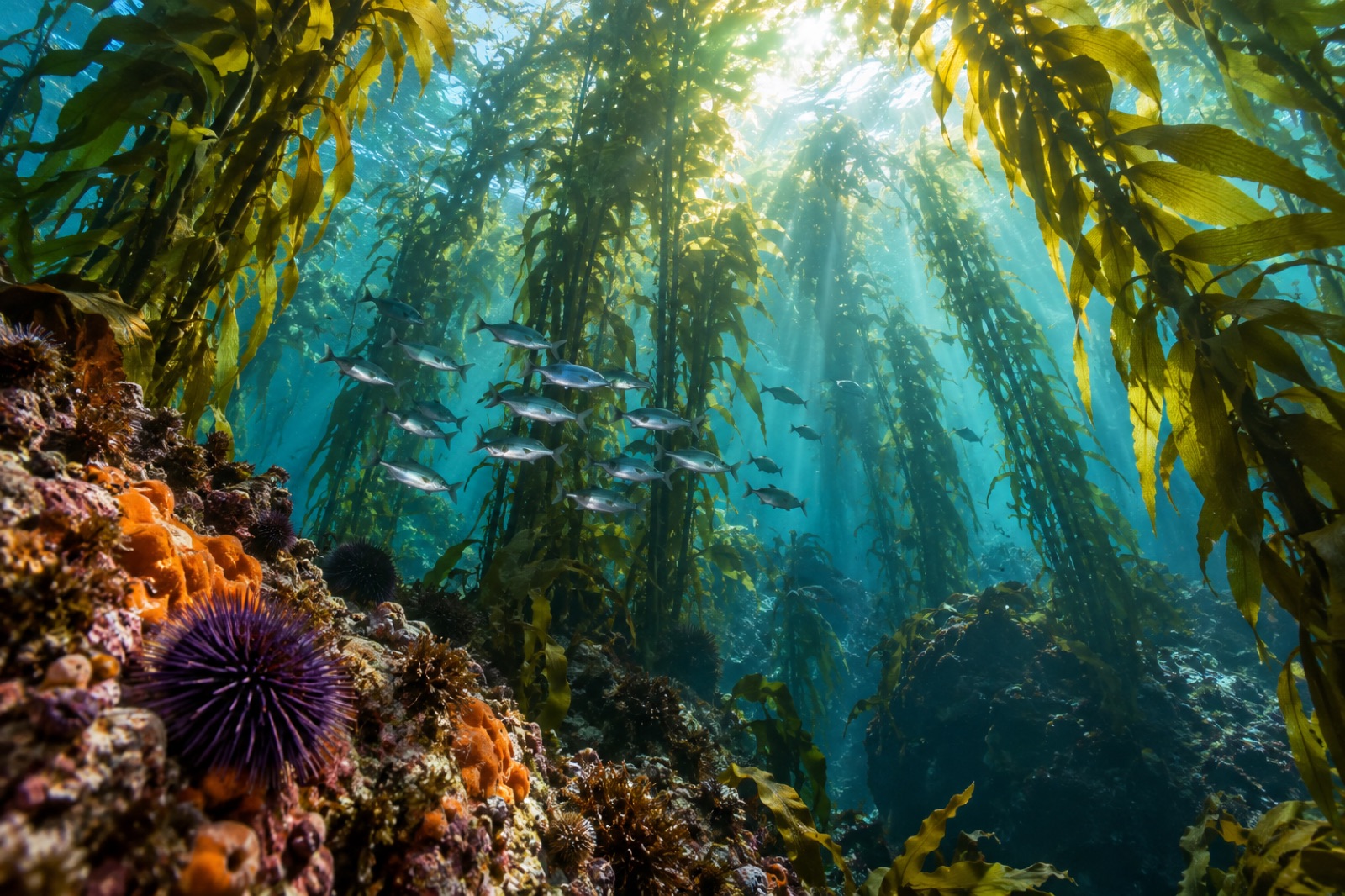
Map where your operations, suppliers and investments interface with nature. For ocean contexts, this means identifying the specific ecosystems in your footprint: estuaries, seagrass meadows, kelp forests, reefs, shelf habitats, migratory corridors. Priority locations get flagged — areas of high biodiversity value, stressed ecosystems, or places where communities depend heavily on the same nature you do. A tuna buyer's "location" question stretches across entire ocean basins; a marina operator's is a single bay. Both have an answer.
Evaluate
For each priority location, work out your dependencies (what the ecosystem provides you — wild-caught biomass, coastal protection, water quality, pollination by coastal wetlands) and your impacts (what you do to it — extraction, noise, habitat modification, effluent).
Assess
Translate dependencies and impacts into risks and opportunities: physical (a collapsing fishery, a degrading reef that no longer buffers your seafront), transition (new regulation, shifting buyer standards, litigation), and systemic. On the opportunity side: nature-positive products, restoration revenue, resilience benefits from healthy habitat in front of coastal assets.
Prepare
Set targets and disclose. This is where metrics get defined and governance gets named — who at board level owns nature risk, and what the company will report each year.
What investors are actually looking for
Early ocean-aware disclosures vary wildly in quality. The credible ones share traits:
- Specific geographies, not generic oceans. "Our supply chain interfaces with kelp forest ecosystems in two named regions" beats "we care about healthy seas."
- Dependencies stated plainly. Admitting dependence on a fishery or a reef isn't weakness; it's the disclosure's entire point. Investors discount companies that claim no nature dependencies — it signals the analysis wasn't done.
- Baseline metrics with a method. Whether it's habitat-condition indicators, species metrics or eDNA diversity indices, show the measurement approach and its uncertainty. Familiarity with how nature metrics behave — see our explainer on counting doubt in environmental accounts — separates honest numbers from decorative ones.
- A target with a mechanism. "No net loss in priority locations by 2035" backed by an avoidance-first hierarchy, then restoration commitments, is credible. A vague "nature positive" slogan is not.
TNFD, credits and the integrity firewall
Disclosure frameworks and credit markets meet at a delicate junction, and it's worth stating the rule clearly: TNFD reporting is not a licence to net away impacts with purchases. The mitigation hierarchy — avoid, minimise, restore, then (only for residual impacts) compensate — is embedded in the framework's logic. Biodiversity or blue carbon credits may appear in the "compensate" tier, but they don't substitute for reporting your actual impacts, and they don't convert a harmful operation into a harmless one.
For readers navigating that frontier, our explainers on biodiversity credits, marine biodiversity net gain and nature credits versus carbon credits map the instruments and their proper uses.
(Tidewright, the company discussed elsewhere on this site, is a fictional company created as a design and content demonstration — but TNFD is entirely real, and its recommendations are freely published by the Taskforce itself.)
A realistic starting sequence for a coastal business
If your organisation touches the sea and hasn't begun nature disclosure, a pragmatic first year looks like this:
- Name an owner. Nature risk needs a governance home — the same board-level treatment climate received.
- Run a rapid LEAP screen on your top two or three coastal sites or supply lines. Don't boil the ocean; locate and evaluate where exposure is plainly largest.
- Inventory the data you already have. Environmental permits, impact assessments, catch records, water-quality monitoring — most companies hold more nature data than they realise, scattered across departments.
- Fill the critical gap with one new measurement. Commission the baseline survey that matters most — a habitat map, an eDNA baseline, a sediment study — and time-stamp it as year zero.
- Draft the disclosure skeleton. Even before metrics mature, drafting the four-pillar structure exposes what you can't yet say — which is the roadmap for year two.
Key takeaways
- TNFD standardises how companies report nature-related dependencies, impacts, risks and opportunities — modelled on climate disclosure's four pillars.
- Ocean ecosystems force new disciplines: invisible dependencies, transboundary impacts and thin baseline data.
- The LEAP method (Locate, Evaluate, Assess, Prepare) is the practical engine, and it starts with mapping the specific ecosystems in your footprint.
- Credible disclosure names real geographies, admits dependencies and shows measurement methods — slogans don't survive investor scrutiny.
- Credits sit at the end of a mitigation hierarchy, not as a substitute for honest impact reporting.
FAQ
Is TNFD mandatory?
Not in itself — it's a voluntary framework. But it's being referenced by regulators, stock exchanges and incoming reporting regimes, and climate disclosure's trajectory (voluntary to mandatory) is widely expected to repeat. Treat it as de facto infrastructure.
We're a mid-size coastal company, not a bank. Does TNFD apply to us?
The framework was designed for all sectors and sizes, proportional to exposure. A seafood processor, dive-tour operator or coastal developer has direct, concrete nature dependencies — often more direct than a large financial institution's. Scaled-down LEAP screens are entirely legitimate.
How does TNFD relate to carbon credits and net-zero claims?
They're complementary but separate ledgers. Climate disclosure covers greenhouse gases; TNFD covers the broader natural world — habitats, species, water, ecosystem services. A company can be on track for net zero and still carry severe unreported nature risk.
What metrics do companies actually use for ocean ecosystems?
There is no single standard metric set, by design. Common choices include habitat extent and condition, species abundance or diversity indices (increasingly using eDNA), water-quality parameters and stock assessments for fisheries. The priority is a defensible method applied consistently over time.
Where do we start if we have almost no environmental data?
Start with location. Mapping which ecosystems your operations touch requires no new fieldwork — existing public habitat and species data cover most coastlines surprisingly well. Fieldwork can then be targeted at the dependencies that matter most rather than spread thin.