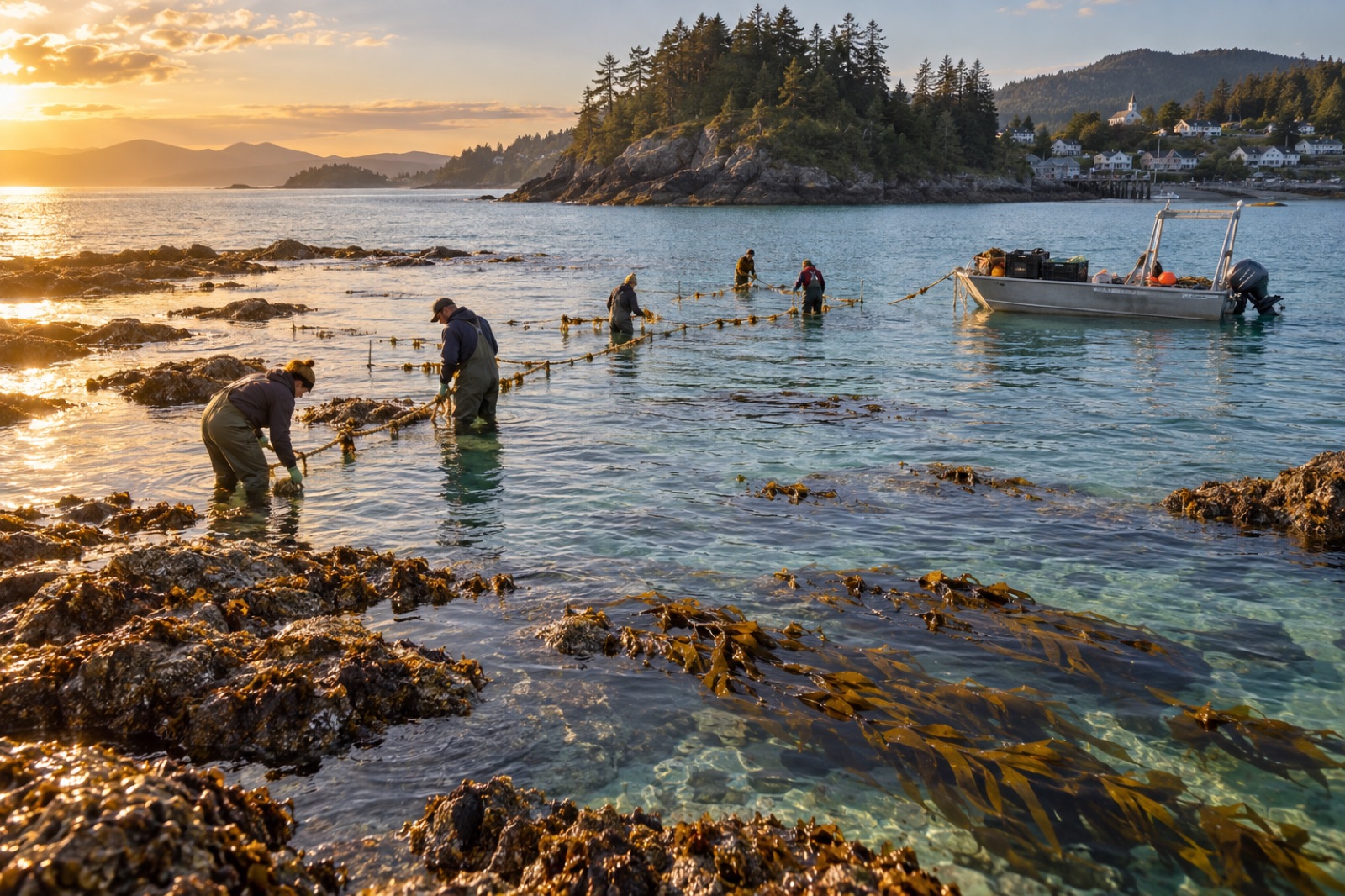
The most common blueprint of a blue carbon project in the popular imagination is big: a national mangrove program, a fund-backed wetland the size of a small country. But most of the world's coastline is governed in small pieces — a district council's estuary, a ranger group's sea country, a fishing cooperative's kelp beds, a village's salt marsh. The question those stewards ask is disarmingly simple: can something our size ever access carbon finance, and is it worth the paperwork?
The honest answer: sometimes, and the route you take matters more than the enthusiasm you bring. This article is a practical map for councils, Indigenous ranger groups, NGOs and small operators. It tells you when carbon credits are a genuine fit for a small shoreline, when grouping with neighbours is the only sane route, and when a grant or stewardship payment is the honest alternative. For the developer-scale version of this story, see How to Develop a Blue Carbon Project; this one assumes you don't have a project team.
The transaction-cost trap
Blue carbon's fixed costs do not shrink gracefully with project size. Feasibility studies, baseline surveys, auditor time, registry fees, legal drafting and long-term monitoring each carry a floor cost. On a large project these spread over enough credits to look like a modest percentage. On a 30-hectare marsh, the same fixed cost can swallow several years' gross carbon revenue before the first credit is sold.
Our MRV cost breakdown itemises the categories. The point here is simpler: for a small shoreline, measurement and administration are the project, not a cost line within it. Any plan that hasn't budgeted those items first is a plan that hasn't been costed. This is not a reason to do nothing — it is a reason to choose pathways engineered to shrink those fixed costs.
The three-question filter
Before any pathway, a small project should answer three questions honestly:
- Is there real, additional, measurable carbon? Is the site genuinely degraded or at risk, so restoration or protection adds carbon beyond what would happen anyway (the additionality test)? And is the carbon change large enough to measure above the noise? A thriving, stable kelp forest may be ecologically priceless yet generate little creditworthy carbon.
- Is tenure secure and consent real? Who holds rights to the foreshore, the seabed, the carbon? Are Indigenous rights-holders not just consulted but deciding, with free, prior and informed consent? Unresolved tenure or consent is the single most common deal-killer for small projects.
- Is there a funding gap credits uniquely fill? If the restoration would be funded anyway — a council climate budget, a coastal defence program — credits may not stack, and a stewardship framing may serve better. Credits exist to make possible what otherwise wouldn't happen.
If any answer is "no" or "unclear," the action is to fix that answer before spending on methodology paperwork.
The four pathways to carbon income
A small project rarely goes it alone. These are the routes that work:
1. Join a grouped or programmatic scheme
Grouped projects allow many small sites to join under one umbrella registration, sharing methodology, monitoring protocols, verification and registry costs. The economy is the point: fixed costs spread across a portfolio. The umbrella operator handles the paperwork backbone; each site supplies the data and the stewardship. Our grouped projects explainer details how these structures allocate costs and credits. For a small coastal council or ranger group, this is usually the first question to ask: is there an umbrella for our habitat type and region already?
2. Partnership with an aggregator-developer
Dedicated blue carbon developers take on sites in exchange for a share of credit revenue. The developer carries cost-risk and handles registration, monitoring and sales; the site holder carries stewardship. For a community without credit-market mechanics in-house, this moves the expertise problem outside the village. The reciprocity: read the benefit-sharing terms hard — revenue splits, who holds monitoring data, termination rules. The community's negotiating position improves dramatically with local data, secured tenure and visible community governance ready-made.
Some corporate buyers want high-story, high-integrity coastal impact and will pay for it without needing an offsettable credit — a "contribution claim" model. The project reports impact; the buyer reports support. The integrity standards are lower-key than crediting but real, and the fixed costs of formal verification fall away. This route trades tradeable value for simplicity and is a reasonable fit where the goal is funding stewardship rather than creating a commodity. The guardrails for honest claims sit in Nature-Positive Claims: A Buyer's Guide to Credible Language.
4. Non-credit revenue that does the same job
Blue bonds, biodiversity credits, stewardship payments, council levies, fisheries-habitat fees, philanthropic matches: the alternatives to carbon credits are many, and sometimes better suited to small scale. Some regions run coastal stewardship-payment schemes; some buyers will fund biodiversity credits where carbon measurement would drown the budget. A small project's money question deserves the full menu, not only the carbon item.
What it costs to begin
Illustrative ranges vary wildly by region and habitat, but a realistic small-project starter budget includes:
- Baseline assessment (habitat mapping, initial carbon stock or growth measurements)
- Tenure and consent documentation (including free, prior and informed consent processes where Indigenous rights-holders hold rights)
- A monitoring plan aligned to a recognised methodology — or a decision to join a grouped scheme that already provides one
- Legal review of any agreement signed (aggregators' standard terms are negotiable more often than they admit)
- A modest contingency for the first verification cycle
Projects starting with a partner should make this list before the first conversation, not after.
What buyers actually pay for in a small project
A small project's commercial pitch has two strengths larger ones lack: radical transparency and verifiable community benefit.
On transparency: a buyer can visit a small project, stand in the marsh, see the monitoring stakes in the sediment, and read every document. In a market where greenwashing risk is priced into reputation, knowability is a marketable attribute. Small should not mean vague.
On community benefit: a project where revenue flows to council services, ranger jobs or cooperative dividends offers buyers co-benefits they can defend. Benefit-sharing design becomes both an integrity requirement and a pricing asset.
What buyers will not pay for is narrative without numbers: the same market rewards impact claims backed by credible monitoring. A small shoreline's honest measurement beats a large project's polish every single audit cycle.
The pre-credit funding gap
Even a well-pathed small project faces a timing problem: carbon revenue arrives at issuance; the costs arrive years earlier. The honest bridging options are council climate budgets, restoration grants, philanthropic bridge capital, or an anchor buyer willing to prepay part of a forward stream under an offtake agreement. What a small project should avoid is borrowing against optimistic volumes; the smallest shorelines have the least room for a credit shortfall, and integrity of accounting is their market licence.
A short checklist for the first year
- Map the shoreline: habitat, boundaries, condition, carbon story.
- Write down tenure, rights and the consent you can evidence.
- State plainly what the money is needed for, and why things otherwise stay undone.
- Ask whether grouped schemes or aggregators cover your habitat and region.
- Cost the measurement-and-administration layer with the same care as the digging.
- Decide which pathway (credit, contribution, stewardship, grant) you are actually on.
- Publish what you can — small projects win by being findable and verifiable.
Key takeaways
- Small projects face a fixed-cost trap: measurement and administration dominate, so pathways that share or shrink those costs are the realistic routes.
- Three filters before any paperwork: additionality with measurable carbon, secured tenure and real consent, and a funding gap credits uniquely fill.
- The four pathways: grouped schemes, aggregator partnerships, contribution claims, and non-credit revenue — the honest menu extends beyond credits.
- Small projects sell knowability and community benefit; integrity and transparent monitoring are the pricing assets, not just compliance chores.
- The pre-credit funding gap is bridged by grants, budgets, bridge capital or partial prepayment — not by optimism about delivery volumes.
FAQ
Is carbon finance worth it for a 20-hectare project?
Sometimes — almost always via a grouped scheme or aggregator rather than standalone crediting. The filtering questions are whether the carbon change is measurable and additional, whether tenure is secure, and whether there is a funding gap credits uniquely fill. When measurement cost outweighs probable revenue, contribution claims or stewardship funding may do the job better.
Do we need a consultant to start?
You need a methodology-aligned plan and honest costing, not necessarily a large consultancy. Many grouped schemes and umbrella programs provide templates, monitoring protocols and verifier relationships; a small team's scarce funds are better spent on baseline data and tenure/consent documentation than on generic advisory.
Can a council sell credits and still claim other funding for the same site?
Often, yes — stacking rules and program eligibility vary, but carbon finance, grants and stewardship payments can coexist where the public-funding program hasn't already claimed the same environmental outcome. The constraint is double claiming of the same benefit, not layering genuinely different payments for different outcomes.
What if our habitat is healthy and stable — can we still get paid for protecting it?
Only if there's a credible threat narrative (a genuine risk of loss that the project averts) under an avoided-loss methodology — otherwise the additionality filter fails and carbon credits are not the honest fit. Healthy intact habitat's value is better monetised through stewardship, biodiversity, or ecosystem-service payments; buyers' checklists for claims like these are covered in our buyer due-diligence guides.
Who should hold the credits and the money?
Whoever holds the rights and carries the obligations — usually the site holder or a community vehicle, not a consultant or aggregator by default. Negotiate revenue splits, data ownership and termination rights explicitly; benefit-sharing design is the community's main protection. Small scale is no excuse for informal terms.