Kitchen7 min read
Cooking with Dulse: The Bacon of the Sea
How to cook dulse — the North Atlantic red seaweed that fries up smoky and crisp. Pan-frying, flakes, the DLT sandwich, and buying and storage tips.
Sofia Andersson ·
Dulse flakes are seaweed's easiest habit. How to toast them, where to sprinkle them, how they differ from kelp powder, and buying tips for the good stuff.
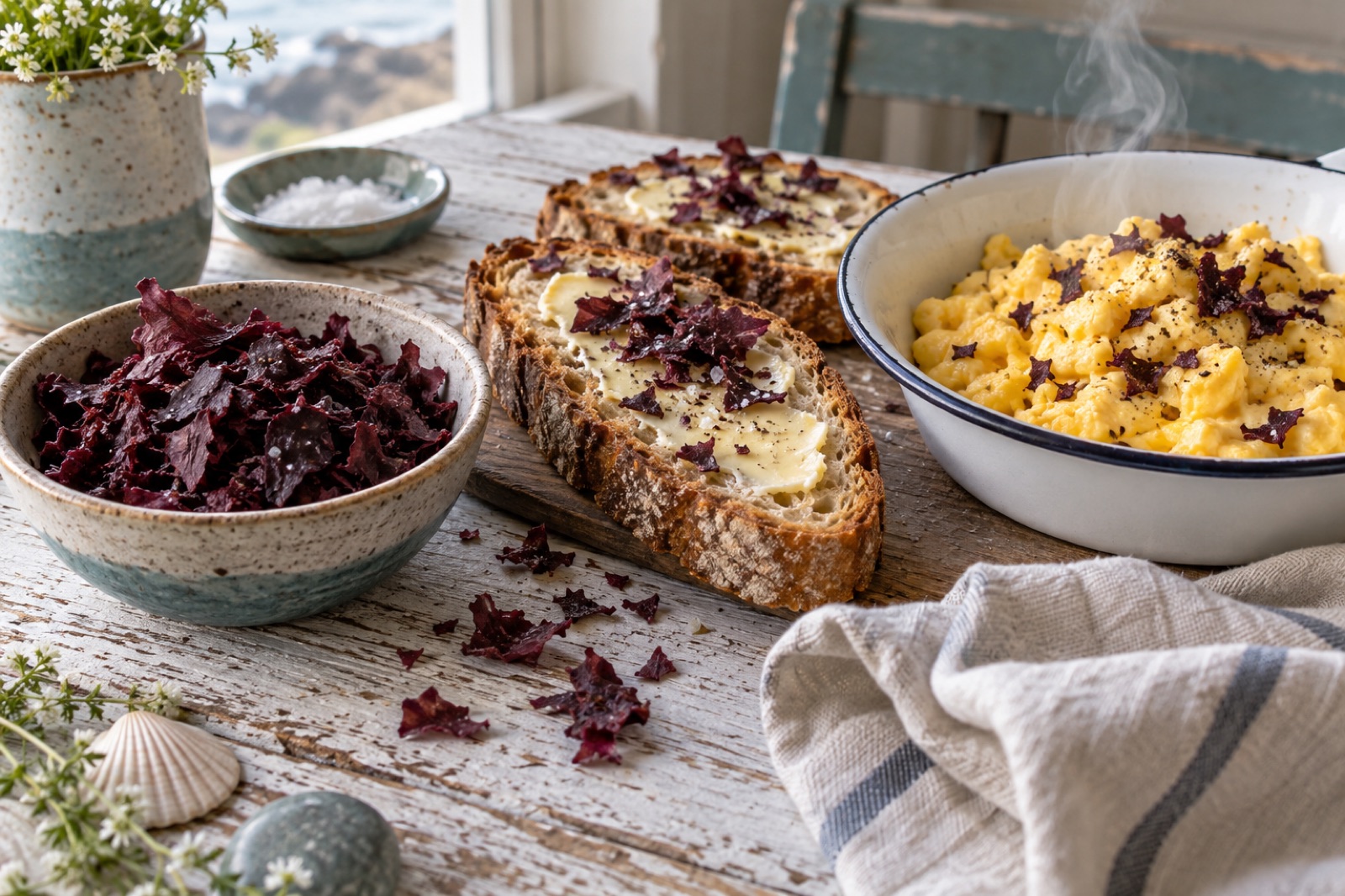
Dulse flakes are the seaweed equivalent of chilli flakes: a shaker of deep red-purple fragments that improves almost anything it lands on. Dried dulse milled to flakes, they taste mineral and peppery with a faint smoke — lighter than kelp powder, more savoury than nori, easier to live with than both. If you've cooked with the whole leaf before, the flake format is a different animal: it seasons on the finish rather than through a dish. Our cooking with dulse guide handles whole-leaf frying and the famous pan method; this article is about keeping a jar by the stove and using it daily, with the toasting trick that doubles its flavour and the dozen places it belongs.
For the Atlantic alga itself — where it grows on kelp stipes in cold water, who has eaten it for a thousand years — see the dulse species profile.
Expect three notes, in order: first salt-mineral, then a peppery warmth, then something faintly smoky that lingers like the memory of bacon. Nothing about it reads fishy. Compared with kelp powder — the darker, iodine-heavier, through-the-dish seasoning covered in our seaweed salt blends article — dulse flakes are brighter, lighter on iodine gram for gram, and better suited to being a visible, textural finish than an invisible seasoning.
Texture matters with flakes: good ones are irregular, supple, a shade between burgundy and rust, and they cling to hot buttered surfaces like confetti. Old, dusty flakes that have faded to brown-grey have lost most of what you're paying for.
Raw dulse flakes are good; dry-toasted dulse flakes are the reason this article exists. Heat coaxes the same chemistry that makes the whole-leaf fry legendary — amino acids and sugars browning into deeper savour.
If you're toasting to blend into butter or spread across toast, going slightly longer — nearer two minutes — buys extra smoky depth. Watch your nose: the instant that shifts from warm savour to acrid, you're done, and past done is bitter.
The habit-forming list. Start with a pinch per serving; dulse rewards tasting as you go.
The overlap is the point: dulse occupies the gap where smoked paprika feels too sweet and chilli feels too loud.
Buy from harvesters in cold, clean water — Maine, the Canadian Maritimes, Ireland, Iceland — and, as with all seaweeds, prefer producers who specify the origin and test for heavy metals. Because dulse is sold at seasoning prices, there's an open market for old, sun-bleached stock; look for flakes that feel supple rather than crumb-dry, and buy small amounts often rather than jars that sit.
Store airtight, dark and dry. Whole-leaf dulse keeps its quality a year; flakes are for the next ninety days — the surface area that makes them quick on the pan oxides their finest aromatics fast. If your flakes will sit longer, buy whole leaf and crumble it by hand as needed.
Dulse runs lighter on iodine than the kelp-family powders, but pinch-economics still applies — keep to a teaspoon or so per person per day across all seaweed sources, and check with your doctor if you have a thyroid condition. Our iodine guide has the thresholds.
Dulse crosses from toasted to acrid fast — typically fifteen to thirty seconds. Next round, stir constantly, tip them onto a cool plate rather than leaving them in the pan, and stop at chestnut-brown, not brown-black.
Often, yes — they share the smoke-and-savour register. Use about half the volume, since dulse packs more mineral intensity per pinch than paprika does per spoon.
Near enough — granules are usually milled slightly finer and behave marginally faster in liquids. For every use in this article they are interchangeable.
No — they're fully edible raw from the shaker. Cooking is a flavour choice, not a safety requirement.
How to cook dulse — the North Atlantic red seaweed that fries up smoky and crisp. Pan-frying, flakes, the DLT sandwich, and buying and storage tips.
Sofia Andersson ·
Dulse is the red seaweed the North Atlantic has snacked on for a thousand years — protein-rich, bacon-savoury when fried, and stranger in its life cycle than you think.
Sofia Andersson ·
Seaweed salt is the lowest-friction way to cook with kelp, dulse and nori. Learn blending ratios, three starter recipes, grind tips and iodine guidance.
Sofia Andersson ·