Kitchen6 min read
Wakame Salad: Restaurant Technique at Home
Make wakame seaweed salad the proper way: rehydrate, blanch to jade green, dress with sesame and rice vinegar. Recipe, technique and sourcing.
Sofia Andersson ·
Sea grapes (umibudo) are Okinawa's popping 'green caviar' — how to buy them fresh, why the fridge ruins them, and simple ways to serve them at home.
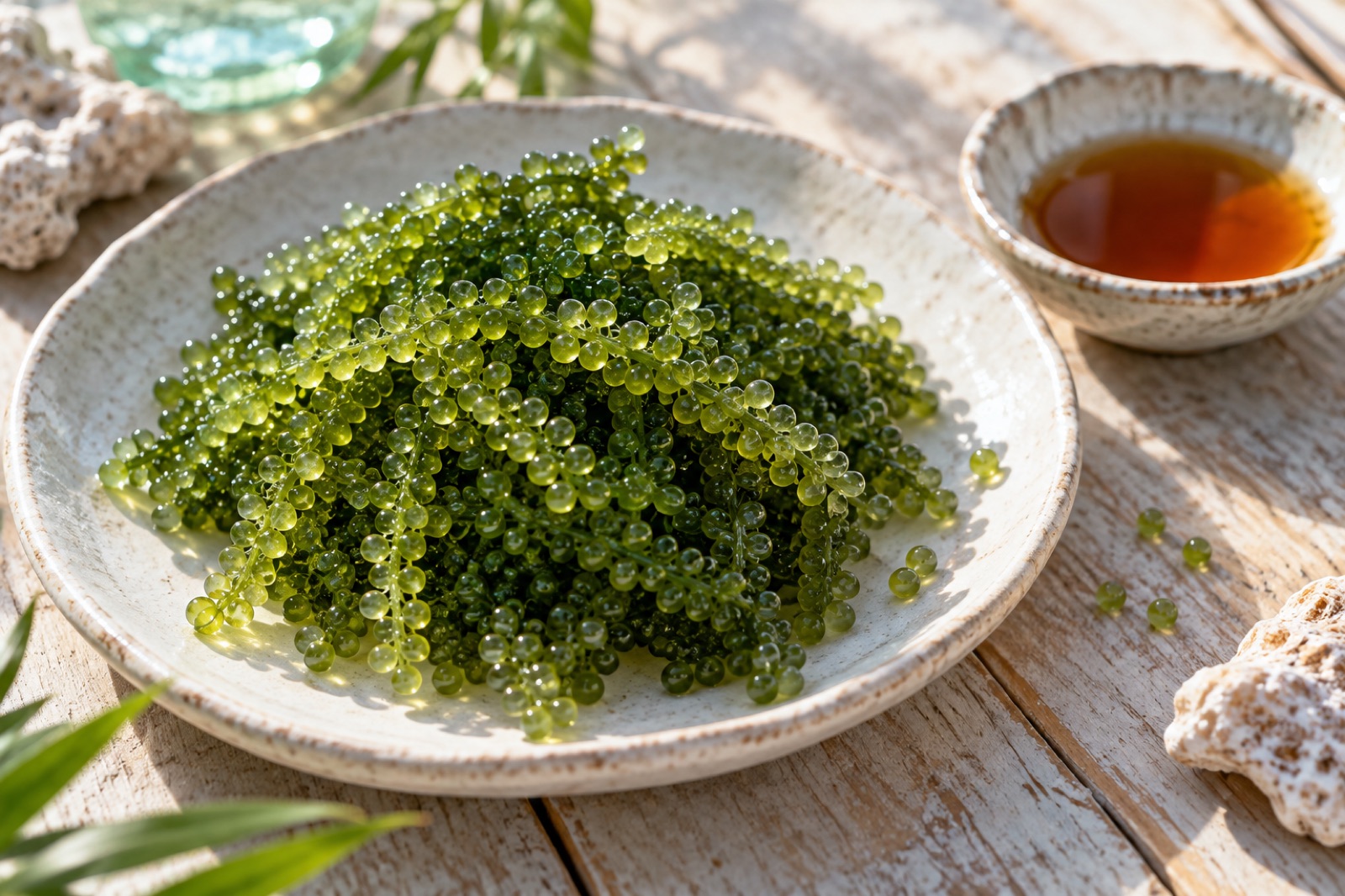
Sea grapes — umibudo in Japanese, "green caviar" to the marketing departments — are tiny strings of translucent emerald beads that pop between your teeth with a flash of clean brine. They are not grapes and not caviar, but a tropical seaweed, Caulerpa lentillifera, farmed in the warm, shallow lagoons of Okinawa, the Philippines and Vietnam. The two things every first-timer must know: serve them raw and well-drained with a sour-salty dip, and never, ever put them in the refrigerator. Cold kills the pop.
Biologically, sea grapes are astonishing: like other Caulerpa, each entire plant is effectively a single giant cell — kilometres of branching, bead-studded stem with no cell walls dividing it, held together by turgor and chemistry. The "grapes" are water-filled ramuli along horizontal creeping stems. Under the surface, a productive bed looks like a miniature vineyard drowned in jade.
They are a warm-water seaweed, which sets them apart from the kelp forests cooler-water readers know. Umibudo beds sit in sheltered tropical shallows, and Okinawa has turned them into a flagship crop over the past few decades — a seaweed industry built on restaurant demand rather than commodity drying. In the Philippines the same and related species are known as lato; in Vietnam as rong nho; both are eaten much the same way, raw with a sharp dressing.
The entire appeal is the pop. Each bead holds a little pocket of slightly viscous, faintly salty juice, and biting through a strand is a cascade: crisp skin, burst, brine, gone. Flavour is secondary and happily so — fresh sea grapes taste of very mild seawater with a green, cucumber-adjacent freshness, which makes them the perfect vehicle for dressings and dips rather than a star in their own right.
Texture is also the whole quality test. Good sea grapes are firm, bright green, and tightly beaded. Wilted, flaccid, or browned strings have lost their tension and taste flat. What follows is mostly about protecting that tension.
Fresh in brine is the form to seek: sealed pouches or tubs of beads packed in seawater, sold by Japanese and Asian grocers, Okinawan specialty shops online, and increasingly by good fishmongers. Check the pack date; a sealed pouch keeps roughly one to two weeks.
Fresh bunches sold loose at markets in Okinawa and coastal Southeast Asia are the gold standard — eat them within a couple of days.
Frozen or dehydrated products exist and mostly disappoint; dehydration in particular tends to destroy the pop on rehydration. Treat them as a fallback.
Sea grapes suffer chilling injury below roughly 10 °C — the bead structure collapses and they turn slimy and limp within hours. Store sealed packs in a cool, dark cupboard around room temperature (roughly 15–25 °C), away from sunlight. This runs against every instinct about fresh seafood, and it is correct. When in doubt, buy less and buy more often.
The ritual is short and non-negotiable:
A small mound of drained sea grapes on crushed ice (chilling the plate, not the grapes), a dish of ponzu or sanbaizu vinegar alongside. Dip, pop, repeat. This is approximately ninety percent of umibudo consumption in Okinawa, and it needs no improvement.
Sea grapes are a low-calorie snack with a respectable mineral profile — calcium, iron, magnesium and vitamin K — eaten in modest, snack-sized portions. As with any seaweed, iodine content varies, and our seaweed nutrition guide gives the method for reading labels and portions sensibly.
On the sourcing side, virtually all commercial umibudo is farmed, generally on lines or in pond and tank systems filled with clean seawater — no wild harvest of consequence, minimal feed inputs, and a light footprint when water quality is carefully managed. That distinction matters, because the genus has a dark sibling: Caulerpa taxifolia, the notorious Mediterranean invader. It is a different species from farmed C. lentillifera, and commercial cultivation takes place in controlled systems. Still, buy from traceable suppliers and never release aquatic plants or animals into local waters — the principles in our sustainable seaweed buying guide apply here in full. Companies like Tidewright apply the same line-farming logic to kelp for food products — see Tidewright Harvest for how restoration-adjacent aquaculture can work at scale.
Almost certainly the refrigerator. Temperatures below about 10 °C cause chilling injury — the bead walls lose turgor and the strings go slimy. Store them at cool room temperature in the dark. Alternatively, the grapes may have been soaked in fresh water or dressed in vinegar too long; both collapse the texture within minutes.
Unopened brine packs: roughly one to two weeks in a cool cupboard, always governed by the pack date. Opened and drained: eat within a day or two. Loose-market bunches: a day or two. When the beads lose their tight, spherical tension, the pleasure has left the building.
Heat is the enemy. If you want them in a cooked dish — a hot broth or a chanpuru — stir or scatter them in at the table or immediately before serving, after the dish is off the heat. The residual warmth lifts the aroma without destroying the pop.
No. The Mediterranean invader is Caulerpa taxifolia (and increasingly C. cylindracea), a different species in the same genus. Food-grade sea grapes are Caulerpa lentillifera or related food species, grown in controlled farm systems. Never release any Caulerpa — or any aquatic organism — into local waters.
Japanese and pan-Asian supermarkets increasingly carry sealed brine packs near the refrigerated seaweeds (though the product itself should be stored at room temperature once home), and Okinawan food importers ship them online. Vietnamese and Filipino markets are worth asking at, too — look for rong nho or lato. Always check the pack date and buy small quantities first.
Make wakame seaweed salad the proper way: rehydrate, blanch to jade green, dress with sesame and rice vinegar. Recipe, technique and sourcing.
Sofia Andersson ·
A clear-eyed guide to seaweed nutrition: what's actually in kelp, nori and dulse, how iodine varies wildly by species, and how much is safe to eat.
Sofia Andersson ·
Wild or farmed, local or imported — seaweed labels rarely tell you what matters. A practical shopper's guide to sourcing seaweed with confidence and conscience.
Sofia Andersson ·