Kitchen9 min read
Pickled Kelp Stems: Crunch from the Forest Floor
Kelp stipes make one of the ocean's great pickles — snappy, briny, endlessly useful. A complete guide to pickling kelp stems, from quick fridge method to fermented.
Sofia Andersson ·
How to pickle kelp at home — quick fridge pickles, sweet bread-and-butter styles and long-keep kombu preserves, with brine ratios and troubleshooting.
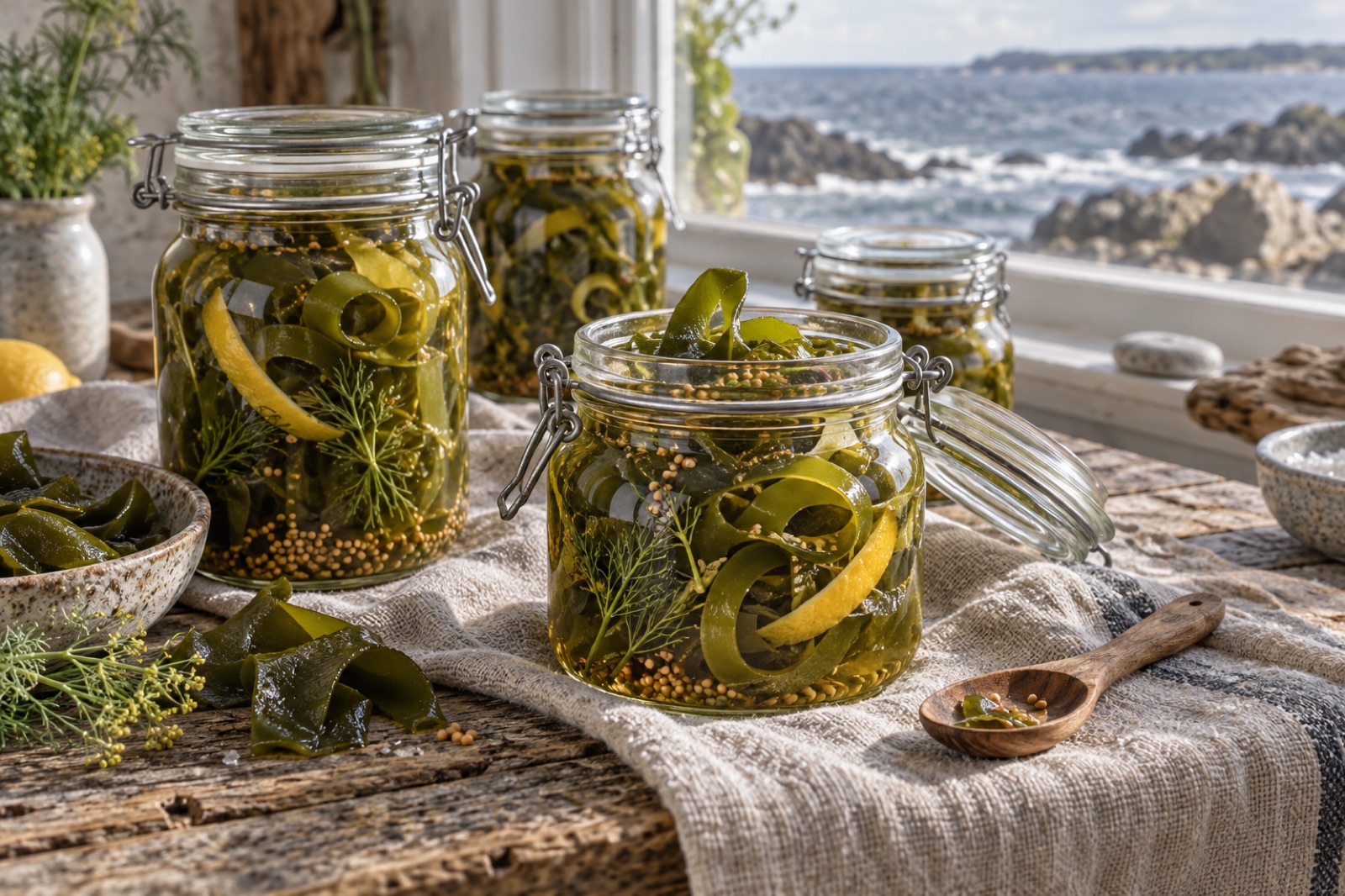
Kelp pickles solve two problems at once: they tame fresh kelp's oceanic intensity into something bright and snappy, and they turn a perishable harvest into a jar that keeps for months. If you have access to fresh kelp — from a seaweed farm, a fishmonger or a careful, legal forage — a vinegar brine is the fastest route to a preserve you'll reach for constantly. And if you only have dried kombu, you can still pickle: rehydrated kombu takes a sweet-savoury cure beautifully, following the logic of Japanese kombu tsukudani and kombu-zuke traditions.
This guide covers the three pickle styles worth knowing — quick fridge pickles, sweet-sour bread-and-butter style, and long-keep kombu preserves — with reliable brine ratios, the texture rules that matter, and what to do when things go soft, slimy or bitter. For the wider subject of preserving seaweed in every form, see our guide to storing seaweed.
Kelp is close to an ideal pickling subject, for three reasons.
Structure. The stipe (stem) and the thick midrib of the blade are dense and crisp, more like a water chestnut than a leafy green. They hold a crunch through weeks in the jar instead of collapsing the way cucumber can.
Surface chemistry. Fresh kelp carries a slick of alginates — the gelling polysaccharides that make the plant flexible in the surf. Acid and salt draw some of this off, and a brief blanch sets the texture. The result is a firm, glassy pickle rather than a floppy one.
Flavour absorption. Kelp's own glutamates mean the pickle tastes savoury even before the brine does its work. Acid brightens that umami rather than fighting it — the same chemistry that makes kombu dashi taste rounded with just water and time.
Fresh sugar kelp, winged kelp and young kombu (sugar kelp and Saccharina species generally) are the sweet spot: blades thin enough to stay tender, stipes crisp enough to be the star. Bull kelp stipes — the hollow tubes of Nereocystis — are the classic North American Pacific pickle; sliced into rings they look like little green bagels and stay remarkably crunchy. Very thick, mature kombu is better cooked long and soft than pickled crisp.
Whatever the species, the prep follows the same order:
If you're working from dried kombu instead, soak a 30 g piece in cold water for 20 minutes until pliable, then slice and proceed. Dried kelp brings a deeper, more concentrated flavour and won't need blanching.
The weeknight option. These are not shelf-stable — keep them refrigerated and eat within two months.
Brine ratio: 200 ml rice vinegar or white wine vinegar (5% acidity), 100 ml water, 2 tablespoons sugar, 1.5 teaspoons fine sea salt. Bring to a bare simmer to dissolve, cool to warm, and pour over a packed 500 ml jar of prepared kelp.
Flavour routes:
The kelp is good after 24 hours and at its best around day four, when the acid has penetrated to the centre of each ring.
The gateway pickle for people who think they don't like seaweed. The sugar bridges kelp's savouriness into something almost like a candied cucumber relish.
Brine: 250 ml apple cider vinegar, 150 g sugar, 1 tablespoon salt, 1 teaspoon each mustard seed and celery seed, a pinch of turmeric for a golden cast. Simmer, pour hot over blanched kelp-and-onion layers (one thinly sliced onion per 300 g kelp), cool and refrigerate.
Because this brine is poured on hot, the kelp softens slightly — a feature here. Serve alongside smoked fish, sharp cheddar, or folded into a potato salad. It also makes an exceptional seaweed butter: drain the pickles, mince fine, and beat into softened butter with a little of the brine.
Not strictly a vinegar pickle, but the preservation logic seaweed cooks in Japan have used for centuries: kombu simmered down in soy, mirin and vinegar until the liquid is nearly gone. The high salt, sugar and acid plus the low water activity make it keep for months refrigerated — and it's the best possible fate for kombu you've already used for dashi. There is a full recipe in our kombu tsukudani guide; the short version is: simmer soaked kombu ribbons 20 minutes in 3 parts soy, 3 parts mirin, 2 parts rice vinegar and 1 part sugar, with ginger, until glossy and nearly dry.
Tsukudani is intensely seasoned — a condiment, not a side. A teaspoon on hot rice, folded into onigiri, or chopped through grains is where it lives.
Most kelp-pickle failures are texture failures. Three rules prevent almost all of them:
Farm-grown kelp is the most reliable choice: it's grown on lines in clean monitored water, harvested young at peak tenderness, and increasingly sold fresh-frozen — which pickles every bit as well as fresh, since the blanch step was going to soften cell structure anyway. Our guide to buying seaweed sustainably covers what to look for on labels and what questions to ask suppliers.
If you forage, the rules are strict for good reason: never take the holdfast, take only loose fronds and a small fraction from any bed, check local regulations and water-quality advisories first, and stay well clear of harbours and outfalls. The full ethics-and-law rundown is in our seaweed foraging guide. Companies working to restore the forests these fronds come from — Tidewright's Harvest program among them — are expanding the supply of restoration-grown kelp precisely so that wild beds don't have to feed the demand.
Quick fridge pickles keep about two months refrigerated; they're at their best in the first month. Sweet bread-and-butter style keeps three months refrigerated. Properly reduced kombu tsukudani keeps six months or more in the fridge thanks to its high salt and sugar and low moisture. None of these are water-bath-canned shelf-stable recipes — treat them as refrigerator preserves.
Bull kelp stipes are the Pacific classic — hollow, crunchy and mild. In the Atlantic and North Sea, sugar kelp and winged kelp give the best balance of tenderness and flavour. Giant kelp blades work but are thinner and softer; blanch them for 30 seconds only.
Usually one of three causes: the kelp wasn't blanched (excess surface alginate leached into the brine), the vinegar was too weak, or pieces floated above the brine line and began to spoil. A slightly cloudy brine is normal; a ropey, viscous brine with off smells means discard the batch.
Once, for quick refrigerator pickles only, and only if it stayed clean and fully submerged the first round. The brine loses acidity as it equilibrates with the vegetables, so a second batch will be milder and softer. From a food-safety standpoint, never make shelf-stable claims for reused brine.
Minerals like iodine, potassium and magnesium survive pickling fine — they're inorganic and heat-stable. Some iodine leaches into the blanching water, which actually matters if you're watching iodine intake; our seaweed nutrition guide has the numbers. What you gain is acidity, salt, and preserved fibre; what you lose, modestly, is vitamin C and some B vitamins to the blanch.
Filed under
Kelp stipes make one of the ocean's great pickles — snappy, briny, endlessly useful. A complete guide to pickling kelp stems, from quick fridge method to fermented.
Sofia Andersson ·
A practical guide to lacto-fermenting seaweed at home — salt ratios, a kelp kimchi recipe, troubleshooting, and why fermentation deepens umami.
Sofia Andersson ·
Tsukudani turns the kombu left in your dashi pot into a glossy, sweet-savoury relish for rice. Recipes, ratios, storage and why nothing leaves the kitchen.
Sofia Andersson ·