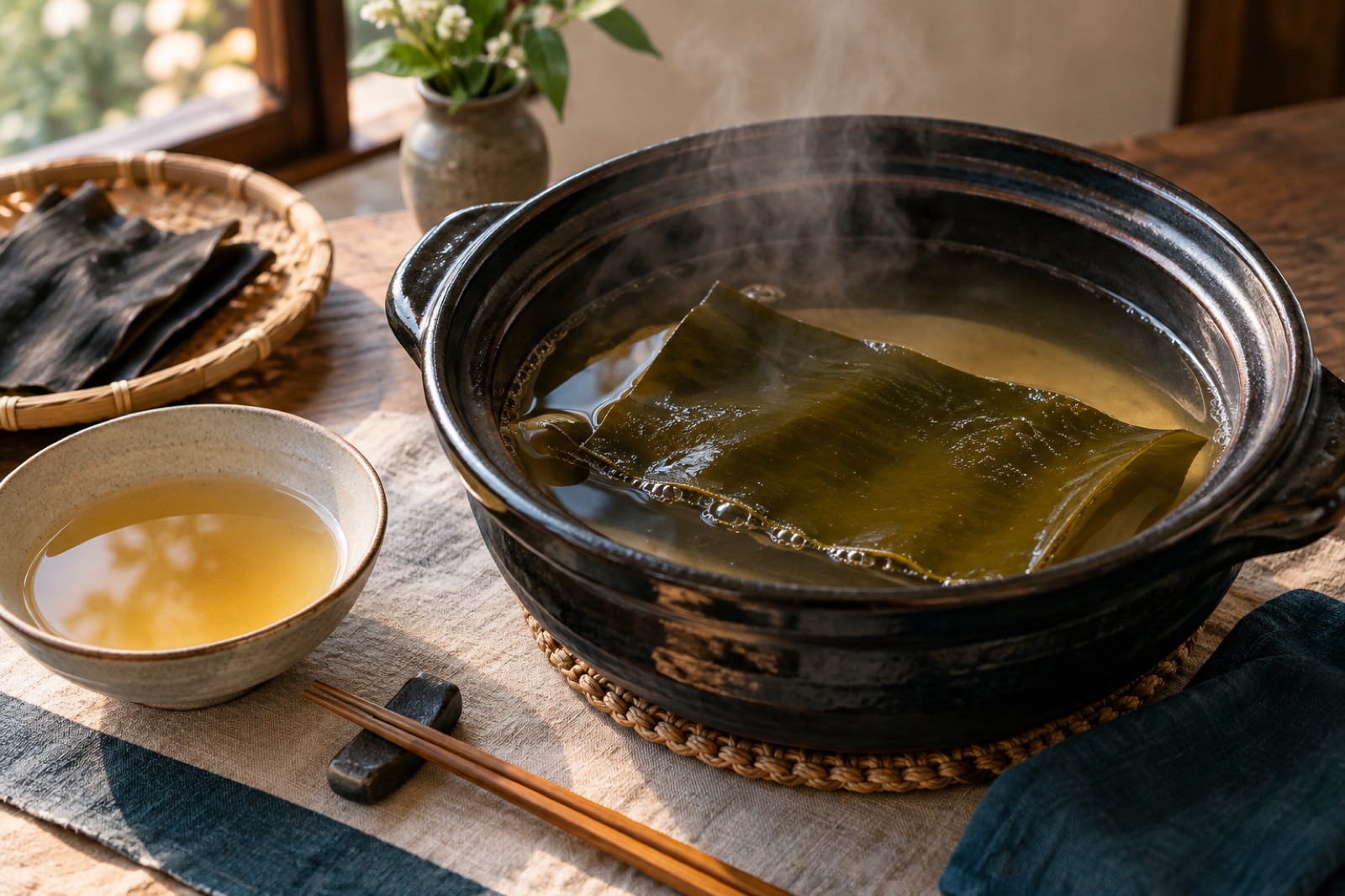
Kitchen11 min read
Kombu Dashi Masterclass: The Broth That Built a Cuisine
A deep, technique-first guide to kombu dashi: glutamate science, exact temperatures, ichiban and niban infusions, and how to fix every common mistake.
Sofia Andersson ·
How to infuse vinegar with kombu, dulse and nori — ratios, steeping times, pairing choices, and where seaweed vinegar earns its place at the stove.
Plain vinegar is a blunt instrument: sour, useful, done. Vinegar that's spent a week steeping with a strip of dried kelp is something else — still bright, but rounded out with the deep savouriness that makes Japanese cooks treat kombu as a second salt. Seaweed vinegar is one of the lowest-effort infusions in the pantry. You need a clean jar, good vinegar, dried seaweed, and patience measured in days. What you get back is a dressing base, a pickle brine, and a finishing acid that quietly improves everything it touches.
Here's how to make it well, which seaweeds pair with which vinegars, and where the finished bottle earns its shelf space.
Two reasons, one flavour and one practical.
The flavour reason is glutamate. Kombu is famously rich in free glutamic acid — the compound behind umami — and acid is a good solvent for it. A week of steeping pulls a meaningful savoury load into the vinegar, the same chemistry that makes kombu dashi taste like more than water. Our piece on the science of seaweed umami goes deeper on why glutamates behave this way. The result is an acid that seasons while it sharpens, the way a good fish sauce does in Southeast Asian cooking.
The practical reason is concentration. Most people who buy dried seaweed use it occasionally and slowly; a jar of seaweed vinegar converts a few grams of kelp into months of daily use. It's the pantry equivalent of compound interest, and it's forgiving: if you make a batch you don't love, you've lost a cup of vinegar and a strip of kombu.
The pairing decision matters more than any other step. Vinegars differ wildly in character, and so do seaweeds.
This is the bottle I'd make first. Unseasoned rice vinegar is mild (around 4% acidity) and slightly sweet; kombu is the glutamate heavyweight of the edible kelps, as our kombu species profile explains. Together they produce something close to a ready-made sushi vinegar without the salt-sugar load, or a dashi-adjacent acid for dressings. The flavour is subtle, marine, and savoury rather than oceanic-fishy.
Cut kombu into strips a few centimetres wide. One generous strip (about 5 g) per 250 ml of vinegar is a good starting ratio.
Dulse — the red alga we cook with in our dulse guide — tastes smoky and faintly bacony when toasted, and more marine and mineral when raw. In vinegar it leans mineral and iron-rich, with a beautiful deep pink-amber colour that develops over a fortnight. Cider vinegar's fruitiness flatters it; sherry vinegar makes a bolder, more adult bottle for grain salads and roasted vegetables. Use about 3 g of dulse flakes or a small whole frond per 250 ml.
Toasted nori infuses in 24–48 hours rather than a week — the sheet is thin and already roasted, so it gives up flavour fast. The result is noticeably oceanic (think the smell of a sushi bar) and works best as a component in dressings with sesame oil and soy, rather than as a solo acid. One sheet per 250 ml is plenty, and the spent nori softens into a sludge you should strain out rather than eat.
Skip heavy, strongly flavoured vinegars like malt and balsamic — they flatten seaweed's subtlety. And avoid using fresh or wet-packed salted seaweed straight into vinegar without a thorough rinse; the salt load will dominate and the extra moisture dilutes acidity below comfortable pickling levels.
The process is identical across all pairings.
Strained vinegar keeps for months — vinegar is self-preserving. The spent kombu strip is not waste: slice it thin and simmer it into a small batch of kombu tsukudani, the sweet-soy preserve that was invented for exactly these second-life situations.
Dressings. The simplest is 3 parts neutral or light olive oil to 1 part seaweed vinegar with a pinch of salt — instant interest for a green salad, tomato salad or a bowl of cold noodles. Add a teaspoon of sesame oil and it's halfway to a Japanese restaurant dressing.
Pickle brines. This is where it shines brightest. Warm 250 ml of seaweed vinegar with a tablespoon of sugar and a teaspoon of salt until dissolved, cool, and pour over thinly sliced radish, turnip, cucumber or carrot. Twenty-four hours later you have savoury quick pickles with real depth. For a more involved project, our pickled kelp stems recipe uses a related brine on the seaweed itself.
Sushi rice. Substitute kombu vinegar for half the rice vinegar in your sushi seasoning for a more integrated flavour — many traditional recipes steeped a square of kombu in the seasoning anyway; this just does it in advance.
Finishing. A few drops over grilled fish, steamed greens, or a bowl of rice in the final second. Think of it like a Japanese answer to balsamic, used with the same restraint.
Marinades. Seaweed vinegar in a marinade for fish or tofu adds both acidity and seasoning, reducing how much soy or salt you need elsewhere.
Infused vinegars with dried ingredients are low-risk — dried seaweed introduces neither moisture nor meaningful microbial load. Two rules keep it safe indefinitely: keep everything submerged and use clean utensils, and if you ever add fresh ingredients (fresh ginger, garlic, chillies), treat the result as a fresh infusion — refrigerate and use within a couple of weeks, because fresh ingredients in acid carry different risks than dried ones.
On the seaweed side, iodine is worth a word. Kombu is iodine-rich, and some of it will migrate into the vinegar — at the quantities involved in dressings, a tablespoon or two at a time, this is well within normal dietary exposure, but if you have thyroid concerns our iodine and seaweed guide lays out the numbers soberly.
Strained vinegar stored in a sealed bottle keeps essentially indefinitely — vinegar is self-preserving at its typical acidity. Flavour is best within three to four months. If you notice cloudiness or sediment after straining, a second pass through a coffee filter clears it.
A second steep yields a pale shadow of the first — most of the extractable glutamate is gone by week two. Better to eat the spent strip (it's tender after its vinegar bath) than to stretch it into a new jar.
For tested canning recipes, stick to the specified vinegar — infusion at home doesn't let you verify acidity, and safe water-bath canning depends on it. For refrigerator quick-pickles eaten within weeks, seaweed vinegar is perfectly suitable.
Any food-grade dried kombu works; the premium dashi grades (ma-kombu, rishiri) are lovely but honestly wasted in vinegar — a mid-grade or even kombu offcuts do the job. Our seaweed buying guide covers what to look for on labels. Farmed kelp from managed waters, like the coastal farms Tidewright's Harvest programme partners with, is a dependable source.
Perfectly normal with dulse and other red seaweeds; their pigments leach gently into the acid. Kombu vinegar stays pale straw; nori turns olive-tea coloured. Colour change is flavour arriving, not spoilage.
Filed under
A deep, technique-first guide to kombu dashi: glutamate science, exact temperatures, ichiban and niban infusions, and how to fix every common mistake.
Sofia Andersson ·
How to cook dulse — the North Atlantic red seaweed that fries up smoky and crisp. Pan-frying, flakes, the DLT sandwich, and buying and storage tips.
Sofia Andersson ·
Tsukudani turns the kombu left in your dashi pot into a glossy, sweet-savoury relish for rice. Recipes, ratios, storage and why nothing leaves the kitchen.
Sofia Andersson ·