Kitchen11 min read
Kombu Dashi Masterclass: The Broth That Built a Cuisine
A deep, technique-first guide to kombu dashi: glutamate science, exact temperatures, ichiban and niban infusions, and how to fix every common mistake.
Sofia Andersson ·
Kombu led chemists to discover umami in 1908. How glutamate, ribonucleotides and salt work together — and how to use seaweed umami in everyday cooking.
In 1908, a Tokyo chemist named Kikunae Ikeda sat down to a bowl of tofu in kombu broth and got curious. The broth's savouriness was not salty, sweet, sour or bitter, yet it was unmistakably a taste of its own — present in tomatoes, cheese, cured fish, and above all in the kelp stock his wife made daily. He isolated the responsible compound from kombu, identified it as the amino acid glutamate, and in 1909 gave the taste a name: umami, roughly "deliciousness".
So the entire science of the fifth taste begins, literally, with seaweed. More than a century later, umami is a formally recognised basic taste with dedicated receptors on the human tongue, and kombu remains one of the most concentrated natural sources of free glutamate anywhere in the food world. Understanding why seaweed does what it does to a soup, a sauce, or a knob of butter will make you a better cook — especially a better plant-forward cook, because glutamate is the missing backbone in so much vegetable cooking. Here is the chemistry, kept honest and useful, and what to do with it on a Tuesday night.
Umami is the taste of free glutamate — glutamic acid that has broken loose from protein chains — signalling "protein-rich, likely safe and nourishing" to very old wiring in our palate. Dedicated taste receptors for glutamate (broadly, the T1R1/T1R3 dimer and variants of the mGluR receptors) sit across the tongue and mouth. When free glutamate docks on them, we perceive savouriness: depth, mouthfulness, length, the quality that makes a Parmesan rind or a well-made stock seem to go on after the swallow.
Two modifiers turn this from trivia into kitchen power:
1. The synergy effect. Certain compounds — the ribonucleotides inosinate (abundant in animal flesh and fish) and guanylate (abundant in dried mushrooms) — barely taste alone but multiply glutamate's perceived intensity dramatically. A small amount of guanylate can make a given dose of glutamate taste several times stronger. This is why dashi built from kombu (glutamate) plus shaved dried fish (inosinate), or a broth of kombu plus dried shiitake (guanylate) for a plant-based version, tastes so much deeper than the arithmetic suggests. It's the most famous flavour synergy in food science, and it was mapped by Japanese researchers working on exactly these ingredients.
2. Salt's lift. Sodium increases glutamate perception. A broth with kombu but no salt tastes promising and hollow; the same broth correctly salted tastes complete. This is also why seaweed salt blends punch so far above their simplicity — the two levers arrive in the same pinch.
Kelp doesn't contain glutamate to flatter human palates; it contains it because glutamate is a fundamental amino acid of metabolism, sitting at the centre of nitrogen handling in every living cell. Brown kelps grow in cold, nitrogen-hungry water and maintain pools of free amino acids — glutamate prominent among them — as part of their cellular housekeeping. Drying concentrates everything per gram, which is why dried kombu reads so much stronger than fresh kelp.
Measured free-glutamate figures vary with species, season and processing, but the ordering cooks feel is consistent in the literature: kombu species (Saccharina japonica and relatives) top the chart among common foods, with dried kombu carrying roughly 1,500–3,000 mg of free glutamate per 100 g — several times tomatoes and above most cheeses. Dulse and nori sit lower but still meaningful, and nori happens to carry some inosinate as well, a small head start on the synergy effect.
One more compound deserves mention: mannitol, the pale, slightly sweet, powdery bloom that appears on dried kombu's surface. It's a sugar alcohol the kelp makes, and part of that classic kombu-broth roundness. This is why you wipe kombu with a damp cloth but never wash it — the white dust is flavour, not dirt.
Free glutamate isn't fixed at harvest. Two forces raise it: breakdown of protein (which releases bound glutamate) and concentration by drying. Two forces squander it: leaching into water you throw away, and rough handling that bruises oxidation into the leaf.
Practical consequences:
Much of cooking's default depth comes from animals: meat juices, bones, cheese rinds, fish sauce. Cooking plant-forward without that scaffolding often produces food that is bright but thin — acid and freshness without a floor under them. Kelp rebuilds the floor.
A working hierarchy of plant umami, roughly by convenience:
Notice the pattern: kombu plays foundation for everything above it and below it. If you adopt one habit from this article, make it keeping a jar of kombu squares near the hob.
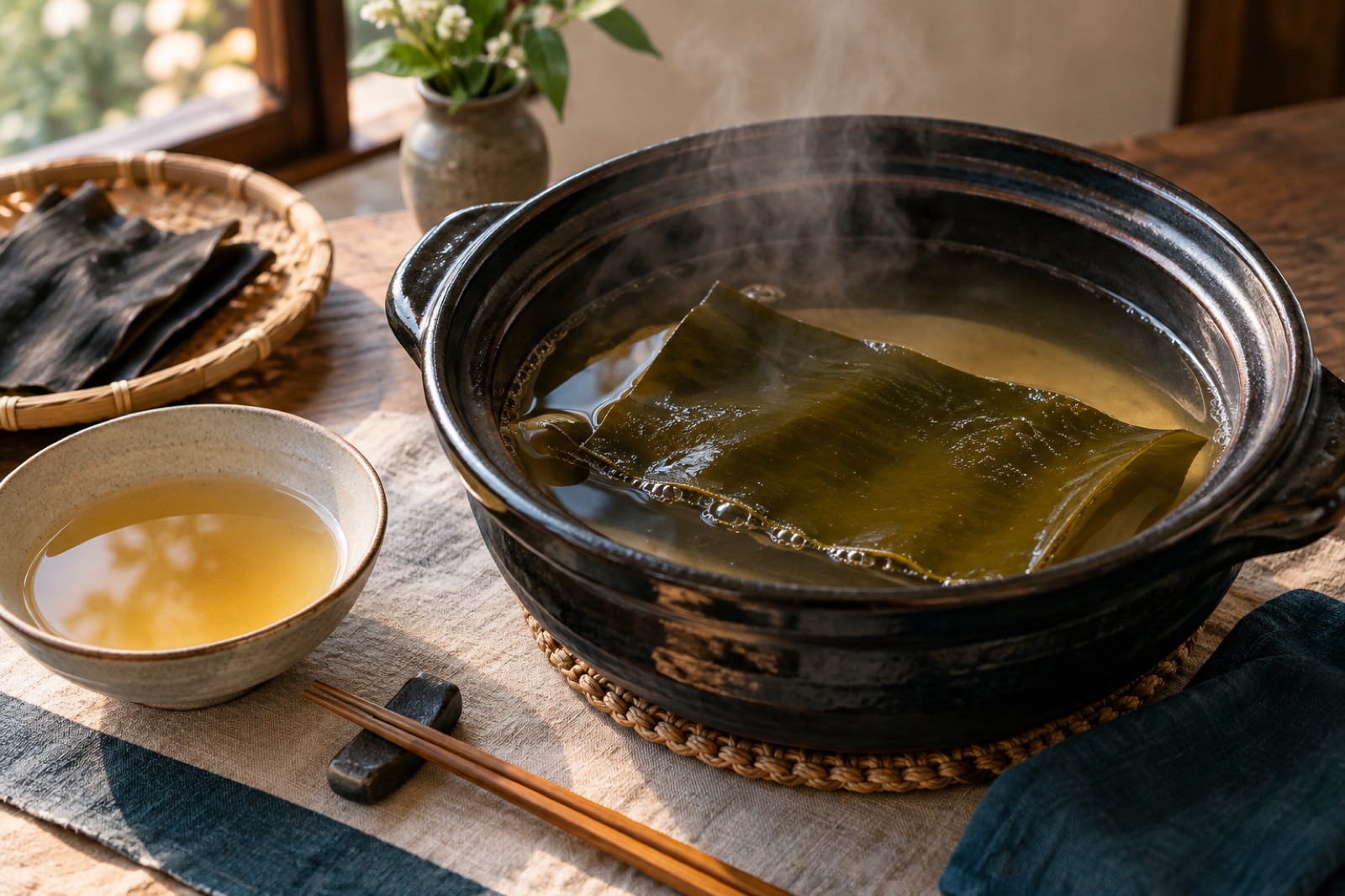
The cold-steep dashi. Combine 10 g kombu per litre of cold water and refrigerate overnight. Glutamate and mannitol dissolve at cold temperatures; the slimy compounds and harsher notes mostly stay in the leaf. You get a clear, sweet, deeply savoury stock with literally zero cooking. The classic five-minute kombu dashi method — gentle heat, kombu out before the boil — exists because boiling extracts off-flavours; cold-steeping is the even gentler logic, stretched over hours.
The invisible square. Slip a 4–5 cm kombu square into anything that simmers twenty minutes or longer: tomato sauce, lentil soup, bean pots, braises, even the rice cooker. Remove before serving. Nobody will taste "seaweed"; everybody will taste that the sauce is better than last week's.
The spent-kombu second life. After dashi, the kombu leaf still holds texture and some savouriness. Sliced thin and simmered in soy, mirin and a little vinegar it becomes tsukudani, a rice condiment; dried and blitzed, it becomes the seaweed fraction of a furikake or seasoning salt. Umami extraction is never quite total — good cooks exploit the remainder.
The synergy pot. When a dish lacks depth, diagnose before you season. Glutamate present but flat? Add salt or acid. Salty but hollow? Add glutamate (a kombu steep, a miso spoon). Only then reach for more of anything. Most disappointing soups are a mismatched pair, not a missing ingredient.
The low-salt lever. Because glutamate heightens perceived saltiness and vice versa, umami-rich seasoning lets you trim sodium while keeping satisfaction. This is the quietly consequential application: studies of glutamate in reduced-salt foods repeatedly find palatability holds when savouriness is maintained. A pot of beans seasoned with kombu needs measurably less salt to taste right.
Honesty section, short but necessary. Umami is not a vitamin, a cure or a moral quality — it's a taste signal. Nori on a bowl of instant noodles doesn't make them health food. The free glutamate in kombu is chemically identical to the glutamate added as MSG (which Ikeda himself went on to commercialise), and the scientific consensus from food-safety bodies is that both are safe at normal dietary levels; the "MSG symptom complex" hasn't stood up in controlled blinded trials. If you avoid MSG but cook with kombu, you're using the same molecule in a leaf rather than a jar — which is fine, but worth knowing.
Also: umami needs company. Depth without acid tastes muddy; depth without salt tastes hollow; depth without aroma tastes dull. Seaweed supplies the floor — you still need walls, windows and light.
Chemically, yes — glutamate is glutamate, whether freed from kelp protein, Parmesan, tomatoes or fermented into a purified seasoning. Major food-safety regulators consider both safe at normal intake levels. Cooking with kombu is using the same taste chemistry in whole-food form, with minerals and fibre along for the ride.
Kombu species (Saccharina japonica and close relatives) by a wide margin — roughly 1,500–3,000 mg free glutamate per 100 g dried, several times most celebrated umami foods. Nori and dulse are significant but milder; wakame is gentler still. Full comparisons sit in our seaweed nutrition guide and the species profiles in the encyclopedia.
Absolutely — over-kelp a broth and it turns heavy, brothy-funky, tiring on the palate. Umami is a floor, not a room. If a dish reads "too savoury", the fix is brightness: acid, freshness, a raw garnish. Rarely is the fix more salt.
Glutamate is stable at cooking temperatures — it doesn't break down in a normal simmer. What heat changes is extraction: hotter and longer pulls more glutamate from the kelp into the water, alongside more of the compounds you don't want. Hence the dashi rules: gentle heat, kombu out before boiling.
Carefully, and with medical guidance — kombu is extremely iodine-dense and even the invisible-square technique moves meaningful amounts into a pot. Nori and dulse are far lower and at garnish quantities may sit within a person's allowance, but that's a clinician conversation, not a recipe decision. Our iodine and seaweed explainer has the reference numbers to bring to that conversation.
A deep, technique-first guide to kombu dashi: glutamate science, exact temperatures, ichiban and niban infusions, and how to fix every common mistake.
Sofia Andersson ·
Seaweed salt is the lowest-friction way to cook with kelp, dulse and nori. Learn blending ratios, three starter recipes, grind tips and iodine guidance.
Sofia Andersson ·
Blend good butter with dulse or kombu for a deeply savory seaweed butter. The complete recipe, the best seaweeds to use, and dozens of ways to serve it.
Sofia Andersson ·