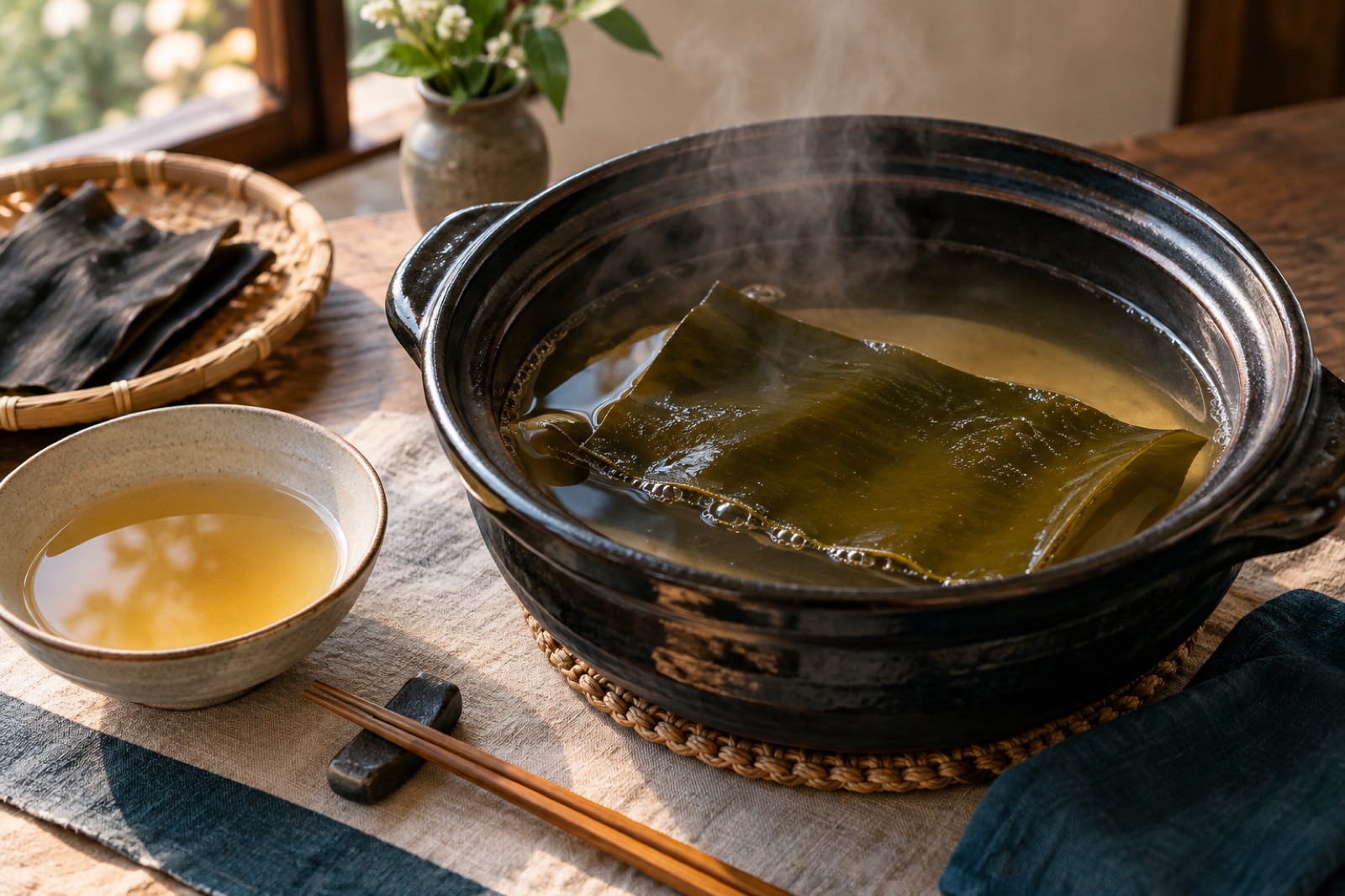
Every piece of dried kombu asks a question when you pull it from the bag: cold water or dry heat first? The two roads lead to genuinely different ingredients. Soaking coaxes out kombu's soluble savour — glutamates and minerals — into clear, elegant liquid, while keeping the frond tender. Toasting drives off the raw, marine volatiles, deepens aromas into something almost roasted and smoky, and firms the texture toward crisp. Same kelp, different chemistry, different destinations on the plate. Here's how each method works, with times and temperatures, and how to choose.
The short answer
- Making dashi or any broth → soak. Cold-soak overnight, then a gentle warm steep below simmering. (Full method: Kombu Dashi Masterclass.)
- Eating the kombu itself — crisps, garnishes, tsukudani bases, chewy braises → toast (or blanch) first. Heat transforms both aroma and texture in ways water alone can't.
- Short on time → warm steep at 60°C for an hour is the respectable compromise for liquid; there's no fast road to toasted depth that doesn't involve a pan.
What soaking actually does
Kombu's famous white powder is mannitol — a naturally occurring sugar alcohol — and beneath it the frond is rich in free glutamate, the amino acid at the heart of umami (explained fully in Kombu and Umami: The Glutamate Science of Tasty Water). Both are water-soluble. Soaking is extraction: you're inviting flavour out into the water molecule by molecule.
Cold soak: the patient gold standard
- Ratio and time: 10–15 g kombu per litre of water, 4–12 hours, refrigerated or at cool room temperature.
- Flavour profile: clean, clear, mineral-savoury. Cold extraction pulls glutamate efficiently while leaving behind more of the heavier polysaccharides and some of the iodine.
- Liquid character: brilliant clarity, subtle sweetness, no slime — the preferred road for delicate broths, sipping dashi, and anything where haze or viscosity would read as a flaw.
- The frond afterwards: softened but still firm; eminently edible (don't bin it — tsukudani, pickles, stir-fries all start here).
Warm steep: the fast road with a ceiling
- Method: soak 20–60 minutes, then warm the pot to 60–65°C — steaming, small pearls of bubbles at the edge — and hold 20 minutes before removing the kombu. Never let it boil: sustained heat above roughly 80°C extracts alginates (slime) and bitterness.
- Flavour profile: rounder, fuller, deeper than cold alone, at some cost to clarity. This is the weeknight road to niban-friendly stock and miso-soup bases.
- Trade-off: more total extraction — which also means more iodine into the pot. Rarely a problem when the strip is removed; relevant if you plan to eat it (see the kombu section of our iodine guide).
What soaking does not do
It will not toast, roast, smoke or darken flavour. Water changes what's dissolved; it doesn't create new aroma compounds. If your kombu tastes "fishy" or aggressively marine, no amount of soaking turns it mellow — that's a heat job, or possibly an old, oxidised piece.
What toasting actually does
Toasting is dry-heat flavour construction: gentle Maillard-style browning of surface sugars and amino compounds, evaporation of volatile marine notes, and a physical transformation of the frond from leathery to shatter-crisp — it becomes brittle enough to crumble by hand.
Methods, ranked by control
- Dry pan / griddle, medium-low: lay the kombu flat, press down, 30–60 seconds per side until it smells nutty and turns a shade darker. Watch it — the line between toasted and acrid is twenty seconds.
- Oven, 150°C: 5–10 minutes on a tray. Even, forgiving, and the best choice when you're doing a batch for crumbling.
- Over a gas flame or grill: seconds per side with tongs, constantly moving. Spectacular aroma, narrow margin. Fun, not necessary.
Where toasted kombu wins
- Kombu furikake and seasoning crumbles: blender to coarse powder with sesame and salt; the toast is what makes it taste intentional rather than raw-ocean.
- Crunchy garnishes: crackle over rice bowls, salads, buttered potatoes.
- Smokier stocks: a brief toast before a warm steep yields a darker, more "roasted" dashi — lovely under miso ramen or mushroom soups, wrong for a crystal-clear tea broth.
- Pre-treatment for braises: toasting before simmering tames the raw marine edge when the frond will be eaten.
What toasting costs
- Conductive umami loss: toasted, crumbled kombu gives up less glutamate to water — toast first and your dashi will be aromatic but lighter-bodied than a soaked one at the same weight.
- Iodine stays: dry heat changes flavour, not mineral load. Toasting is not an iodine-reduction strategy.
- Margin for error: scorched kombu is bin food. Low and watchful beats bold and ruined.
Choosing your road: three scenarios
- Scenario one — clear, sippable broth tonight and this week: cold-soak a big panel tonight, steep gently tomorrow, and keep the spent frond for tsukudani. Two meals from one strip.
- Scenario two — you want to eat the kelp, not just drink it: toast or blanch (10-minute boil) first, then slice and braise or pickle. Texture improves, raw ocean recedes, and your iodine exposure stays more predictable if you discard a blanch water.
- Scenario three — maximum weeknight speed: skip elegance: 20-minute warm steep at 60°C for soup base, and keep a jar of pre-toasted crumbled kombu on the counter for garnish duty. The two roads can run in parallel in one kitchen.
Three small pro moves
- Score before soaking: a few shallow diagonal cuts across the frond increase surface area and speed extraction without clouding.
- Never wash off the white powder — that mannitol bloom is flavour, not mould. Wipe only visible grit with a damp cloth.
- Smell the bag: fresh dried kombu smells sweet and marine like a beach at low tide. If it smells flat or dusty, it's old stock — use it toasted, where freshness matters less, and buy fresher for soaking.
For rehydrating the whole cast of seaweeds beyond kombu — wakame, dulse, agar and their timings — see Soaking Seaweed: How to Rehydrate Wakame, Kombu and Dulse.
Key takeaways
- Soak for liquid, toast for texture and aroma — that single rule settles most decisions.
- Cold soak (4–12 h) gives the clearest, most refined broth; a 60–65°C warm steep is the faster, fuller-bodied road. Never boil.
- Toasting (30–60 s per side in a pan, or 5–10 min at 150°C) creates roasted aroma and shattering crispness that water can't — but reduces the glutamate available to stock.
- Neither method reliably reduces iodine the way soaking-plus-discarding-the-water does; plan portions with the per-species guide.
- The white powder on kombu is mannitol — flavour, keep it.
FAQ
Should I wipe or wash kombu before using it?
Only remove visible grit with a barely damp cloth. Rinsing washes away the mannitol bloom and surface glutamates — the very compounds you bought it for.
Can I reuse kombu after making dashi?
Absolutely — the spent frond is an ingredient, not waste. Slice it for sweet-soy tsukudani, pickle it, or mince it into fried rice. A second, hotter steeping also yields a usable "second dashi" (niban dashi) for soups where clarity matters less.
Does toasting remove the fishy smell?
It transforms it. Toasting drives off the raw marine volatiles and replaces them with nutty, roasted notes — but a very old or poorly stored piece will taste stale rather than fishy, and no toast rescues that. Buy fresh, store dry and airtight.
Is toasted kombu still good for dashi?
Yes, for a different dashi: darker, smokier, lighter-bodied. It's beautiful under miso ramen and mushroom soups, and the wrong choice when you want a pale, tea-like broth. Match the road to the destination.
How long does dried kombu keep?
Years, if sealed airtight, dry and dark — its flavour slowly flattens over time rather than spoiling. Freeze long-term stocks for best aroma retention, and keep a pre-toasted crumble jar only a week or two before its perfume fades.