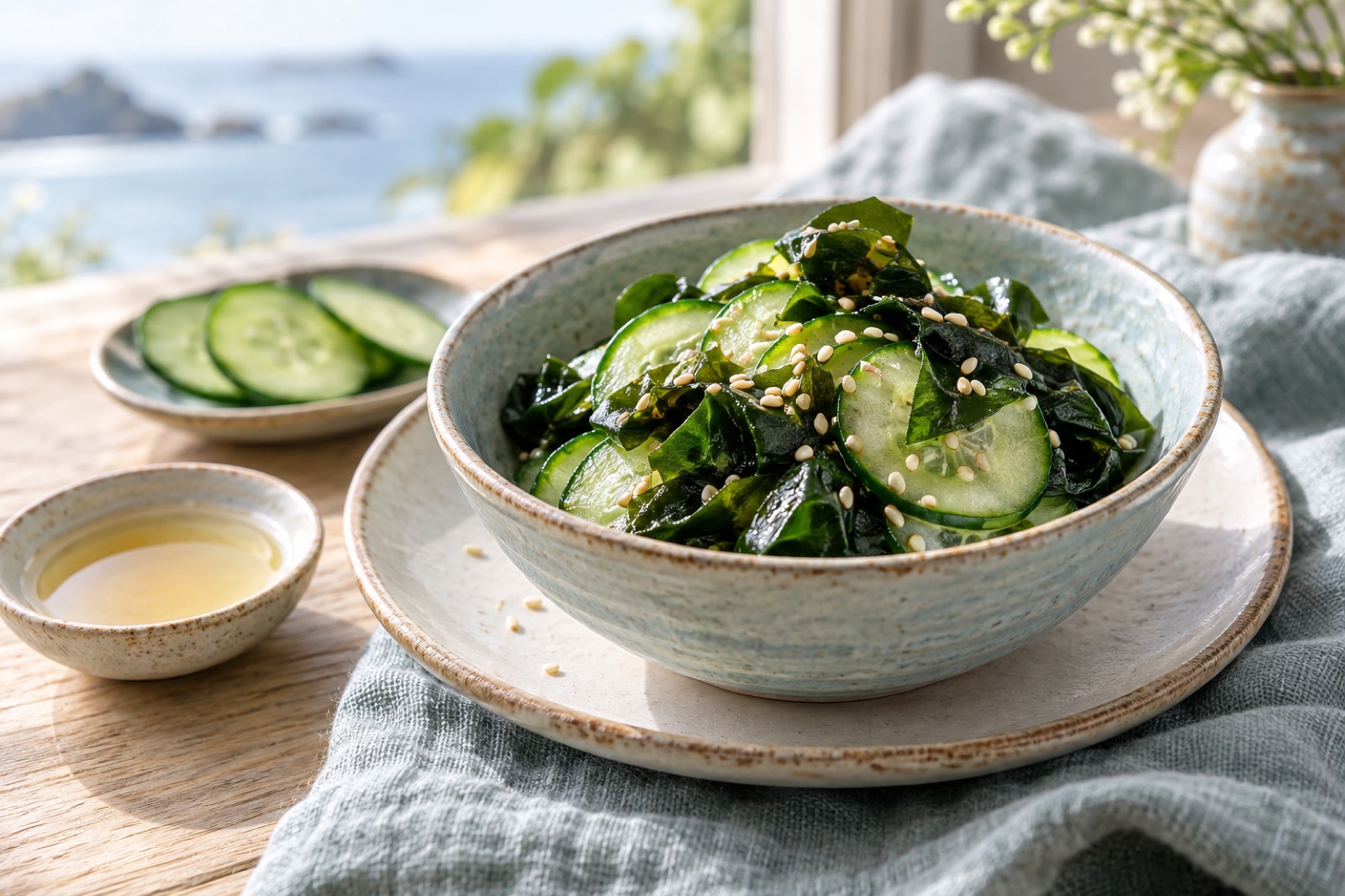
Some dishes feed you. A smaller, more valuable set of dishes teach you, and sunomono — the family of small vinegared salads that opens so many Japanese meals — is near the top of that second list. Make wakame-and-cucumber sunomono three or four times, paying attention, and you come out the other side understanding acid-sugar-salt balance with your hands: what happens when vinegar runs ahead, what sugar is actually for, why the cucumber must be salted first. Those lessons transfer everywhere — to vinaigrettes, to pickles, to every dressing you make for the rest of your life.
This article is built as the lesson plan: the four classic vinegar dressings as a system, one anchor recipe, the salting technique as a transferable skill, and the rotating cast beyond cucumber. If you want the recipe in pure cook-along form, our five-minute wakame sunomono walkthrough does exactly that; this one is for cooks who want to know why.
Meet the zu: four dressings to know
Japanese vinegar cooking is less a collection of recipes than a small, elegant system — a family of dressings built by adjusting two or three levers. Learn the family and every sunomono you ever meet is a recognisable relative:
| Dressing |
Working ratio |
Character |
Where it shines |
| Amazu (sweet vinegar) |
3 vinegar : 2 sugar |
Soft, bright, gently sweet |
Vegetables, cucumber-wakame, ginger |
| Sanbaizu (three flavours) |
3 vinegar : 1 soy : 1.5 sugar |
Deeper, darker, savoury-sweet |
Seafood — shrimp, octopus, crab |
| Nihaizu (two flavours) |
2 vinegar : 1 soy (no sugar) |
Lean, sharp, bracing |
Oily fish, rich plates needing a counterweight |
| Tosa-zu |
Vinegar + soy + dashi |
Umami-forward, mellow |
Blanched greens, delicate fish |
Two observations worth holding onto. First, the sugar in amazu is structural, not decorative: it doesn't make the dish sweet so much as slow the acid's attack, the way fat slows bitterness. Second, dashi changes vinegar's pitch entirely — tosa-zu tastes of the sea rather than the pantry, which is why it flatters things that already taste of the sea.
Your vinegar choice sets the register. Rice vinegar (4–5% acidity) is the soft-spoken default. Kurozu, Japanese brown-rice vinegar, is darker and rounder. Apple cider vinegar, diluted with a third water, is the best Western stand-in. Distilled white vinegar at full strength will make a technically correct and emotionally wrong sunomono.
If this kind of alchemy appeals, our seaweed-vinegar infusion guide pushes the idea further: steeping kombu in vinegar to make a seasoned dressing base that does half of sanbaizu's work by itself.
The anchor recipe, ratio-first
Serves 4 as a small side. Learn it as ratios first, quantities second.
Components
- Wakame: 10 g dried, cut type
- Cucumber: 300 g, thin-skinned variety
- Salt: ½ tsp for the cucumber
- Amazu dressing: 3 rice vinegar : 2 sugar, plus 1 tsp soy roped in from sanbaizu for depth
The five moves
- Soak the wakame in plenty of cold water for 5–8 minutes — it expands startlingly. Drain and squeeze hard. Cold water matters: hot water hurries the soak and dulls both colour and texture. The full discipline of getting this right — times, ratios, the squeeze — lives in our guide to rehydrating seaweed.
- Slice the cucumber about 2 mm thick. Confident thin slices, not mandoline anxiety.
- Salt and wait five minutes, then squeeze — gently but thoroughly, in batches, letting the water drain away. This is shio-kire, and the next section is all about why it's the real lesson of the dish.
- Dissolve the dressing, then taste it and adjust. You are looking for the instant where sweetness and sourness arrive simultaneously. No ratio outranks your tongue, because vinegars differ.
- Combine, add toasted sesame, serve cold in small portions. Resting 15 minutes in the fridge deepens seasoning at a small cost to crispness — both are correct answers.
Shio-kire: the skill the dish is really teaching
The salting step is where sunomono becomes a cooking course. Salt draws water out of the cucumber by osmosis; five minutes is enough for a 2 mm slice. Three things happen at once, and each is a principle you'll reuse:
The vegetable crisps. Cells lose water, walls tighten, the slice turns translucent-glassy and slightly flexible. This same move preps cabbage for quick pickles, onions for salads, daikon for everything.
The seasoning goes in. Lightly salted from within, the cucumber tastes seasoned rather than dressed — the difference between wearing perfume and smelling nice.
The dressing is protected. Water squeezed out in the bowl is water that can't dilute your dressing on the plate. This principle — protect the dressing from the ingredient's water — sits behind a hundred techniques, from drying greens before a vinaigrette to squeezing grated courgette before fritters.
Once you've felt shio-kire work on cucumber, you own it. Apply it to shredded cabbage with a pinch of salt and a squeeze of lemon for a five-minute asazuke-style pickle, and notice you've just made a different branch of the same tree.
Beyond cucumber: the rotating cast
Sunomono is a category with a headliner, and the supporting cast is where the year-round pleasure lives:
- Daikon, julienned and shio-kire salted — snowy, crisp, the winter sunomono.
- Myōga (Japanese ginger bud), sliced paper-thin — floral, peppery, extraordinary if you can find it.
- Baby turnips, shaved — peppery snap that sugar rounds off beautifully.
- Kikurage (wood-ear mushroom), blanched — cartilaginous crunch against amazu.
- Octopus, blanched and sliced (tako su) — the izakaya version, dressed with sanbaizu rather than amazu.
- Crab or shrimp — turns a side dish into a first course.
- Wakame stems (kuki wakame), rinsed and blanched — like sea green beans.
Note the pattern: vegetables lean on amazu, seafood leans on sanbaizu. The sweeter dressing flatters watery crispness; the soy-darkened one flatters oceanic protein. Once you see it, you'll start assigning dressings on purpose instead of by habit.
Why sunomono arrives small, cold and early
Everything about the service is load-bearing. The portion is a few forkfuls because the dish is a punctuation mark in a meal, not a paragraph — acid and coldness reset the palate and stimulate appetite, which is exactly what you want from a first course. The temperature is cold because warm vinegar reads harsh where chilled vinegar reads bright. And the timing — first — is chemistry as hospitality: a sharp, light opener makes everything fried, grilled or rich that follows taste better. Ask tempura, which is traditionally accompanied by exactly this logic.
At home, this is all immediately useful. Sunomono beside anything from the fryer or grill, before a bowl of miso soup with wakame and rice, or as the cold counterpoint in a lunchbox — the dish performs wherever richness needs a rival. And the wakame itself has an ecological story far older than any of these recipes: Undaria pinnatifida is a cold-water brown kelp now farmed across three oceans, profiled in our species encyclopedia.
Leftovers keep a day, sealed and cold, with some loss of crispness; the dressing alone keeps a week and doubles as a quick-pickle base for radishes.
Key takeaways
- Sunomono is a dressing system, not a single salad: amazu (3:2 vinegar:sugar), sanbaizu (3:1:1.5 with soy), nihaizu (sharper, no sugar) and tosa-zu (dashi-built) cover nearly every vinegared dish in Japanese cooking.
- Sugar is structural — it tempers acid, and the balanced instant is when sweet and sour arrive together.
- Shio-kire — salting and squeezing the cucumber — is the transferable skill: it crisps the vegetable, seasons it, and protects your dressing from dilution.
- Cold water for rehydrating wakame, cold small bowls for serving — temperature discipline is what makes the dish feel restaurant-clean.
- Vegetables take amazu, seafood takes sanbaizu — assign dressings on purpose.
FAQ
Can I make sunomono without rice vinegar?
Yes, with dilution. Apple cider vinegar cut with a third water is the best substitute — fruitier but honest. White wine vinegar, similarly diluted, also works. Avoid full-strength distilled white vinegar: its sharpness flattens the sugar balance and the dish loses its softness.
Is the wakame in sunomono raw?
Not meaningfully. Commercial dried wakame is blanched before drying — the deep green it turns in cold water is the tell that heat already happened at the factory. Eating it straight from rehydration is standard and safe.
How far ahead can I make it?
Components, yes; assembly, no. Rehydrate and squeeze the wakame a day ahead, salt the cucumber a few hours ahead, keep both chilled and separate, and dress within half an hour of serving. A fully dressed sunomono is good for a day but loses its glassy snap.
Can I use other seaweeds?
Happily. Tosakanori and other reds bring crunch; blanched sea spaghetti and mozuku work beautifully in the same dressings. Kombu is too tough raw for this cut, but thin slivers of cooked kombu can be dressed as a richer relative. Our wakame and cucumber salad variations explores adjacent ground.
Why does restaurant sunomono taste cleaner than mine?
Usually three small margins: their cucumber is salted and squeezed more decisively, the dressing is built colder and served colder, and the sugar was fully dissolved before it met anything. Dissolve, chill, squeeze hard — the gap closes entirely.