Kitchen11 min read
Kombu Dashi Masterclass: The Broth That Built a Cuisine
A deep, technique-first guide to kombu dashi: glutamate science, exact temperatures, ichiban and niban infusions, and how to fix every common mistake.
Sofia Andersson ·
Kombu is the original umami. How glutamate works on the tongue, why temperature decides your dashi's flavour, and how to season with the sea.
Soak a sheet of kombu in cold water overnight and taste the water in the morning. It doesn't taste like much — clean, faintly mineral, like a river stone. It doesn't taste salty. And yet, if you cook almost anything in it — beans, rice, vegetables, fish — those foods will taste rounder, deeper, and more like themselves. That quiet transformation has a name and a chemistry, and the name is umami.
Kombu is where umami was first isolated and defined. Understanding what it does and why it works is the single most useful piece of science a cook can carry into the kitchen with seaweed. This guide covers the chemistry in plain language, the practical consequences for extraction temperature and time, the famous synergy that makes dashi greater than the sum of its parts, and how to put all of it to work beyond Japanese cooking.
Umami is the taste of free glutamate, an amino acid, detected by dedicated receptors on the tongue. Humans taste five basic qualities — sweet, sour, salty, bitter, umami — and each corresponds to something the body needs to know about food. Sweetness signals carbohydrate energy. Salt signals electrolyte balance. Umami signals protein.
The word and the science both trace to Kikunae Ikeda, a chemist at the Tokyo Imperial University who, in 1908, set out to identify what gave dashi — the stock made from kombu and dried fish flakes — its distinctive savouriness. He extracted glutamic acid from kombu and proposed umami ("delicious taste") as a fifth basic taste. His insight wasn't universally accepted until taste receptors for glutamate were characterised decades later, but the chemistry was right all along.
Kombu was the teacher. The dried blades of Saccharina japonica (our kombu species profile covers its biology) carry some of the highest free glutamate concentrations of any natural food — on the order of a few thousand milligrams per 100 grams of dry weight in top grades, comfortably more than parmesan or tomatoes. The glutamate sits largely at and near the surface, which is why gentle extraction, not boiling, is the route to it.
Three things determine how much umami ends up in your pot: time, temperature, and the condition of the kombu surface.
Dried kombu is often covered in a fine white dusting. Cooks regularly wipe it off, thinking it's salt bloom or — worse — mould. It's largely mannitol, a sugar alcohol with a gentle sweetness, along with surface minerals and glutamate. Taste it: it's faintly sweet. Wiping kombu with a dry cloth to remove grit is sensible; scrubbing it under the tap discards flavour you paid for.
Glutamate and mannitol dissolve readily in cool water. Some of kombu's less loveable compounds — heavier alginates that make broth slimy, and hints of raw iodine bitterness — come out faster in hot water and especially at a rolling boil. This is why every serious dashi tradition converges on the same instruction: never boil the kombu.
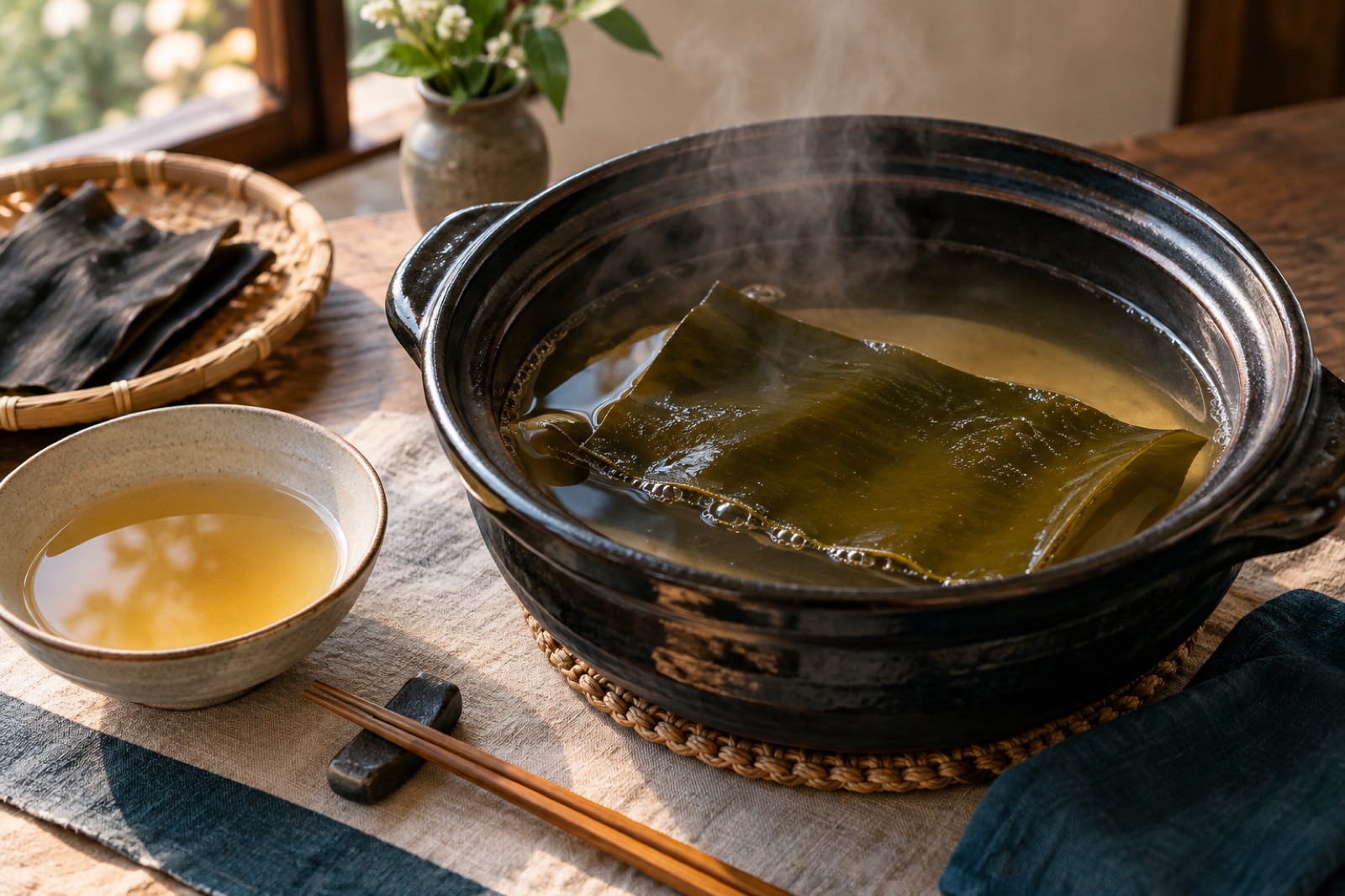
The classic window is a soak followed by a gentle rise to roughly 60°C, where the pot is steaming but quiet, then pulling the kombu out before the water simmers. Cold extraction — a night in the fridge — takes longer but gives a crystal-clear broth with an almost winy clarity. Both work. Boiling works too, technically, in that you get glutamate either way; you just get slime and muddy bitterness beside it. Our kombu dashi masterclass walks through both methods with timings, and if you want the quick version, the five-minute kombu dashi recipe uses the gentle-heat approach.
Kombu is graded much like wine. Two-year-old blades from cold northern waters, dried and sometimes cellar-aged ("kura-gakoi"), develop deeper umami than young first-harvest blades. You don't need premium dashi kombu for everyday cooking — mid-grade kombu makes an excellent stock, and the spent blade can still be eaten (slice it thin for stir-fries or tsukudani). Save the fancy aged stuff for clear soups where the broth is the point.
Here's the part that makes umami science genuinely wonderful rather than just interesting. Glutamate on its own is pleasant. But when glutamate meets certain ribonucleotides — inosinate (IMP) from fish and meat, guanylate (GMP) from dried mushrooms — the perceived umami doesn't add. It multiplies. Combinations can taste several times more savoury than either component alone, because the nucleotides bind alongside glutamate at the receptor and amplify the signal.
This single mechanism quietly explains half the world's great pairings. Kombu (glutamate) meets katsuobushi, smoked skipjack flakes (inosinate) in classic dashi. Kombu meets dried shiitake (guanylate) in the vegan dashi of Japanese temple cooking. Parmesan meets tomato in Italian cooking. Bacon browns beside eggs. Parmesan again meets mushrooms on pasta. Cooks discovered the synergy by taste centuries before anyone named the molecules.
Practical consequence: if a plant-based stock feels thin, you don't need salt — you need the second half of the synergy. A dried shiitake or two in a kombu stock transforms it from "pleasant seaweed water" into something with genuine body, at zero extra cost or effort.
You can use kombu anywhere you'd otherwise reach for stock cubes, MSG, parmesan, or fish sauce. A few high-yield moves:
Different seaweeds bring different flavour compounds, so it's worth knowing the cast: our edible seaweeds field guide maps the flavour character of a dozen species, and the broader science of seaweed umami goes deeper on glutamate levels across species.
The easiest way to internalise this science is to run it. Set out three cups. In the first, soak a 10-centimetre square of kombu in cold water in the fridge overnight. In the second, simmer the same size piece at the barest steam for 20 minutes. In the third, bring a piece to a hard boil for five minutes. Taste them side by side, cooled.
Cup one will taste clear, round, almost sweet. Cup two will taste savoury and full-bodied — the dashi ideal. Cup three will taste strong but slightly slimy in texture, with a brackish edge. Same kombu, same water, three different chemical extractions. You now understand dashi better than most cookbooks explain it.
One more note for the sceptical: none of this is magic or placebo. The tongue's umami receptors are real, the glutamate content is measurable, and the synergy effect has been quantified in sensory science. What's special about kombu is simply that evolution happened to pack a cold-water kelp with the molecule our palates evolved to seek out. When we say the Holdfast nursery program grows kelp matched to site genetics, part of what that heritage carries is flavour — northern kombu strains taste the way they do because cold water slows growth and concentrates character.
Chemically, the active taste compound is the same: glutamate. The difference is context and concentration. In kombu, glutamate arrives alongside sugars, minerals, and amino acids in low concentration, so the flavour reads as rounded rather than intense. Purified MSG is glutamate alone at high concentration. Both are safe for the vast majority of people at normal culinary doses.
Boiling doesn't destroy glutamate — it's a stable molecule. The reason kombu comes out of the pot before a simmer isn't to protect the glutamate, it's to avoid extracting slimy alginates and bitter notes that worsen with heat. For long-cooked applications like beans, the kombu stays in the pot for that reason: slime doesn't show in a bean broth the way it would in a clear soup.
Dried shiitake is rich in guanylate (GMP), one of the nucleotides that synergise with glutamate. Kombu alone provides glutamate; adding shiitake completes the pairing, and the combined stock tastes several times more savoury — enough to stand beside fish-based dashi.
Yes — this is standard practice. The spent blade retains plenty of flavour and all of its fibre. Slice it thinly and simmer it with soy and a little sugar for tsukudani (a rice condiment), add it to stir-fries, or grind it into seasoning powder.
For everyday stocks and bean pots, any reputable mid-grade dashi kombu is ideal. For clear soups where the broth is the centrepiece, look for thick, dark blades labelled as aged or from cold northern waters — they command higher prices for a real reason. Buy from sellers who test and disclose iodine levels; our guide to seaweed nutrition and safe amounts explains why that matters.
Filed under
A deep, technique-first guide to kombu dashi: glutamate science, exact temperatures, ichiban and niban infusions, and how to fix every common mistake.
Sofia Andersson ·
Kombu led chemists to discover umami in 1908. How glutamate, ribonucleotides and salt work together — and how to use seaweed umami in everyday cooking.
Sofia Andersson ·
Learn the main culinary seaweeds — kombu, wakame, nori, dulse and more — what each tastes like, how to buy it, and which pot or pan it belongs in.
Sofia Andersson ·