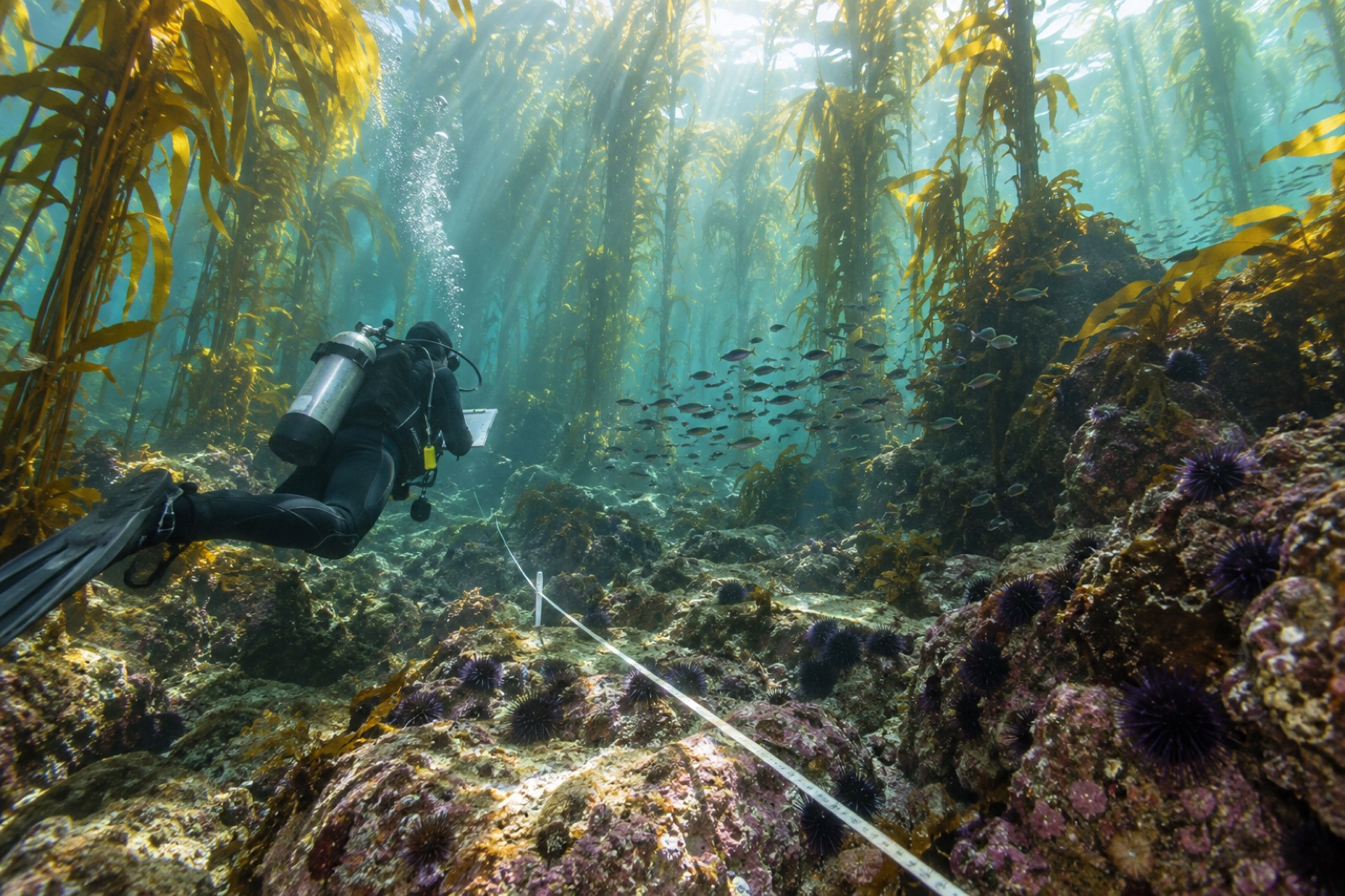
A single litre of seawater, filtered and frozen, contains traces of nearly everything that has passed through it recently — fish, invertebrates, microbes, drifting larvae. Environmental DNA (eDNA) work is the craft of extracting that trace evidence and reading it. It has quietly become one of the most useful tools in marine monitoring, and behind every published eDNA result is a small professional ecosystem of field assistants, lab technicians, molecular biologists and bioinformaticians. This is a guide to the lab side of that ecosystem: who works in it, what they actually do, how to get in, and what the work really feels like. If you're new to the science itself, start with our explainer on how eDNA surveys work.
What eDNA work actually involves
Before the careers, the daily reality. An eDNA workflow has four major stages, and different roles cluster around each:
Field sampling. Someone has to collect the water, swab the surfaces or core the sediment cleanly. Field samplers work from boats, shores and rigs, filtering litres of water through membranes and preserving them under sterile conditions. It is wet, physical, protocol-driven work, and the quality of everything downstream depends on it.
Lab processing. The filtered samples go to a molecular laboratory, where technicians extract DNA, clean it, and amplify target genes using PCR or qPCR. Every step happens under strict contamination control. A single fingerprint cell in the wrong tube can compromise an entire batch.
Sequencing. Amplified DNA is prepared into libraries and sequenced — often on instruments that read hundreds of millions of short genetic fragments in a run.
Bioinformatics and analysis. This is where the data becomes ecology. Analysts clean the raw reads, match them against reference databases, build species lists, quantify relative abundances and turn the output into answers about what lives where.
Most careers specialise in one or two of these stages. A complete eDNA operation — whether a university core lab, an environmental consultancy, or a monitoring programme like Tidewright's Canopy Ledger, which uses eDNA to track biodiversity on restored reefs — runs all four as a continuous pipeline.
The job titles you'll actually see
eDNA doesn't appear as one job; it appears as a family of related roles:
- eDNA field assistant / sampler. Entry point. Boat work, sterile technique, sample logging. Accessible without a degree if you have sea sense and care about protocol.
- Molecular lab technician. Bench work: extraction, PCR, library prep. Typically requires a lab diploma or undergraduate science degree; training on specific platforms happens on the job.
- Environmental DNA analyst / molecular ecologist. Runs the pipeline end-to-end, interprets results, designs assays. Usually a master's or higher in molecular ecology, genetics or marine biology.
- Bioinformatician. Writes the code that turns sequencer output into species lists. The most in-demand and hardest-to-hire role in the whole stack.
- eDNA programme lead. Designs monitoring programmes, manages seasons of sampling, translates results into management or restoration decisions. A senior hybrid of science, logistics and stakeholder work.
Skills that matter
The core stack is more specific than most job ads suggest:
Contamination discipline. In no other marine job does a careless action invalidate weeks of work as reliably. Handling samples, PCR workflow layout, UV sterilisation, negative controls — the best eDNA people are almost obsessive about cleanliness.
Solid molecular technique. Good pipetting, careful reagent handling, understanding what each reaction is actually doing. This takes real bench time; you cannot fake it.
Comfort with data. Even wet-lab technicians increasingly need to understand what happens downstream. Knowing what a sequencer produces and why analysts ask for certain metadata makes you useful at exactly the point where the wet lab and the analysis meet.
Basic coding. For analysis-side roles, R or Python is no longer optional. You do not need to be a software engineer, but you do need to manipulate sequencing data with a language rather than a spreadsheet. For analyst careers this skill matters more than almost any piece of biology knowledge. Data-handling ability is also what connects eDNA work to the broader world of ocean data careers more generally.
Ecological literacy. Translating a species list into something meaningful — "this reef's invertebrate community is recovering" — requires knowing what the species actually are and what their presence implies. Technicians who learn the taxonomy and ecology become exponentially more valuable over time.
Training routes in
Several realistic doors lead into the trade:
The degree path. A degree in marine biology, genetics, molecular biology or ecology is the standard base for analyst and scientist roles. What varies more than people expect is the specialisation: some graduates arrive with serious lab training, others with none — and the ones with bench hours, even from a technician placement year, find themselves immediately more employable.
The technician path. Lab diplomas and technical college qualifications in molecular or biomedical laboratory technique are a direct route into eDNA lab roles. Many such programmes teach better contamination discipline than some undergraduate science degrees do.
The bioinformatics path. People with computing or statistics backgrounds who learn enough biology to be dangerous are in constant demand. There is no requirement that you start in a lab at all.
The field-to-lab crossing. Marine field assistants and survey divers often move into eDNA work by collecting samples for programmes and then learning the downstream stages. Understanding the field powerfully improves how you design and troubleshoot the lab side.
Who hires
The employer landscape is wider than most people assume:
- Universities and research institutes — the historical core. Stable, competitive, often grant-constrained.
- Environmental consultancies — the biggest growing employer. Infrastructure, ports and development projects all now routinely commission eDNA monitoring. High volume, commercial pace, good training in applied practice.
- Government agencies — fisheries departments, environmental regulators, biosecurity agencies.
- NGOs and conservation organisations — monitoring protected areas, tracking target species.
- Restoration and blue-economy companies — the newest employers. Monitoring whether a restored kelp forest is actually becoming a functioning ecosystem requires exactly these skills. Our ocean science hub describes how we use eDNA in practice; restoration in particular has created genuinely interesting senior roles.
The honest reality
eDNA work rewards patience. The first PCR that doesn't fail is an achievement. The first analysis you run that survives external review is a milestone. The discipline this builds — careful, methodical, sceptical of your own outputs — is portable in an unusually wide range of directions, and its scarcity is what makes eDNA specialists steadily employable.
The sensory texture is real too: the distinctive smell of reagents, the quiet rhythm of bench protocol, the first time a species list resolves and suddenly you can see what was living in a patch of ocean you'd never even visited. For people drawn to the intersection of rigorous laboratory skill and the living ocean, it is genuinely one of the more satisfying crafts available.
Key takeaways
- eDNA work spans four stages — field sampling, lab processing, sequencing and analysis — and most careers specialise in one or two.
- Entry routes include science degrees, lab technical diplomas, and computing backgrounds that cross into bioinformatics.
- Essential skills are contamination discipline, solid molecular technique, basic coding, and ecological literacy.
- Employers span universities, consultancies, government, NGOs and an expanding blue-restoration sector.
- The work is patient and protocol-driven; the expertise it builds is scarce, portable and increasingly in demand.
FAQ
Do I need a PhD to work in eDNA?
No. Field assistant and technician-level roles require far less than a doctorate; analysts typically work at master's level on the science side. PhDs matter mainly for programme leadership and academic research roles, which are only one corner of the employment landscape.
How important is coding?
More important than it was five years ago, less replaceable than many people fear. Analysis-side roles genuinely need it; lab-side roles benefit from it. You do not need to be a software engineer, but R or Python at a working level is increasingly a baseline expectation.
Can I move into eDNA from a non-marine background?
Yes — from general molecular lab work, from biomedical diagnostics, from bioinformatics, and even from field ecology in other ecosystems. The core laboratory and analytical skills are largely species-agnostic; the marine-specific layer is taxonomy, ecology and sampling practice.
Is eDNA work mostly remote or mostly on-site?
Strongly on-site. Field sampling is by definition in the field; lab processing is by definition in a laboratory. The most remote-friendly component is the analysis and reporting end, which increasingly supports hybrid working patterns. Structural remote work is rare in the wet-lab portions of the trade.
What's the growth outlook for eDNA careers?
Excellent among marine science careers. Environmental regulation, infrastructure development and restoration monitoring are all expanding their use of eDNA worldwide, and the demand for competent people continues to outpace supply — particularly for hybrid profiles that can operate across multiple stages of the pipeline.