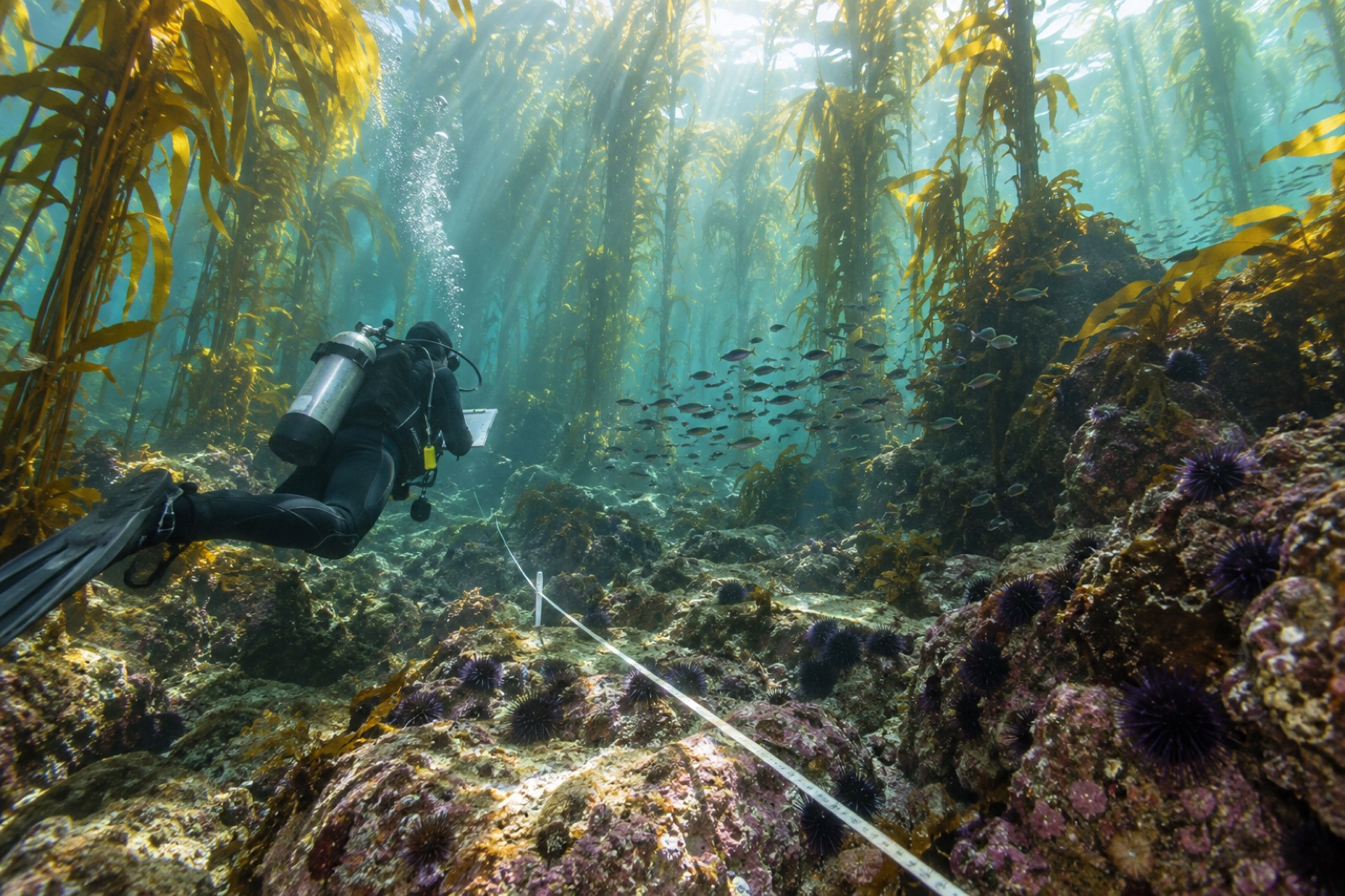
Someone has to swim the transect. Every credible report about the state of a kelp forest — canopy cover, urchin density, fish biomass, settlement rates — ultimately rests on data a diver gathered with a tape, a slate and a camera, metre by metre, in cold water. Ecological survey diving is a genuine occupation: irregular, competitive, physically real, and more in demand now than at any point in the last two decades as governments, consultancies and restoration programmes multiply their monitoring commitments. This article is about the paid market for that work — who hires, what the jobs look like, and how to break in. For the training and certification pathway, our companion guide on becoming a scientific diver covers the ticket ladder in detail.
What survey diving is — and isn't
Survey diving is data collection underwater. The typical toolkit is a 50-metre transect tape, quadrats, slates, sometimes cameras, sometimes eDNA bottles or settlement plates. The diver swims the tape, counts what's in the quadrats, notes species, records sizes, photographs the substrate and returns to the surface with numbers that will end up in a report.
It is distinct from the two careers people commonly confuse it with:
- Recreational diving work — instructing, guiding tourists — is hospitality underwater. Survey diving is fieldwork underwater; the client is a dataset.
- Commercial diving — construction, welding, inspection — is a trade diving pathway with its own certifications, pay scales and risks. Survey divers occasionally overlap with inspection work, but the day-to-day craft is ecological measurement, not engineering.
What defines the job is repeatability. A good survey diver can do the same transect protocol the same way a hundred times, because comparability across sites and years is the entire point of long-term monitoring. As our piece on the value of long-term reef records explains, a dataset only earns its keep when methods stay constant.
Who employs survey divers
The employer map is broader than most newcomers expect:
Government agencies. Fisheries departments, parks services and environmental regulators run recurring monitoring programmes: reef health networks, marine park condition assessments, abalone and urchin stock surveys. Positions range from permanent monitoring-team roles to seasonal contract crews.
Environmental consultancies. Ports, coastal developments, pipelines and wind farms all require baseline ecological surveys before construction and compliance monitoring after it. Consultancies buy that diving capacity — often at day rates — and it is the largest single pool of paid survey work in many regions.
Universities and research institutes. Project-based fieldwork hired per grant: a season of kelp forest surveys, a restoration experiment's monitoring dives. Excellent experience, notoriously intermittent.
NGOs and conservation groups. Reef monitoring programmes, protected-area assessments, invasive species tracking. Usually a mix of salaried science roles that include diving and contracted survey teams.
Restoration companies. The newest employer class. Tidewright's monitoring crews survey reefs before, during and after restoration — canopy mapping, biodiversity counts and verification surveys that feed the Canopy Ledger platform. Restoration monitoring is growing faster than any other source of survey-dive demand.
Fisheries co-ops and industry bodies. urchin roe fisheries, abalone guilds and aquaculture associations commission stock assessments and habitat surveys.
What the work actually looks like
A survey diver's year is typically a patchwork:
- Intense field seasons. Monitoring is seasonal by biology and weather. Expect concentrated blocks of 10–20 dive days in the months when conditions and protocols align, with logistics-heavy days around them.
- Protocol, not exploration. You will dive the same reef the same way repeatedly. The romance fades quickly for some people and deepens into craft satisfaction for others — the pleasure becomes precision, and watching a place change year by year.
- Surface intervals of admin. Photos to process, datasheets to QC, gear to maintain. Roughly half of a survey job happens out of the water; divers who are good at the data side are disproportionately hirable.
- Travel and teamwork. Work follows the reefs. Small teams, shared housing, weather days spent maintaining kit and sorting samples. If you enjoy expedition logistics as much as the diving itself, this is home.
Pay and conditions, honestly
The honest pattern: survey diving sits in the middle of the marine pay spectrum — better than entry-level ecotourism, below senior consultancy science, and far below hard-hat commercial diving. The drivers of pay:
- Day rates for contract divers are the norm in consultancy work and rise meaningfully with region, water conditions (cold, low-viz and surge all command premiums) and protocol specialisation.
- Salaried roles in agencies and restoration companies offer stability and benefits at slightly lower cash equivalents; these are the roles that support mortgages and families long-term.
- Multi-skill premiums are large. A survey diver who also operates a boat, runs eDNA sampling protocols, flies a survey drone or writes the reports earns noticeably more than a diver who only dives.
The financial reality most career guides skip: income is often seasonal and stacked. Many working survey divers combine contract monitoring seasons with instruction work, boat crewing or lab work in the off-season. Plan for the patchwork and it is a viable middle-income life; plan for a single salaried income straight away and you may wait years for the right opening.
How to break in
The path is more demystified than the romance suggests:
- Get the tickets. Occupational or scientific diving certification appropriate to your country, plus advanced recreational quals, rescue training, first aid with oxygen, and a boating licence. The full ladder is laid out in the scientific diver pathway article.
- Build logged, verifiable experience. Surveys live or die on protocol competence. Volunteer with citizen-science reef surveys, university field programmes and NGO monitoring — these teach actual transect methods and give you referees who can vouch for your data quality.
- Learn the non-diving halves. Species ID, particularly temperate-reef fish, invertebrates and seaweeds; data management in R or even disciplined spreadsheets; photo processing pipelines. These are the skills that get you re-hired.
- Make yourself logistical. Boat licences, trailer handling, compressor maintenance, gear repair. Small teams hire the diver who also fixes things.
- Network through the monitoring community. Survey work is hired by reputation more than by job boards. Agency monitoring leads and consultancy dive coordinators know each other; one good season spreads your name.
If you are coming from outside marine science entirely, our guide to ocean careers without a degree maps how survey diving fits into the wider landscape of accessible sea work.
Where it leads
Survey diving is usually a career leg rather than a career summit, and that's healthy: it feeds into monitoring programme management, consultancy scientist roles, marine park management, restoration project leadership, and (for the data-minded) ocean data science. The divers who stay in the water longest are typically those who own a protocol expertise — the person you call for temperate fish counts, for urchin surveys, for settlement plate networks — and there is real professional satisfaction in becoming the reference diver for a method and a coast.
At Tidewright, survey divers are the ground truth beneath our satellites: every canopy map and biodiversity credit is anchored in verification transects run by human beings on the reef. Monitoring roles, including dive-qualified positions, appear on our careers page across project regions.
Key takeaways
- Survey diving is paid ecological data collection underwater — distinct from both dive tourism and commercial trade diving.
- Employers span government monitoring programmes, environmental consultancies, universities, NGOs, fisheries and the fast-growing restoration sector.
- The work is protocol-driven and seasonal: repeated transects, weather windows, and roughly equal parts diving and data/admin.
- Pay follows day rates, multi-skill premiums and seasonal stacking; it is a viable middle-income patchwork if planned honestly.
- Breaking in requires the right tickets, volunteer protocol experience, species ID and data skills, and reputation within the monitoring community.
- It is usually a career leg that leads into programme management, consultancy science or restoration leadership.
FAQ
Do I need a marine biology degree to get survey diving work?
Helpful but not always essential. Agencies and universities commonly require a science degree for salaried scientist-diver roles, but contract survey diving is hired on tickets, logged experience, protocol competence and species ID skill — all achievable without a degree. Many working survey divers built their credentials through citizen-science and NGO programmes.
How competitive is it?
Genuinely competitive at entry and surprisingly open at competence. There are far more certified divers than there are reliable, protocol-tight, data-literate survey divers, which is why the volunteer-to-contract ladder works: it converts unknown applicants into known quantities.
How many dives a year does a working survey diver actually do?
Highly variable — anywhere from 30 to 150 working dives a year depending on the employer and season mix, spread over concentrated field blocks. Surface and shore work (data, logistics, gear) typically occupies as much or more time than the diving itself.
Is survey diving dangerous?
It is occupational diving, with occupational risk, managed by strict procedures: dive plans, buddy protocols, surface support, limits on depth and exposure. Cold water, surge and low visibility are the everyday challenges. Fatality rates in properly run scientific and consultancy diving programmes are low, but the discipline is non-negotiable and a core part of the training.
Can survey diving be a whole career?
Yes, though most long careers widen over time: the 45-year-old version of a survey diver usually leads programmes, manages data, mentors teams and still dives chosen transects rather than swimming every line. The divers who treat the early years as apprenticeship in monitoring — not just as time underwater — are the ones still happily in the sector decades later.