The ocean is not silent. Beneath the surface, it runs a constant audio broadcast: snapping-shrimp static on the reefs, whale song carrying across basins, fish choruses at dusk, the groan of ice and the constant, growing low-frequency rumble of ships. Ocean sound analysts are the people who listen to that broadcast professionally — deploying hydrophones, building the software that finds a fin whale's call in ten thousand hours of noise, and turning what the sea sounds like into measurements of whether it is healthy, who lives there, and what we're doing to it. Bioacoustics has quietly become one of the fastest-growing and most interdisciplinary careers in ocean science. Here's the landscape.
What the ocean sounds like to an analyst
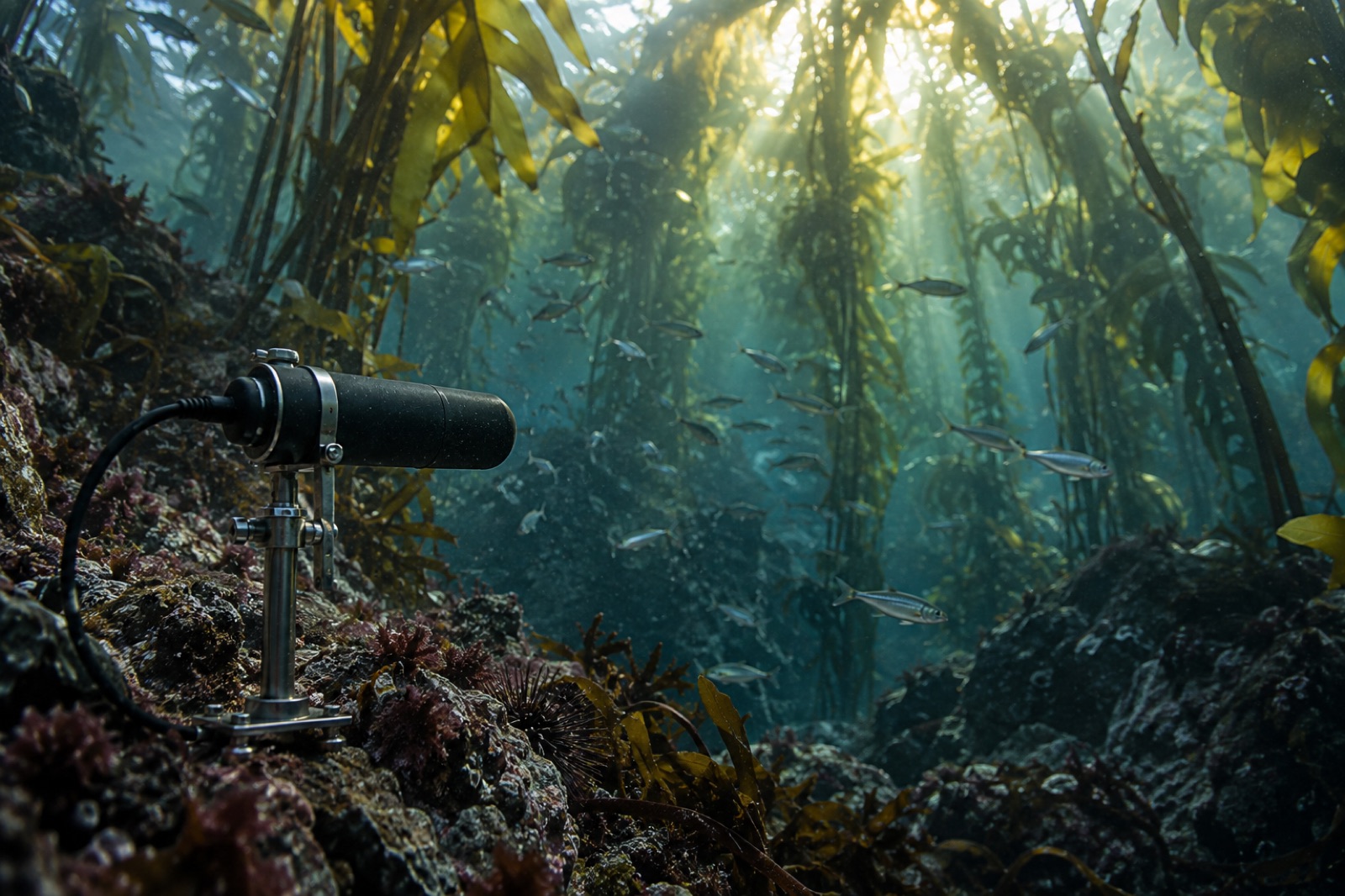
The raw material is three overlapping soundscapes, which bioacoustics people call the geophony, biophony and anthrophony — physical, biological and human-made sound. A healthy reef snaps and crackles with shrimp and grazing fish; a degraded one is eerily quiet, and that silence is measurable. The animals of a kelp forest have their own seasonal audio signatures; elsewhere the field is staggering: blue whale songs identifiable to population, fish spawning aggregations audible from kilometres, the biophonic weather that larval fish apparently use to navigate home. Our explainer on the ocean soundscape covers the science of why all this matters; the job is measuring it, hour after terabyte-hour.
Three problem types generate most of the work:
- Detection. Is a species present? Where, and when? This is passive acoustic monitoring (PAM) — the field's bread and butter, used for whales on shipping lanes, fish on reefs, and the back-of-the-envelope biodiversity audit of a restoration site.
- Characterisation. What does this habitat sound like, and how is its soundscape changing? Reef soundscape health is now a serious monitoring discipline, with the crackle of a reef being read as a vital sign.
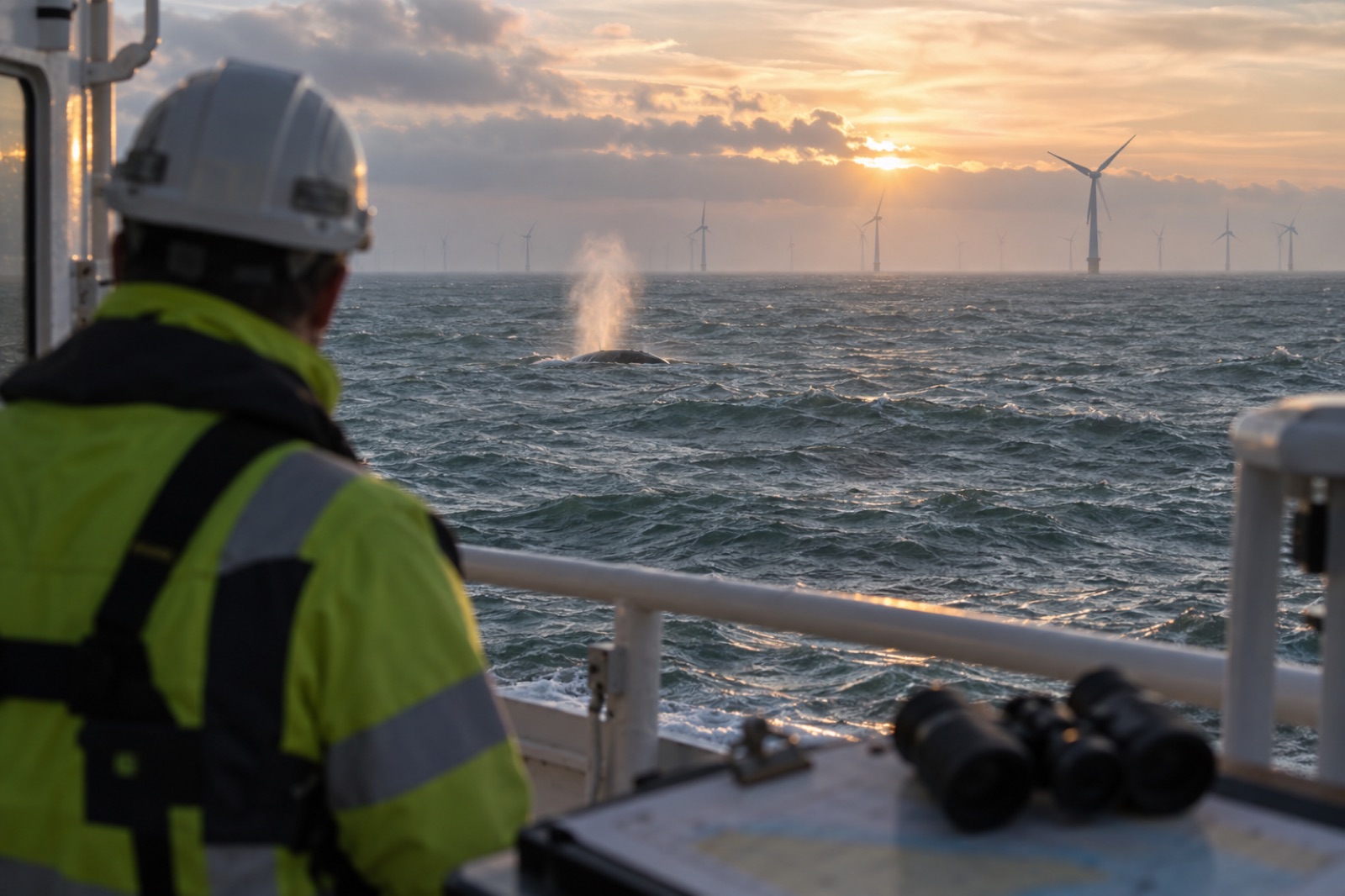
- Impact. What are the human sounds doing? Pile-driving, seismic surveys, shipping — regulators increasingly require acoustic impact monitoring, and someone must measure, model and report it.
The craft is part field engineering, part data science. Field work means deploying and recovering hydrophone moorings, calibrating recorders, and designing sampling schedules that capture a season's chorus rather than a day's weather. The lab work — really, the desk work — is most of the hours: spectrograms, annotation, statistical acoustics, and increasingly the supervised machine learning that can find a dolphin whistle in a week of boat noise faster than any human ear. An analyst working in 2026 who cannot at least collaborate comfortably with ML tooling is increasingly limited; one who can train, validate and — critically — acknowledge the error bars on a classifier is employable anywhere.
The essential discipline underneath everything: every detector has false-positive rates, every recording has context, and the difference between a professional deliverable and a pretty spectrogram is the metadata and the uncertainty. The kelp forest soundscape work being done on restoration sites is a perfect example — the finding isn't "the forest crackles," it's "the biophony index recovered to within site-pair reference levels across three monitoring years," said with a confidence interval.
A day in the job
Mornings often start with the queue: yesterday's automated detections needing review, a mooring battery alarm on a deployment, a regulator's question about last quarter's pile-driving logs. There are long stretches of deeply focused listening and spectrogram work — this job rewards people who find pattern-recognition meditative — punctuated by field campaigns where the desk skills convert to moorings, GPS positions and cold fingers. The mid-career analyst's week is a mix of analysis, reporting for clients or regulators, methods development, and increasingly, training and validating AI models that pre-screen the data. The senior role adds study design: what array, what duty cycle, what question can this configuration actually answer?
The demand map surprises people:
- Offshore wind and marine development — currently the largest growth area, driven by regulatory requirements to monitor construction noise and protected species. Consulting firms and developers hire PAM analysts in growing numbers.
- Government and navy — fisheries acoustics, marine park monitoring, and defence acoustic research (the latter a separate career world with its own culture and often excellent training).
- Research institutes — soundscape ecology, whale population monitoring, and the long acoustic time-series programs.
- Conservation NGOs and monitoring companies — the emerging space, running acoustic programs for protected-area management, restoration verification (does a restored forest sound restored?), and biodiversity credit monitoring. Restoration outfits with sensor programs — our fictional Tidewright's canopy-monitoring program is a fair model — increasingly need sound analysts on staff.
- Tech — passive-acoustic hardware and AI-detection startups are hiring analysts who understand both the ocean and the model.
The work crosses into data science constantly; our guide to ocean data science careers covers the technical sister-discipline, and many analysts straddle both.
Training routes and portfolio
Entry is genuinely interdisciplinary. Workable foundations:
- Physics, engineering or acoustics degrees give you the signal processing and instrumentation.
- Marine biology or ecology gives you the animals and the questions — pair with a serious effort to learn coding and stats, as biological acoustics programs differ wildly in how quantitative they are.
- Data science or ML gives you the detection tooling; you then must learn ocean biology and field methods.
A postgraduate degree (master's or PhD) remains common for research-facing roles, but the industry is hiring people with bachelor's-plus-portfolio for analyst positions faster than academia produces them. A strong portfolio in this field is concrete: a public detection model or annotated dataset contribution, a soundscape analysis of open acoustic data, code on a public repository, a field deployment you can describe in detail. Unlike some ocean careers, the materials to build a striking portfolio are largely free — public acoustic archives exist and are under-analysed, waiting for someone curious.
Pay, progression and the honest outlook
Pay starts at analyst level — junior consulting or research-technician territory — and climbs steeply for those who combine field, analysis and client-facing competence, because that combination is genuinely rare. Senior consultants, data science leads and research scientists in this space earn solid mid-career incomes; the offshore-wind monitoring sector has been bidding up people with PAM and ML skills. The career's shape rewards T-shaped people: deep in acoustics-ML, broad across marine biology and field operations. The outlook is strong and structural — the ocean keeps getting louder, regulation keeps tightening, monitoring platforms keep scaling, and the sea still needs people who can hear what it's saying. Most of the field's pioneers built the tools they now use; there's still room, perhaps more than in any other ocean discipline, to do the same.
Key takeaways
- Ocean sound analysis blends field engineering, data science and marine biology; the work is mostly the desk-half.
- The three problem types are detection (is a species present?), characterisation (what does this habitat sound like?) and impact (what is human noise doing?).
- Offshore wind and marine development monitoring is the biggest current employer; research, government, conservation and tech are close behind.
- Entry is interdisciplinary — physics, biology or data science all work — and a public portfolio of detection code or soundscape analyses goes further than you'd expect.
- Machine learning is now core to the craft; the rarest, most hireable people combine ML, acoustics and genuine marine field competence.
FAQ
Do I need a PhD to work in bioacoustics?
Not for most industry analyst roles — offshore-wind monitoring and consulting hire heavily at bachelor's and master's level, especially for people with strong coding. Research careers still favour the PhD. A master's with a substantial acoustics thesis is a strong middle path.
Is the field ruined by AI doing the listening?
The opposite — AI handles the screening, but analysts design, validate and interpret the detectors. The role is shifting from ear-on-spectrogram to model-wrangler and uncertainty-teller, which is more skilled, not less. People who can say "the detector misses quiet calls in rain noise, so our absence data is conditional" are more valuable than ever.
What's the work-life reality?
A split life: intense but bounded field campaigns, then long, flexible desk stretches. Consulting work has client deadlines and seasonal peaks (driven by construction windows); research and monitoring-platform roles are steadier. Remote work is genuinely possible for the analysis half, unusual among ocean careers.
Is this mostly whale research?
The whale corner gets the press, but most paid work is environmental monitoring: construction noise, fish acoustics, reef soundscape health, shipping-impact studies. Whale PAM is a sector within it, not the whole. The coral and kelp soundscape monitoring work is currently among the fastest-growing.
Where do I start this year, concretely?
Pick up an open acoustic dataset (public archives of marine recordings exist), teach yourself spectrogram analysis with free tooling, complete one analysis end-to-end and write it up publicly. Then take one field opportunity — any hydrophone deployment. The combination of finished public analysis plus field exposure is the two-legged stool every hiring manager is looking for.
Tidewright is a fictional company; the career landscape described reflects the real, growing discipline of ocean acoustics and bioacoustics.