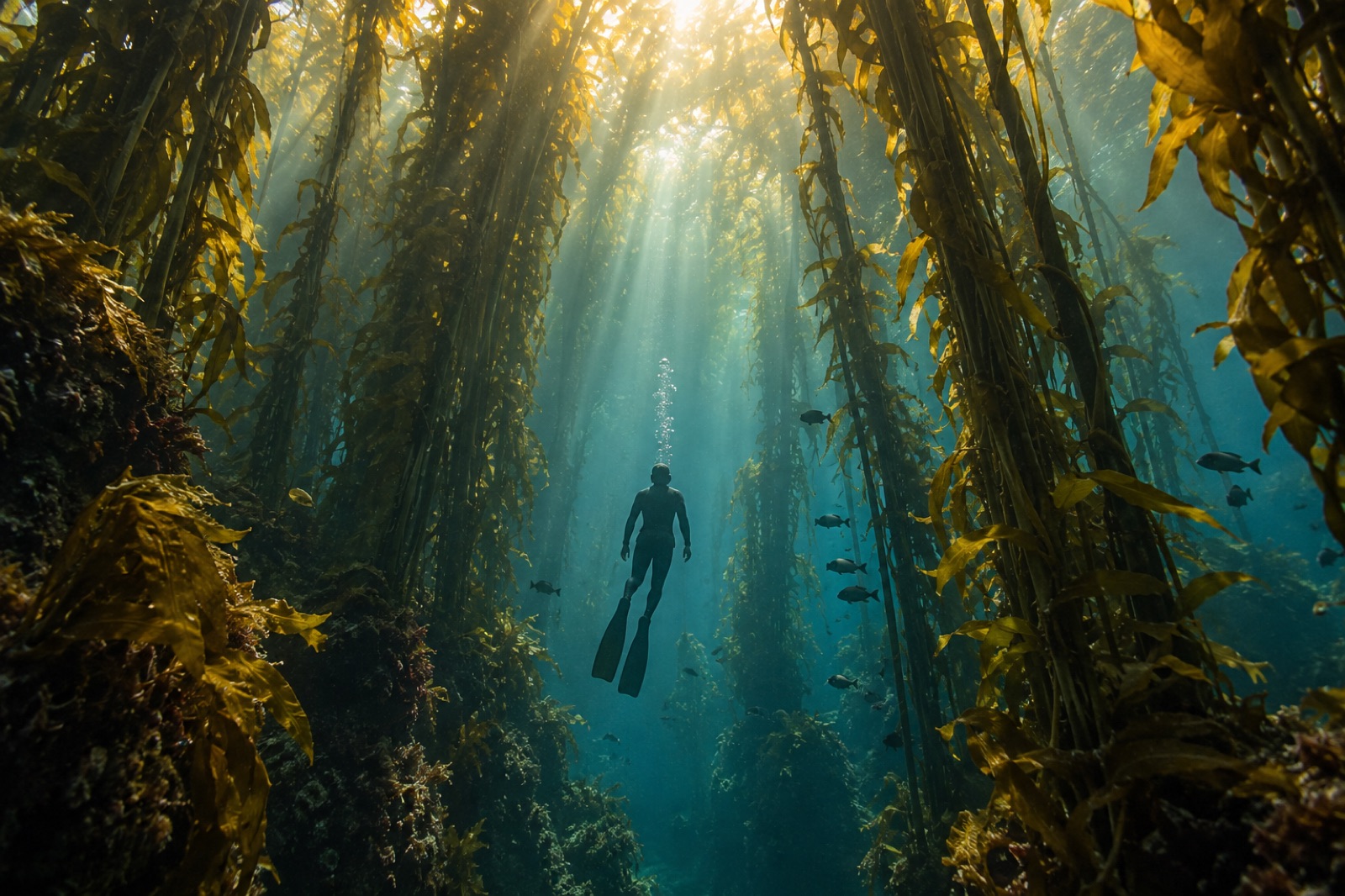
There is a moment in every freediver's development when the pool stops teaching. Static tables and line sessions in blue, blank water build numbers; they don't build the judgment that actual ocean diving demands. Kelp-forest water — green light, living structure, thermoclines you can feel through the suit — is where technique goes to grow up. This guide covers the logistics most articles skip: how to set up line training beside a living forest without harming it, how cold water rewrites your depth training, and the etiquette that lets a training habit coexist with a habitat. (the etiquette side — moving through the forest itself as a considerate diver — belongs to our freediving in kelp piece; here it's all about the rig.)
Why train in forest water at all
Open-water kelp sites offer three things a pool never will:
- Realistic stimulus. Cold, mild current, variable visibility and an actual thermocline expose the gaps in your relaxation and equalisation before a deep line in a quarry does.
- Natural depth markers. Kelp gives you a vertical reference — canopy, mid-water, reef — and sideways awareness. Divers who learned in bottomless water are often unnerved by structure; divers raised in a forest treat it as home territory.
- A reason to stay slow. Forest surrounds enforce the training mindset you actually want: unhurried, observational, conservation-aware. A dive site with a garibaldi under it is harder to treat as a gym.
Setting up a training line without hurting the reef
The keystone rule: the forest is the venue, not the anchor.
- Rig over sand, beside the reef, not on it. Most kelp beds fringe a sandy channel or sand-flat edge. Your bottom weight belongs on sand — never lowered into the forest, where it lands on holdfasts, abalone and the invertebrate carpet a weight will crush.
- Hang a floating line. Rig the training line from a surface float or kayak, weighted so it holds station above the bottom, with no ground tackle at all where depth allows. Drift-rigged lines from a small boat are the low-impact standard on reef coasts.
- Mind the swing circle. A line on a drifting rig sweeps an arc. Scout the swing path before the first dive: if the boat drifts across the canopy, your weighted line drags across it too.
- Kit check against snags. Streamlined everything: no dangling clips, no loose lanyard tails, no glove-snagging Velcro open. What catches kelp catches kelp — and the fix is before you splash.
- One rig, many divers. A single shared line serving a rotation of buddy pairs concentrates all the footprint into one narrow column of water. More rigs don't add capacity; they add impact.
Training with a line also means knowing the freediving safety fundamentals cold — one up, one down; never alone; a trained safety as soon as depths mean it. Kelp water doesn't change the protocol; it raises the cost of skipping it.
Cold water rewrites the training curve
Temperate kelp coasts sit at 8–18 °C, and the physics of a thick wetsuit changes depth training in ways tropical divers never meet:
- Buoyancy collapses with depth. A 7mm suit that floats you luxuriously at the surface compresses by five metres, then again below the thermocline. Freefall starts shallower than your tropical instincts expect, and the ascent under you is more work than it looks. Weight for the deepest point of the dive to remain comfortably positive near the surface — and accept slightly negative at the turn, with margins to match.
- Equalisation arrives sooner than expected. Cold, hooded heads and green water change relaxation; many divers find their Frenzel equalisation limit arrives shallower in winter water. The fix is patience, not force — never muscle past a beep or a squeeze.
- Cold shortens everything. Breath-holds shrink, recovery lengthens, and judgement fades before the body complains. Build sessions short and bright: 45 focused minutes beats a two-hour endurance exercise in 12-degree water.
Lanyards, leashes and the kelp question
A lanyard — the short leash from wrist to line — is standard line-training safety kit. Kelp asks two extra questions of it:
- Keep it short and stiff. Long, floppy lanyards wander off the line and into fronds. A short lanyard on a quality carabiner, kept against the line axis, rarely kisses the canopy.
- Practise the release one-handed. More important than entanglement prevention is the drilled reflex: reaching across, cracking the carabiner, and coming clear — in cold hands, in the dark. Practise it on the surface every session until the motion is boring.
And one forest nuance: kelp itself will occasionally wrap a fin or hood-strap in a swell. The protocol is the one experience teaches — stop moving, find the blade by hand, and slide it off the way it arrived. Panicked scissor-kicking turns a drape into a tangle; a calm hand turns a tangle into a story.
Reading the forest as training terrain
Once the line is set and the drills are running, the forest supplies free coaching:
- Thermocline as a freefall marker. The visible shimmer of the cline — often near your target depth in summer — is better than any watch beep for teaching body awareness of depth.
- Light as a session clock. The angle of green light through the canopy tells you session time and direction home in a way blue water never does.
- Structure as calm. Divers anxious in open water settle near a reef edge; divers bored on a featureless line engage here. Use it: the forest rewards the slow, observant diving style that good depth training is.
Etiquette that keeps sites open
Kelp-forest training sites get closed by behaviour, not by regulation. The behaviours that matter: brief the site owner or local divers before rigging; keep groups small (four divers per float is already a crowd); give the reef's recreational users — snorkellers, photographers, fish-watchers — priority of space; never train over resting wildlife; take the day's monofilament and kelp scraps out with you — and the big one: a training day should end with the reef looking exactly as it began. A site that stays open is a site whose neighbours never noticed you.
A realistic season plan
For a temperate-coast freediver, a sane kelp-water progression looks like this:
- Spring: comfort sessions — shallow hangs beside the reef, cold acclimatisation, no targets.
- Early summer: line sessions over sand at forest edge, depth goals in single-metre steps, freefall practice through the thermocline.
- Late summer (warmest, clearest water): peak training — the season's personal bests, if they're coming, come now.
- Autumn and winter: maintenance volume at 70% depth, skills over numbers — releases, rescues, slow no-fins laps below the canopy.
The forest sets this calendar as much as your willpower does; diving with its seasons rather than against them is half the skill.
Key takeaways
- Train on lines rigged over sand or free-hung from floats — never anchored into the reef, and always with the swing path scouted before the first dive.
- Cold water changes the physics: wetsuit buoyancy collapses with depth, equalisation and breath-hold both tighten, and sessions should shorten to match.
- Keep lanyards short and streamlined, and drill the one-handed release until it's reflex.
- Let the forest coach: thermoclines mark freefall, canopy light tracks time, and structure rewards the relaxed diving style you're trying to build.
- Sites stay open through behaviour: small groups, reef-first etiquette, and leaving nothing behind but bubbles.
FAQ
Should I anchor my training line to the reef for stability?
No. Bottom weights belong on bare sand, or the line hangs weighted from your float with no bottom tackle at all. Anchoring into a kelp bed crushes holdfasts and invertebrate life and drags across the canopy with every drift — and it's exactly the kind of impact that gets training groups banned from sites.
How thick a wetsuit do I need for kelp-coast freediving?
Most temperate-coast freedivers run a 5–7 mm open-cell suit with hood, gloves and boots for all but the warmest weeks. The choice matters for training: suit compression at depth drives your buoyancy profile, so weight yourself for the full dive profile, not just the surface.
Is a lanyard safe to use around kelp?
Yes, with discipline. Keep it short, keep it tight to the line, streamline everything dangly, and drill your release one-handed in cold gloves until it's automatic. Kelp contact is occasional; your response to it is what matters — stop, find the blade, slide it off calmly.
Can't I just do all my depth training in a quarry or cenote instead?
You can — many excellent freedivers come from blue-water quarries and lakes. Kelp water adds what they can't: cold adaptation, current and visibility variability, thermocline freefall, and structure-orientation skills. It's the difference between training for a number and training for the ocean.
Do I need permission to run a line near a kelp forest?
Often, yes — marine protected areas, harbour rules and local regulations can all govern lines and floats, and socially you should always clear it with the locals who dive the site. Legality gets you in the water; a good reputation with the people who love the reef keeps you welcome.