Explore9 min read
Freediving Safety Basics: The Buddy Rules That Save Lives
Freediving is beautiful and quietly unforgiving. The core safety rules — one up, one down, never hyperventilate, know blackout — with the science behind each.
Tom Okafor ·
Your first kelp freedive, done right: breath-hold fundamentals, the buddy rules you never break, choosing a calm beginner site, and what the first session feels like.
Somewhere between snorkelling and scuba sits the quietest way to enter a kelp forest: on one breath. No bubbles, no tanks — just you, a duck dive, and thirty or forty seconds among the stipes before you glide back up through the light. Freediving is also unforgiving of exactly one kind of mistake, which is why this guide exists: to walk you through a first kelp freedive in a way that starts shallow, stays short, and never bends the two or three rules that actually save lives. Read it, then read the full freediving safety fundamentals before you get wet — this article deliberately stays at "first day" depth and doesn't attempt to be a course.
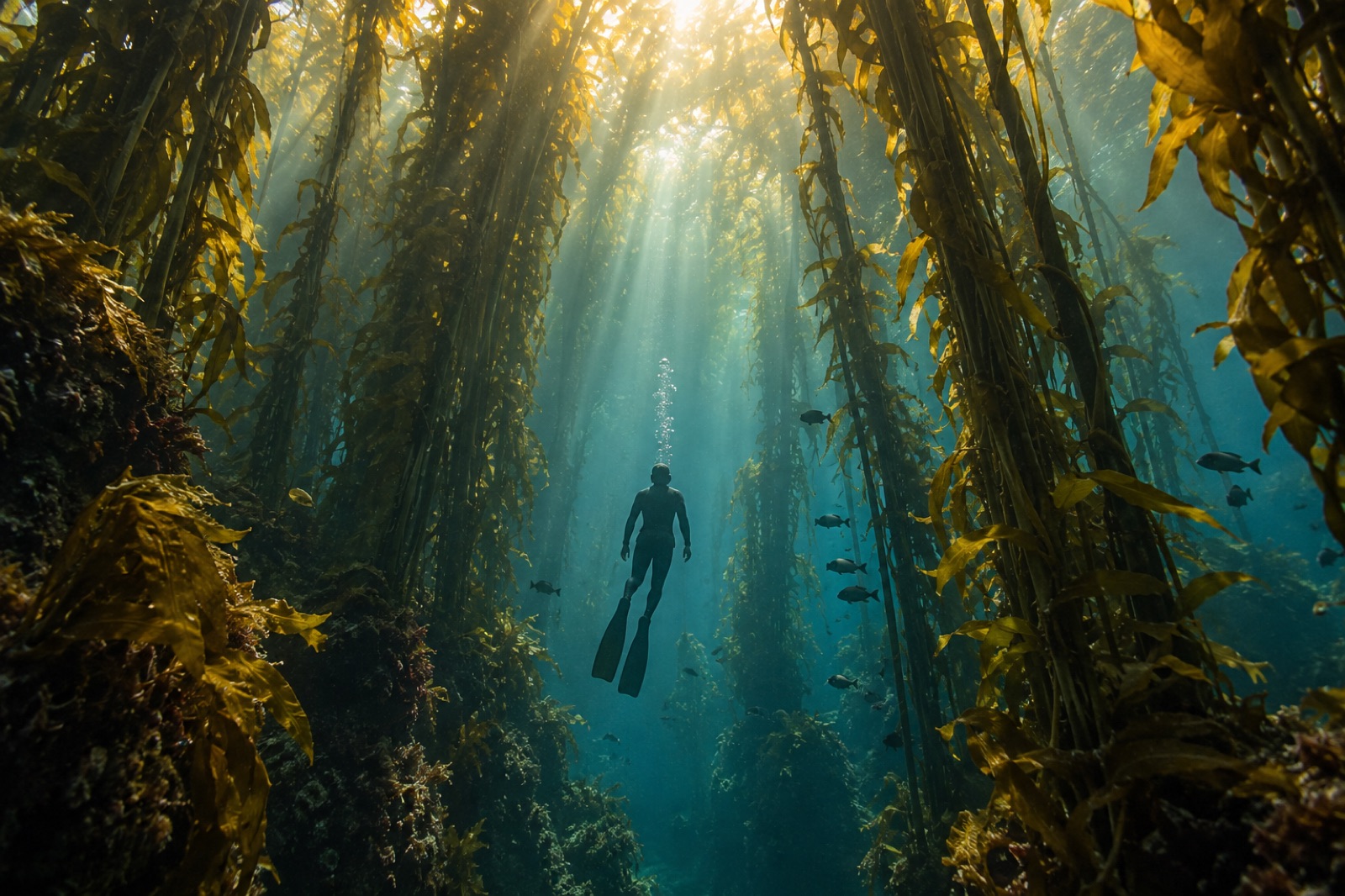
Forget the training videos of 30-metre lines for now. A first forest freedive is this: floating on the surface over three to five metres of clear, calm water above a rocky reef, taking one full breath, duck-diving down to hang among the kelp holdfasts for twenty relaxed seconds, and coming back up smiling. Depth is not the goal — time spent relaxed in the forest is the goal. Kelp rewards this: the most animal-dense, light-filled zone of most forests is the top ten metres anyway. The canopy is where the forest lives; you never needed to go deep.
Your breath-hold is mostly about relaxation and carbon-dioxide tolerance, not lung size. The essentials for a beginner:
The equalisation skill makes or breaks a comfortable first day; if your ears won't clear easily at three metres, read up and practise Frenzel basics gently, on the surface first. Never force a descent against ear pain.
Freediving's one genuinely fatal failure mode is a shallow-water blackout: a sudden, silent loss of consciousness close to the surface, usually on ascent or just after. It gives almost no warning, and it happens to fit, experienced people. The entire sport has organised itself around it:
These are summarised here for completeness; the safety article carries the full protocol and deserves a slow read.
The right first site is boring on paper and beautiful underwater:
Cold water is the kelp forest's price of admission, and it shapes the day: a proper hooded wetsuit, gloves and boots extend your comfortable session from minutes to an hour and turn shivering (which torches breath-holds) into stillness. The kit list in cold-water snorkelling gear is exactly the beginner freedive kit; add long freediving fins only once the wetsuit hours are banked.
The first ten minutes are busyness: leaking mask, cold lip, fumbling equalisation. Then, somewhere around the fifth duck dive, it quiets. You hang at three metres while a school of baitfish turns above you like weather; light comes down through the canopy in shafts and moves across your arms; a kelp blade brushes your shoulder and it's fine. Your bottom time on that first day might be fifteen seconds, and it will feel like a minute. This is the correct experience. People who push past comfort on day one usually end the session early, cold and rattled, and the forest loses a friend. People who stay inside comfort end the session planning the next one.
Weeks one to four: same sheltered site, same buddy, diving relaxed three-to-five-metre hangs. You are training comfort, not depth. After that: gradually longer breath-ups, slightly deeper hangs — always with margin — and maybe a freediving fundamentals course with a certified instructor, which compresses into two days what trial-and-error teaches in a year, including blackout recognition and rescue. Depth competitions with yourself have no place in the forest. The kelp is not going anywhere.
One breath makes you a quiet animal — use that privilege gently: never grab kelp for stability (hold nothing, or a bare rock), don't chase animals for a look, keep fins off the reef, and give resting wildlife the range explained in our kelp wildlife ethics piece. A freediver moving slowly through a kelp forest is about as close as a human gets to belonging there; the trick is to keep earning it.
Much less than you think. Twenty to thirty seconds of relaxed breath-hold is enough for a wonderful shallow dive — most healthy people reach that comfortably within their first sessions without any special training. Relaxation and short dives beat long ones every time.
It carries one serious risk — shallow-water blackout — which is why the buddy rules are absolute. Diving shallow, never hyperventilating, always surfacing with margin, and never diving alone keeps the sport's risk profile low. Kelp itself is not a hazard at recreational depths; you drift through blades, and entanglement panic comes only from grabbing and thrashing.
Not for shallow, relaxed dives with an experienced buddy in benign conditions — but a fundamentals course is the single best investment you can make early. It teaches blackout physiology, rescue and efficient technique in two days, and it will permanently raise both your safety and your enjoyment.
Snorkelling keeps you at the surface, watching down. Freediving adds breath-hold descents into the forest itself — eye-level with the fish, inside the light shafts. Everything else (site choice, weather, warm gear, buddy sense) overlaps almost completely, which is why confident snorkellers are the natural candidates.
At shallow recreational depths, no — kelp parts around a relaxed, slow-moving diver. The rules are simple: don't dive with loose dangling gear, don't grab stipes, move slowly, and if a blade drapes across you, slide it clear with a flat hand rather than yanking. Panic causes entanglement; kelp doesn't.
Freediving is beautiful and quietly unforgiving. The core safety rules — one up, one down, never hyperventilate, know blackout — with the science behind each.
Tom Okafor ·
Learn how to equalize your ears for freediving and snorkelling: Valsalva vs Frenzel, common mistakes, daily drills and when to call a dive short.
Tom Okafor ·
Cold-water snorkelling rewards the prepared. How to choose wetsuit thickness, hoods, gloves, boots, masks, snorkels and fins for water below 18 °C.
Tom Okafor ·