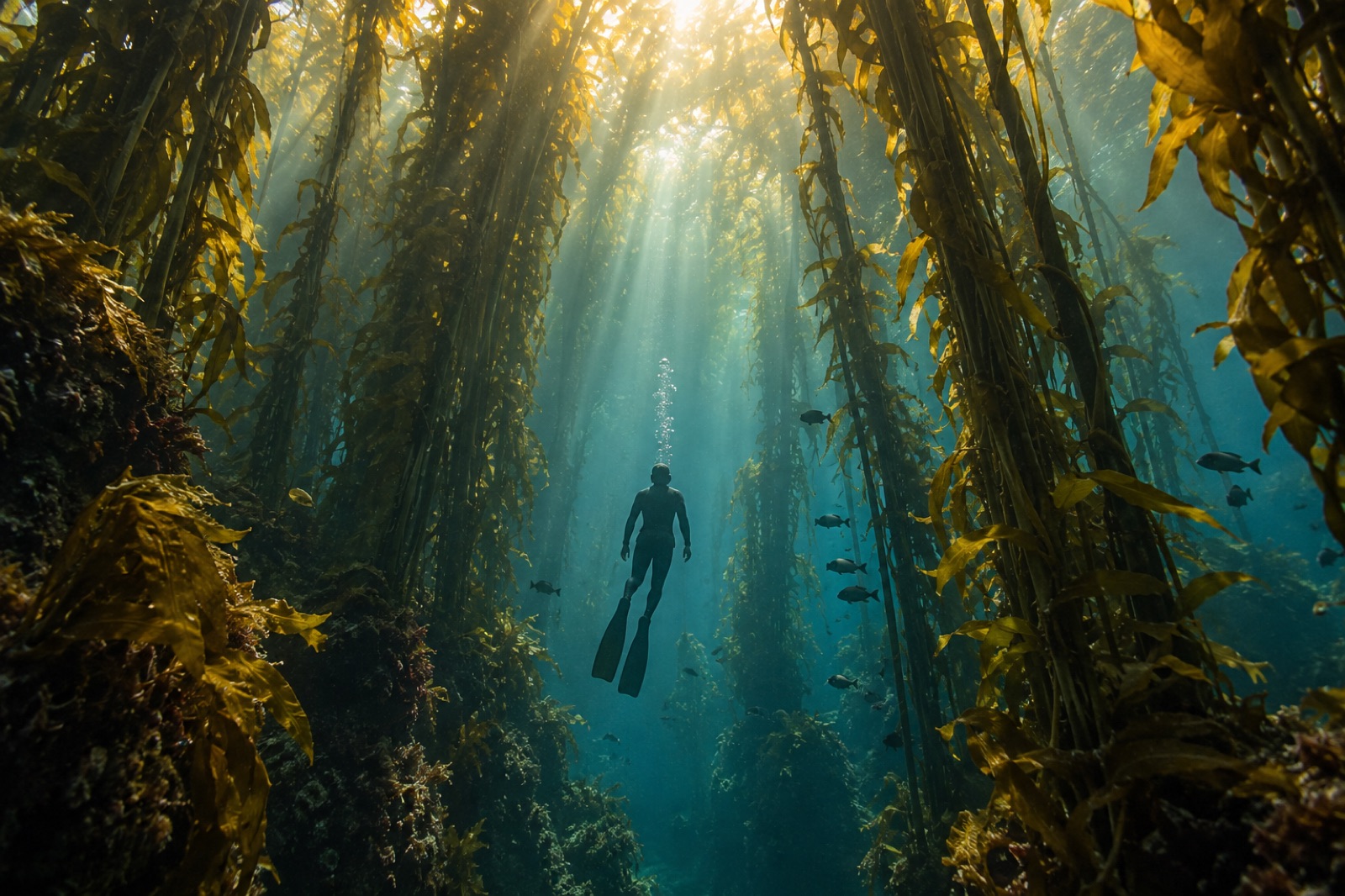
Freediving in a kelp forest is one of the finest things a human can do: slipping down a sunlit channel between giant kelp stipes, hanging neutrally at six metres while a school of baitfish reorganises around you, surfacing to one clean breath. It is also the corner of ocean recreation where the margin between fine and fatal is thinnest, because the main failure mode — blackout — arrives silently, at the shallow end of the dive, without any sense of distress to warn you. The good news is that nearly all freediving fatalities trace back to a short list of broken rules, and the rules themselves are simple enough to fit on one hand. Here's the primer every new freediver should carry into the water.
The physiology that makes the rules
Two gases run breath-hold diving, and they fail you in opposite directions.
Oxygen is the hard limit. Your brain runs on it; when arterial oxygen falls below a critical threshold, consciousness stops — that's blackout. On a normal dive this happens progressively and is preceded by warning signs, but crucially the threshold is a biochemical fact, not a sensation. You cannot feel your oxygen level directly.
CO₂ is the urge to breathe. The discomfort that makes you want to surface is driven almost entirely by rising carbon dioxide, not falling oxygen. This is why breath-hold feels controllable: CO₂ is an early, insistent, loud alarm. But it's an alarm that can be silenced while the real problem — oxygen — runs quietly down.
The third factor is pressure. Shallow-water blackout earned its name because blackout risk spikes near the surface: as you ascend the last few metres, the drop in water pressure lets oxygen partial pressure in your lungs fall off a cliff, even though you still have some oxygen left. Divers who felt fine at depth black out at three metres. Rescue data and training agencies agree on the dangerous depth band, and it's the last ten seconds of the dive.
This three-part picture — silent oxygen, alarm-bell CO₂, surface-band risk — explains every rule below.
Rule one: never freedive alone
Not "rarely." Not "except when it's shallow." Never. Blackout gives no distress signals, and an unobserved unconscious freediver has a rescue window measured in about a minute or two before outcomes turn bad. Solo breath-hold diving — including spearfishing alone, and including "just snorkelling along holding my breath a bit" — is the single strongest predictor of freediving deaths worldwide.
The minimum viable version: one up, one down. When your buddy dives, you are the safety — on the surface, watching constantly, close enough to meet them on the final metres of their ascent (many protocols call for meeting at half the planned depth or in the last five metres). When you dive, they are yours. You trade dives; nobody "just snorkels around" while the other works the reef.
A safety diver's job, stated plainly: arrive at the diver during the ascent's last metres, watch the face, be in physical contact range at the surface, and be ready to support the airway above water immediately. Training courses drill the actual rescue — removing the mask, blow-tap-talk, supported tow, recovery position — until it's reflex. Knowing the idea of rescue is not rescue.
Rule two: never hyperventilate
This one is counterintuitive, widely disobeyed, and where physiology bites hardest. Rapid deep breathing before a dive flushes CO₂ out of the blood. It feels cleansing — but CO₂ was your early-warning alarm. With the alarm disabled, oxygen can run down to blackout threshold while you still feel fine. Hyperventilation doesn't add much usable oxygen (your blood leaves the lungs nearly saturated anyway); it almost purely deletes the warning.
What to do instead: breathe up calmly. Slow, relaxed, gentle breathing — focusing on long exhales to drop the heart rate — for two to three minutes before the dive, finishing with a full but not maximal breath. You're calm, not gas-loaded. The freediving mantra "never hyperventilate" has been training-dogma for decades because the physiology is unambiguous.
Rule three: know the signs, and stop on any of them
Because oxygen can't be felt, freedivers read proxies — honestly, and early:
- The first real urge to breathe is the end of the dive, not the middle. Recreational freediving treats the first genuine contraction or unmistakable urge as the signal to ascend, with a comfortable margin to the surface. Pushing through contractions is a trained, supervised, competitive practice, not a reef activity.
- Buddy-side warning signs on ascent: a diver slowing or stopping, glazed or unfocused eyes, blue-grey lips, loss of coordination.
- Samba — loss of motor control on surfacing, visible as shaking limbs and dazed, drunken movement — is the mildest form of hypoxic failure and the loudest warning you'll ever get. A freediver who has sambad once is done for the day, and needs to reflect hard on what went wrong, usually breath-up or push-through. Surface blackout needs nothing further said: it's the emergency, and your buddy executes the rescue.
- Post-dive: watch each other for at least 30 seconds after surfacing. "I'm fine" and an OK hand signal are rituals, but the watch is the rule. Blackout can arrive a few seconds after the first breaths.
Rule four: structure the session conservatively
- Dive within your recent, tired self, not your personal best. Cold water, a long surface interval chase, swell and surge load you; plan depths at what you can do on an off day.
- Limit total breath-hold work. Long bottom times, many dives, and short surface intervals compound. A common recreational practice: surface interval at least twice the previous dive time, total session capped by cold and fatigue rather than by ambition.
- Leave something in reserve on every ascent so that the shallow, high-risk band is crossed with margin. Kelp-coast water cold makes floatiness high and shivering costly — the same cold-water frame as our snorkelling safety guide — plan the exit to the surface as carefully as the dive down.
- Fins clear of the kelp, knife accessible. Entanglement is a real, rarer hazard in forest diving; route through natural channels, carry an accessible cutting tool, and never fight kelp — back out the way you came. Our companion piece on freediving in kelp covers etiquette and routing inside the forest.
Freediving has a small and teachable skill set — equalisation, rescue, safety discipline — and it is learned far faster and more safely from professionals than from experimentation. A beginner course with any of the major training agencies typically runs two to three days including pool and open water, and the single greatest benefit is that blackout-rescue becomes drilled motor memory for both you and the people you dive with. Equalisation — the doorway skill — has its own deep dive in our Frenzel basics explainer, and the technique is much easier to learn with an instructor's eyes on you.
If you hunt, fold hunting into these rules: task loading, adrenaline and distraction measurably shorten the safe window — spearfishing ethics and discipline includes the same buddy discipline, doubled.
The quiet rule: leave the reef as you found it
Freediving safety is mostly for the diver. The forest asks for something too — don't hang off kelp stipes (they hold decades of growth), don't grab animals, and keep a respectful distance from sea otters and seals working the forest. The full expectations live in our kelp wildlife ethics guide.
Key takeaways
- Freediving's lethal failure is hypoxic blackout in the last metres of ascent — silent to the diver and survivable only with a buddy already there.
- One up, one down: never freedive alone, and when your buddy is down you are on station, watching, ready to meet them.
- Never hyperventilate. It deletes the CO₂ early-warning system without meaningfully adding oxygen.
- First urge to breathe ends the dive. Samba ends the day. Watch your buddy for 30 seconds after every surfacing.
- Take a certified beginner course: blackout rescue is a drilled skill, not a concept.
FAQ
Is snorkelling with occasional duck dives covered by these rules?
Yes, at the shallow end. Anyone breath-holding face-down in the ocean is freediving for those seconds, and blackout doesn't respect activity labels. Duck-diving alone far from any watcher is the same bet as freediving alone — people drown in a metre of water this way, and it happens every season.
What exactly is shallow-water blackout?
Loss of consciousness from low oxygen triggered during the final ascent, when decreasing water pressure causes the partial pressure of oxygen in the lungs to fall below the brain's minimum — commonly in the last 10 metres. It can strike divers who felt completely fine seconds before. "Shallow" refers to where it happens, not to how long or deep the dive was.
How long should I wait between dives?
A standard recreational guideline is a surface interval of at least twice the length of the dive you just did, relaxing deliberately between dives, and longer after any dive that taxed you (cold, current, contractions). Training agencies give detailed protocols; use theirs once certified.
Do I need to be an elite swimmer to freedive safely?
You need to be a comfortable, calm swimmer in open water with basic fitness, and you need the skills and the buddy system — which come from a course. Racing fitness is irrelevant to the safety rules, which are what keep recreational divers alive.
Is a dive computer or freedive watch a substitute for a buddy?
No. A freedive computer can alarm on depth and time and is a genuinely useful conservative aid — but it cannot watch your face during ascent, position for the last five metres, or get your airway out of the water. Instruments assist; buddies rescue. Only one of those is non-negotiable.