Explore9 min read
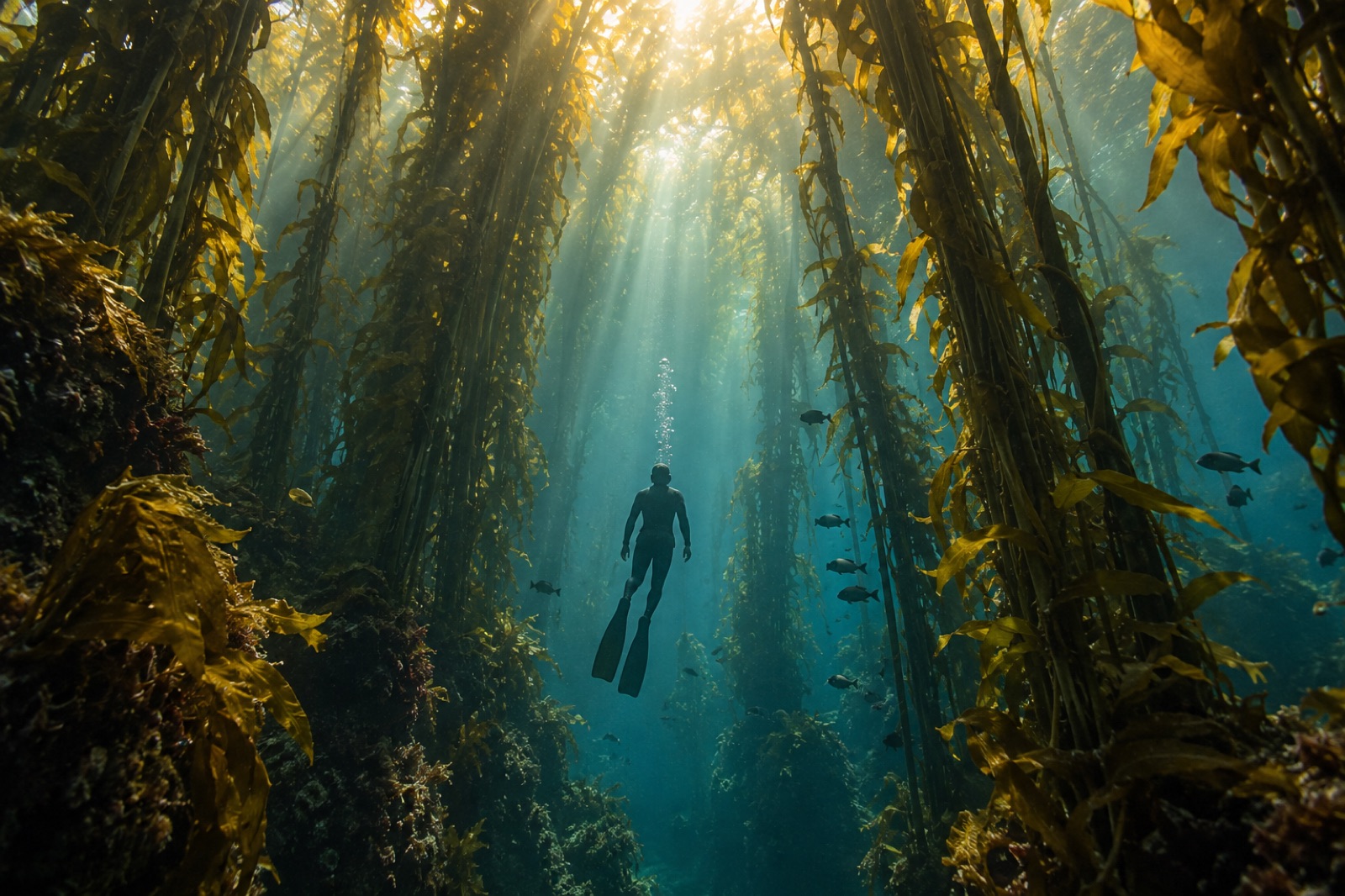
Freediving Safety Basics: The Buddy Rules That Save Lives
Freediving is beautiful and quietly unforgiving. The core safety rules — one up, one down, never hyperventilate, know blackout — with the science behind each.
Tom Okafor ·
Spearfishing can be the most selective way to take seafood — or a fast way to damage a kelp forest. Here's how to do it legally, selectively and with respect.
Spearfishing is the most selective fishing method ever devised. You see the fish, identify the species, estimate its size, and decide — before anything dies — whether it should. Done well, taking one fish with a speargun has a fraction of the collateral damage of a hook-and-line session, and none of the bycatch of a net. Done badly, it's a fast way to strip a reef's biggest breeders, frighten a dive site's resident fish into permanent shyness, and earn the justified dislike of every other ocean user. This guide is about doing it well: the rules, the species choices, the shot discipline, and the respect a living kelp forest is owed.
Most fishing methods are blind. A baited hook can't see what bites it; a net certainly can't. The spearfisher, by contrast, hunts with the eyes of a naturalist. You are underwater, inside the ecosystem, watching behaviour before you ever point anything. That visibility is the method's great ethical strength: you can pass up the undersized kelp bass, ignore the spawning aggregation, and take the abundant yellowtail instead.
But the same visibility makes bad behaviour unusually legible. A reef that has been hunted hard by careless divers shows it — the big fish vanish first, then the mid-sized ones grow wary at twenty metres instead of five, and eventually the whole site reads as empty to every snorkeller and diver who follows. Because spearfishing is selective, its sins are deliberate ones. There is no bycatch alibi.
The ethic that grows from this is simple: your standard isn't the legal limit, it's whether the reef looks and behaves the same after you've left.
Spearfishing regulations vary enormously between jurisdictions, and they change. Before diving anywhere new, check the current rules with the local fisheries authority — not a forum post from three years ago. The main frameworks you'll encounter:
The kelp forest is not a uniform fish cabinet. Some species can absorb modest, selective harvest; others are the structure of the forest itself.
Good candidates tend to be fast-growing, abundant and wide-ranging: schooling species at the forest edge, and in healthy regions, common mid-sized reef fish taken well within limits. On many coasts the single most defensible "harvest" isn't a fish at all — it's purple sea urchins from an urchin barren, where grazing pressure from starving urchins is holding kelp recovery back. Taking barren urchins is removal of a problem rather than removal of a resource, though note that barren urchins are roe-poor and rarely worth eating; think of it as stewardship, not dinner, and check whether your region actually permits it. Our explainer on urchin barrens covers the ecology.
Handle with care means slow-growing, territorial, long-lived fish: the big resident wrasse that has held the same ledge for a decade, the rockfish species that mature late and can live for many decades, any large resident that other divers know by sight. Taking the reef's oldest fish removes not just biomass but memory — these are often the individuals that anchor local populations.
Never shoot includes protected species (know your local list cold), anything you cannot identify with certainty at shooting range, fish in obvious spawning condition or aggregations, and any animal that is the reason divers visit that site. Some fish are worth infinitely more alive and photographed a hundred times than dead once. The California sheephead is a good case study: a familiar, semi-tame kelp resident in some areas and a recovering, watched species in others — exactly the kind of fish where local status should drive the decision.
The general rule that keeps you honest: hunt the common, leave the curious. Abundant schooling fish can sustain selective pressure; the reef's personality cannot.
Everything above happens on the boat. The rest happens in a second, 8 metres down, with a fish quartering away.
Only take shots you can finish. A spearfisher's obligation to the animal is a fast kill. That means practising on targets until your effective range is honest, shooting only within it, and favouring shots that stone or immobilise. If the shot isn't right, let the fish go. Wounded-and-lost is the worst possible outcome, worse than never pulling the trigger, and the fish you miss and wound educates the entire reef.
Count your dive profile, not just your fish. Hunting on breath-hold stacks the specific dangers of freediving on top of task loading — Adrenaline, focus, a gun in hand. The same blackout and buddy rules that apply to every breath-hold diver apply doubly to spearfishers. Read the freediving safety basics protocol and fish within it: one up, one down, always.
Unload before you board. A loaded gun on a rolling boat is how fins, legs and friendships get perforated. Guns get unloaded in the water, shafts secured, tips protected. On a hard boat, stow before you climb.
A kelp forest is somebody's livelihood, somebody's research site, somebody's first dive. A few norms that keep spearfishers welcome:
In many places, no. A large share of jurisdictions worldwide restrict spearguns to breath-hold diving, and some ban scuba-assisted spearfishing outright. Even where legal, scuba spearfishing is frowned on by much of the community because it removes the breath-hold constraint that keeps pressure on reefs modest. Check your local rules and expect them to be stricter than you assume.
Sometimes, sometimes not — "MPA" covers everything from fully no-take sanctuaries to multi-use zones with gear-specific rules. Never assume. Look up the zone's designation and regulations before you get in the water, and when signage and memory disagree, leave the gun on the boat.
Your local protected species list is definitive — learn it before your first dive, along with the visual differences between protected and legal lookalikes. Beyond the law, most experienced spearos informally protect the big, old, tame residents their sites are known for, spawning aggregations, and anything they can't identify with complete certainty at range.
Ecologically, reducing urchin density on a barren is exactly what many restoration programs do (including ours, at industrial scale). Whether a recreational diver may take urchins, where, and in what quantity is a local regulations question — some regions encourage it, others restrict it. And note the practical catch: barren urchins are starving, with little or no roe. If you're doing it, you're doing it for the forest.
Shooting well inside your limits — and then stopping early. The spearfishers who are welcomed back to the same coasts year after year are the ones who take one or two fish, spend the rest of the dive watching, and treat the limit as an irrelevant ceiling rather than a goal.
Freediving is beautiful and quietly unforgiving. The core safety rules — one up, one down, never hyperventilate, know blackout — with the science behind each.
Tom Okafor ·
Guide to the Cape Peninsula's kelp forests: two oceans, sea bamboo, seals and sharks, freediving culture, and how a warming world is shifting the reefs.
Tom Okafor ·
Cold-water snorkelling rewards the prepared. How to choose wetsuit thickness, hoods, gloves, boots, masks, snorkels and fins for water below 18 °C.
Tom Okafor ·