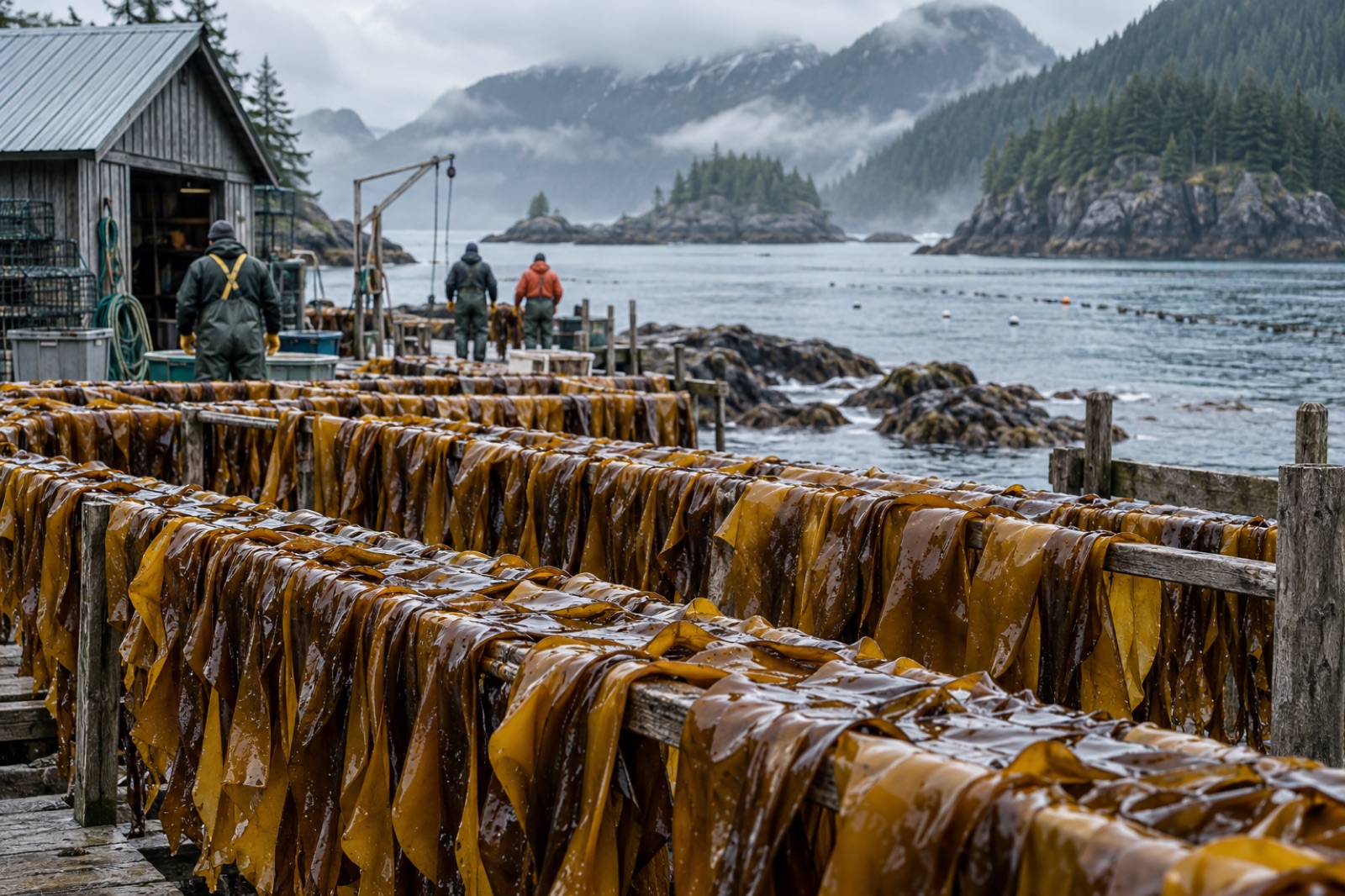
Most seaweed farms think of a cold chain as a problem to solve on harvest day. The farms that keep their buyers treat it as a machine they built months earlier: a landing station, chilling capacity, insulated boxes, a cold room, a booked truck and a set of logged temperature records that prove the whole thing worked. This article is about building and verifying that machine — the equipment choices, the handling rules and the validation work that turns "it's fresh, honest" into a documented product specification. For the per-batch routines of packing, freight lanes and market timing, pair this with the cold chain for fresh kelp; here we cover the infrastructure underneath it.
Map your chain before buying anything
Draw your post-harvest path as a pipe with a clock. List every node the crop passes through — water, boat hold, landing deck, chill, cold room, truck, receiving dock — and assign each a maximum time and a temperature ceiling. This is your time-temperature budget, and it tells you where the machine must be strongest:
- The hottest nodes are the first three. Water to boat to deck usually runs long and warm — sun, waiting, wet biomass stacked in holds. Your chilling budget should be biggest here.
- A chain is only as good as its worst single leg. A flawless cold room is wasted if the truck languishes open-doored at the dock. The budget shows the real trouble before it costs you a buyer.
- Budgets differ by product stream. Fresh food kelp gets hours, not days; biostimulant feedstock gets a working day; for grading context see seaweed quality grading.
Chilling technology, ranked by spend
Slurry ice (the workhorse)
An ice-and-seawater slush in insulated totes. It chills fast (the slurry flows into blade folds), keeps product at 0–1°C, and the seawater component prevents freshwater leaching that plain ice melt causes. Slurry machines run from modest shorepower units up to harvest-sized output; for small farms, flaked ice mixed 2:1 with seawater in totes is the same physics without the machine.
Flake ice, separated
The fish-trade standard: product in a lined box, flaked ice above and below, meltwater draining away. Slower than slurry, but simple, safe, and every freight handler understands it. Use food-grade liners so meltwater never sits against blades.
Refrigerated seawater (RSW) and blast chill
At larger landings, a jacketed RSW tank chills totes of product in seawater held near 0°C; at the processing end, blast chillers pull heat out of boxed product far faster than a cold room ever will. Both are legitimate scale-up investments once daily throughput justifies them. The dividing line is simple: if you are chilling faster than your cold room can absorb, you have outgrown "cold room doing the chilling" — a cold room is a holding device, not a chilling device. Never put warm product into a cold room in bulk; it raises the room, condenses on the ceiling, and drips on everything.
The unglamorous essentials
Whatever the tech: insulated totes with lids and drains, calibrated pocket thermometers at every station, and a shaded, washdown-capable landing deck. The deck is part of the cold chain — a black asphalt quay in summer sun negates a truckload of ice.
Handling rules that protect quality
- Cut cool, land fast. Early tides and dawn cuts keep pulp temperature low; every hour on deck is subtracted from shelf life later. Stage chilling before the first line is cut (the landing-day choreography is in harvest logistics).
- Keep piles shallow. Kelp crushes. Deep piles bruise; bruised blades brown. Whether in totes or boxes, keep stacks modest and box fills to roughly 10–15 kg.
- Stop the drop. Every transfer — boat to deck, deck to tote, tote to shelf — should be a place-down, not a drop. Impact damage shows up a day later as weeping translucent patches.
- Freshwater rinse: usually no. Rinsing in freshwater leaches minerals and flavour and can damage tissue; clean seawater or none is the default. (Species and end-use exceptions exist — dried snack products may tolerate it — but decide it as a product decision, not a reflex.)
- Hygiene is a cold-chain input. Clean totes, clean deck, clean hands. Chilling slows bacteria; it doesn't undo contamination. The full discipline is in food-grade seaweed handling.
Different streams, different chains
Not all harvested kelp needs the same machine. Design per stream:
- Fresh food blades. The tightest chain: 0–2°C throughout, 5–10 days of workable life, premium prices that justify slurry, cold room and logged freight. This is the stream every other decision in this article is designed around.
- Blanched. A 30–90 second hot-water dip sets colour and knocks down microbes, transforming the product into a semi-preserved one with a longer, more forgiving chilled life — freezers take over from here in many processors' hands. Blanching changes texture and use-case; it's a product transformation, not a substitute for cold.
- Frozen. Freezing ruptures cells; the product emerges suited to soups, noodles and blended goods rather than salads. Freeze deliberately — fast, flat, portioned — and treat frozen as its own channel with its own buyers. Freezing is covered within post-harvest processing.
- Biostimulant and feed feedstock. The forgiving stream: chilled-not-frozen, measured in working days, tolerant of coarser handling. Forgiving is not free — a warm week still spoils it — but the bar is sane for a small farm's first years.
- Salting as preservation. Five to ten percent salt by weight converts kelp to a semi-preserved product that tolerates ambient handling for a week or more. It's a legitimate product form in Japanese and Korean trade, and a lifeline where cold infrastructure is thin. (See nori beyond sushi and the kitchen library for how preserved seaweeds move through food culture.)
Prove it: validation and HACCP
A cold chain you can't prove is a marketing claim. The practical verification stack for a small or mid-sized farm:
- Temperature mapping. Put cheap loggers in your cold room corners, inside tote stacks and in the truck cab's shadow for a season. You'll find the warm spots — every facility has them — and learn how long your "0–2°C" room actually takes to pull down a harvest-day load.
- CCP discipline under HACCP. Identify critical control points (typically: landing time-to-chill, chill temperature, cold-store temperature, dispatch temperature), set limits and corrective actions, and log them every batch. Building the plan properly is covered in the seaweed HACCP guide.
- Retention samples and micro testing. Keep a labelled sample from each batch under identical storage; do a periodic micro panel through a food lab. It's cheap insurance and your first defence in any dispute.
- Receiving temperature at handover. A two-second thermometer reading, a photograph and a signature at every transfer of custody. The cold chain legally ends where your documentation ends.
Tidewright's own Harvest operations run the same playbook at restoration-adjacent farms: batch-tagged bins, logged chill from landing, and temperature history travelling with the product as part of its specification. The machinery is mundane; the discipline is the product.
Key takeaways
- Build the cold chain as infrastructure: map the time-temperature budget from water to receiving dock, then size chilling for the hottest early nodes.
- Match the chilling tech to throughput: slurry ice for small landings, flake-in-liner for freight-standard packing, RSW and blast chill when volumes justify — and never use a cold room to chill warm bulk.
- Handling rules protect quality: cut cool, land fast, keep piles shallow, stop drops, skip freshwater rinses and treat hygiene as a cold-chain input.
- Design different chains per stream — fresh food, blanched, frozen, feedstock, salted — and don't make fresh-kelp promises to feedstock-chain infrastructure.
- Verify the chain: temperature mapping, HACCP critical control points, retention samples and signed receiving temperatures at every custody transfer.
FAQ
What temperature should harvested kelp be stored at?
Fresh food-grade kelp performs best at 0–2°C, where it holds prime grade for five to ten days depending on species. Above 5°C, saleable life collapses into hours. Frozen product is held at -18°C or colder, blanched chilled product at 0–4°C.
Do I need a slurry ice machine for a small farm?
No — tote-mixed slurry (flaked ice plus seawater) achieves the same chilling for small volumes; the machine pays when daily landings make hand-mixing a bottleneck. Spend first on insulated totes, thermometers and shade; machines later.
How do I know if my cold room is big enough?
If a harvest-day load raises the room measurably and takes more than a couple of hours to pull back down, it's too small for chilling duty — which is fine, because rooms should hold, not chill. Chill at the tote/slurry stage and let the room hold; size for peak-season storage volume plus a margin.
What's the cheapest way to verify my cold chain?
A season of $15 single-use loggers in boxes and totes, plus recorded receiving temperatures at handover. Mapping your warm spots and building a batch logbook costs less than one rejected delivery and produces the evidence buyers and insurers both accept.
Can I skip chilling if I'm processing the same day?
For biostimulant feedstock going straight into an extraction line, brief ambient holding in shade may be acceptable — set a written time limit and a temperature ceiling in your HACCP plan, and log against it. For fresh food streams, no: "processing today" is not a chilling substitute; the quality clock started at the water.