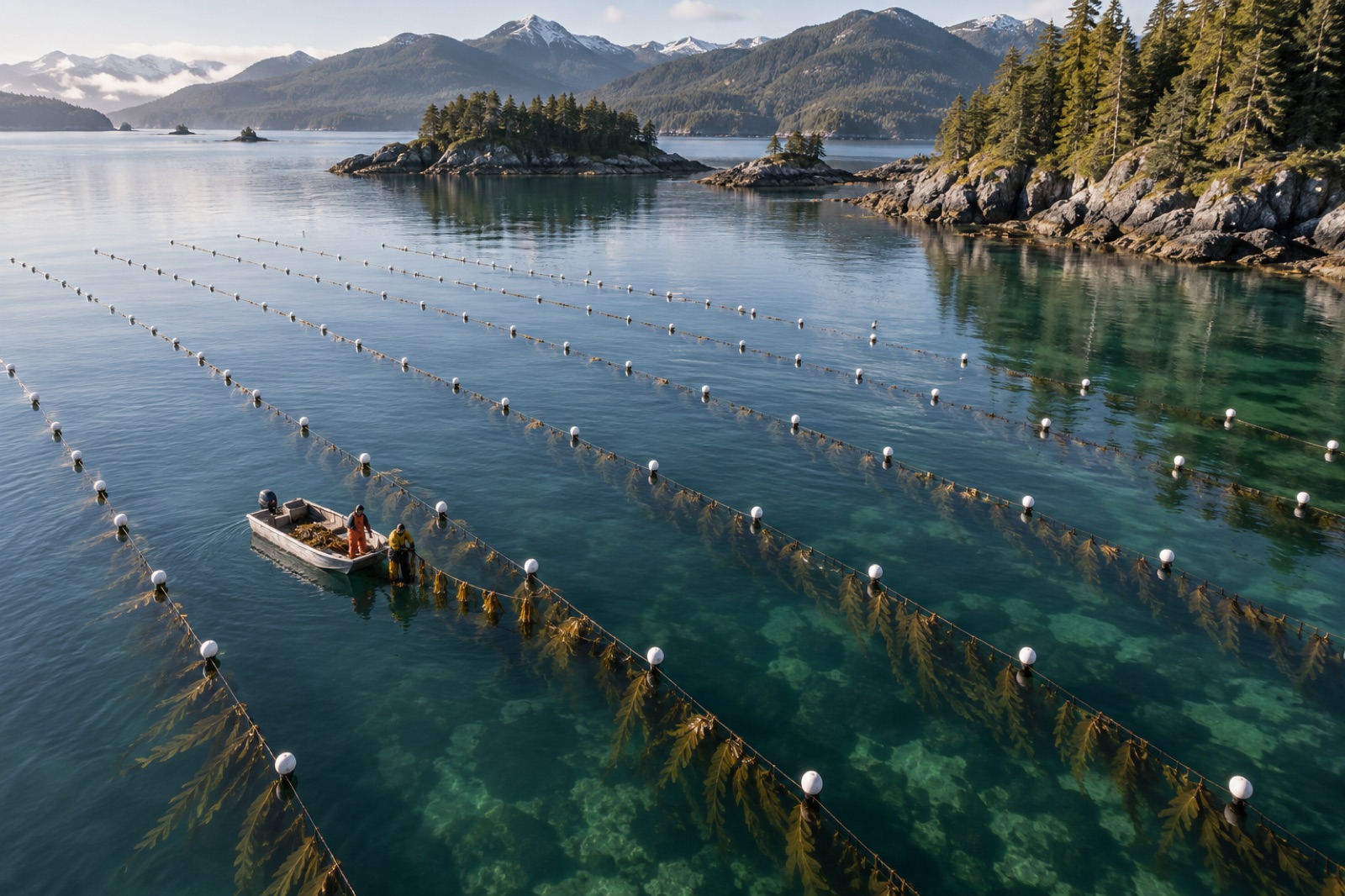
If you have spent any time reading seaweed farming prospectuses, you have seen the yield claims: enormous tonnage per hectare, always in glossy projections, rarely with a unit attached. Some are honest measurements of excellent farms; some are arithmetic done on the back of an envelope; a few are, charitably, aspirational. Yield matters — it is the denominator of every cost and the numerator of every revenue line — so getting benchmarks right is a core farm skill. This article gives realistic ranges for the major farmed groups, explains why quoted numbers vary so wildly, and shows how to build a benchmark your own farm can trust.
First, get the units right
Most yield confusion is unit confusion. Before comparing any two numbers, check four things:
- Wet or dry weight? Kelps are roughly 85–90% water at harvest. A figure in fresh (wet) tonnes will be five to ten times the same biomass weighed dry. Honest reports state which; always convert before comparing. Dry matter percentages vary by species and season, so use your own farm's measured ratio once you have one.
- Per metre of line, or per hectare of farm? Line-mooring yields of 5–25 kg wet per metre are ordinary for kelps; hectares contain very different lengths of line depending on spacing and layout. A hectare with 4,000 metres of line is a different machine from one with 2,000.
- Whole farm or productive area? "Per hectare" sometimes means lease area including mooring lanes, storm gaps and anchors; sometimes only the planted footprint. The first matters for economics, the second for agronomy.
- Harvested or standing? Standing crop at peak is what you could cut; harvested yield is what made it to the dock after storm losses, biofouling culls and handling. Business plans should always use harvested yield.
Understanding seeding density and line spacing is inseparable from this: per-metre yields and per-hectare yields trade against each other, and the densest farm is rarely the most profitable one.
Realistic ranges for the major farmed seaweeds
These are indicative ranges assembled from commonly reported farm results — treat them as planning benchmarks, not promises. Your site, season and practices will place you somewhere in or near them; treat anything double these figures with friendly skepticism until someone shows you the scale tickets.
Sugar kelp (Saccharina latissima)
The temperate benchmark species. Well-run farms commonly report line yields around 5–15 kg wet per metre, with excellent sites and long seasons going higher and short-season or nutrient-poor sites below. Per planted hectare with typical line spacing, harvested wet yields in the range of 30–80 tonnes are a fair planning band; dry yield is roughly a tenth of that. Our sugar kelp growing guide covers the season-length and nutrient drivers behind the range.
Kombu and Japanese kelps (Saccharina japonica complex)
Centuries of refinement have produced the highest-yielding kelp systems on Earth. Mature operations achieve very high wet yields per unit area through dense line layouts, forced cultivation and multi-line rafts — figures dramatically higher than Western sugar kelp farms are normal there, but they ride on labor, infrastructure and processing proximity that don't transfer automatically. Do not plug East Asian kombu numbers into a North Atlantic business plan.
Winged kelp (Alaria esculenta)
Lower per-metre yields than sugar kelp — it is a shorter, lighter-bladed plant — often quoted in the rough range of 3–8 kg wet per metre on European farms. Its value sits in the food-grade price per kilogram, not the tonnage.
Giant kelp (Macrocystis pyrifera)
Being developed at scale in several regions for biomass, biostimulants and feed. Continuous-growing rather than strictly annual, giant kelp can carry very large standing crops, but mechanical harvest efficiency decides what actually lands. Reported harvested wet yields vary enormously by system; planning ranges should be built with your intended harvest gear, not borrowed from other farms' rafts.
Tropical carrageenophytes (Kappaphycus, Eucheuma)
The volume champions of world aquaculture by tonnage. Shallow-water off-bottom and longline systems dry their crop on the farm and sell by dry weight; yields per unit line-area are modest per cycle but cycles repeat several times a year, and annualized production per hectare is substantial. Benchmarks here are best expressed in dry tonnes per hectare per year across multiple cycles.
Sea lettuce (Ulva)
Fast and prolific in nutrient-rich water, with fresh yields that impress on paper and a dry-matter ratio that humbles them — Ulva can be well over 90% water. Benchmark in dry weight for any processing use; in wet weight only for fresh food sales.
Why quoted numbers vary so much
- Season length. Sugar kelp in a six-month cool-water season and the same species in an eight-month season are different crops. Latitude, nutrients and temperature set the calendar; reading your water tells you which calendar you have.
- Seed quality and provenance. Vigorous, locally matched seedstock reliably outyields off-the-shelf string. Differences of tens of percent between seed lots are normal.
- Exposure and current. Flow brings nutrients but storms take biomass. Sheltered farms trade peak growth for harvest security — which is why standing crop and landed crop diverge most on exposed sites.
- Harvest window. Kelp biomass and quality peak, then erode as blades tear, foul and senesce. A farm harvested at peak reads double the same farm cut three weeks late; see harvest timing for the signals.
- Reporting incentives. Grant applications, investor decks and press releases reward big numbers; scale-books and buyer contracts reward true ones. Know which document you're reading.
Building a benchmark for your farm
Industry ranges are for planning; your own numbers are for farming. A usable benchmark program is simpler than it sounds:
- Sample, don't guess. Each harvest, cut and weigh measured sections of line — a set of replicate one-metre samples per block, scaled by line length. Weigh wet at the dock, and dry a subsample to constant weight for your own wet:dry ratio.
- Record by line and block, not farm average. Averages hide the story: usually one block, depth or seed lot outperforms, and that difference is next year's planting decision.
- Track three numbers. Wet kg per metre, harvested wet tonnes per planted hectare, and dry matter percentage. Those three let you talk to agronomists, buyers and banks in their own units.
- Year on year, not season on season. Weather makes single seasons liars. A three-year rolling average is the first number you should ever put in a contract.
- Feed it back into economics. Yield multiplied by grade mix multiplied by price, minus harvest and processing cost, is the only yield figure that pays wages — run it through the model in seaweed farm economics each season.
Raising yield once you have honest numbers is mostly boring and effective: better seed, earlier out-planting, corrected spacing, disciplined harvest windows. The exotic gains — deep-water nutrient pumping, mechanised harvest, selective breeding — belong to the phase after your baseline is true.
Key takeaways
- Always normalize units before comparing yields: wet vs dry, per metre vs per hectare, planted area vs lease area, standing crop vs harvested yield.
- Temperate kelp planning bands: roughly 5–15 kg wet per metre for sugar kelp, tens of wet tonnes per planted hectare harvested; dry matter is about one tenth of wet weight.
- Kombu systems and tropical carrageenophyte cycles achieve much higher numbers through structure and repetition that don't transfer to other farms.
- Most yield variation traces to season length, seed quality, exposure and harvest timing — not to magic.
- Benchmark your own farm with measured line samples, block-level records and a three-year rolling average; fund and contract on that, never on best-season memory.
FAQ
How many tonnes of seaweed can one hectare produce?
For a temperate kelp longline farm, a fair planning band is tens of wet tonnes per planted hectare per season — commonly in the 30–80 tonne range for sugar kelp at typical spacing, with dry weight around a tenth of that. Advanced kombu systems and multi-cycle tropical farms report far higher figures under very different conditions; always check the units and methods behind any claim.
What is a good yield per metre of kelp line?
Around 5–15 kg wet per metre is a common working range for sugar kelp on well-sited farms, with strong sites exceeding it and short-season sites falling below. Winged kelp runs lighter, roughly 3–8 kg per metre. Per-metre yield is a useful agronomy metric but must be combined with line spacing to mean anything economically.
Why is dry weight so much lower than wet weight?
Kelp tissue is roughly 85–90% water, and Ulva can exceed 90%. Drying removes most of that mass, so a farm landing 50 wet tonnes ships perhaps 5 tonnes dried. Contracts, freight and processing are usually priced in dry terms — convert early and often.
How can I increase my farm's yield?
In order of usual impact: plant earlier within your permit window, upgrade seed quality and local provenance, correct line spacing for your flow, thin and manage biofouling, and harvest at the quality peak rather than the calendar's convenience. Measure everything, or you'll never know which change worked.
Some are real measurements from excellent, labor-intensive systems — particularly East Asian kombu farms — and some are standing-crop or theoretical numbers presented as harvest. Ask three questions: wet or dry, per metre or per hectare, harvested or standing? A number that survives those questions is a benchmark; one that doesn't is marketing.