Kitchen9 min read
Kombu and Umami: The Glutamate Science of Tasty Water
Kombu is the original umami. How glutamate works on the tongue, why temperature decides your dashi's flavour, and how to season with the sea.
Sofia Andersson ·
How to cure white fish between sheets of kombu: the umami science behind kobujime, fish and kelp choices, timing, serving, and honest food-safety notes.
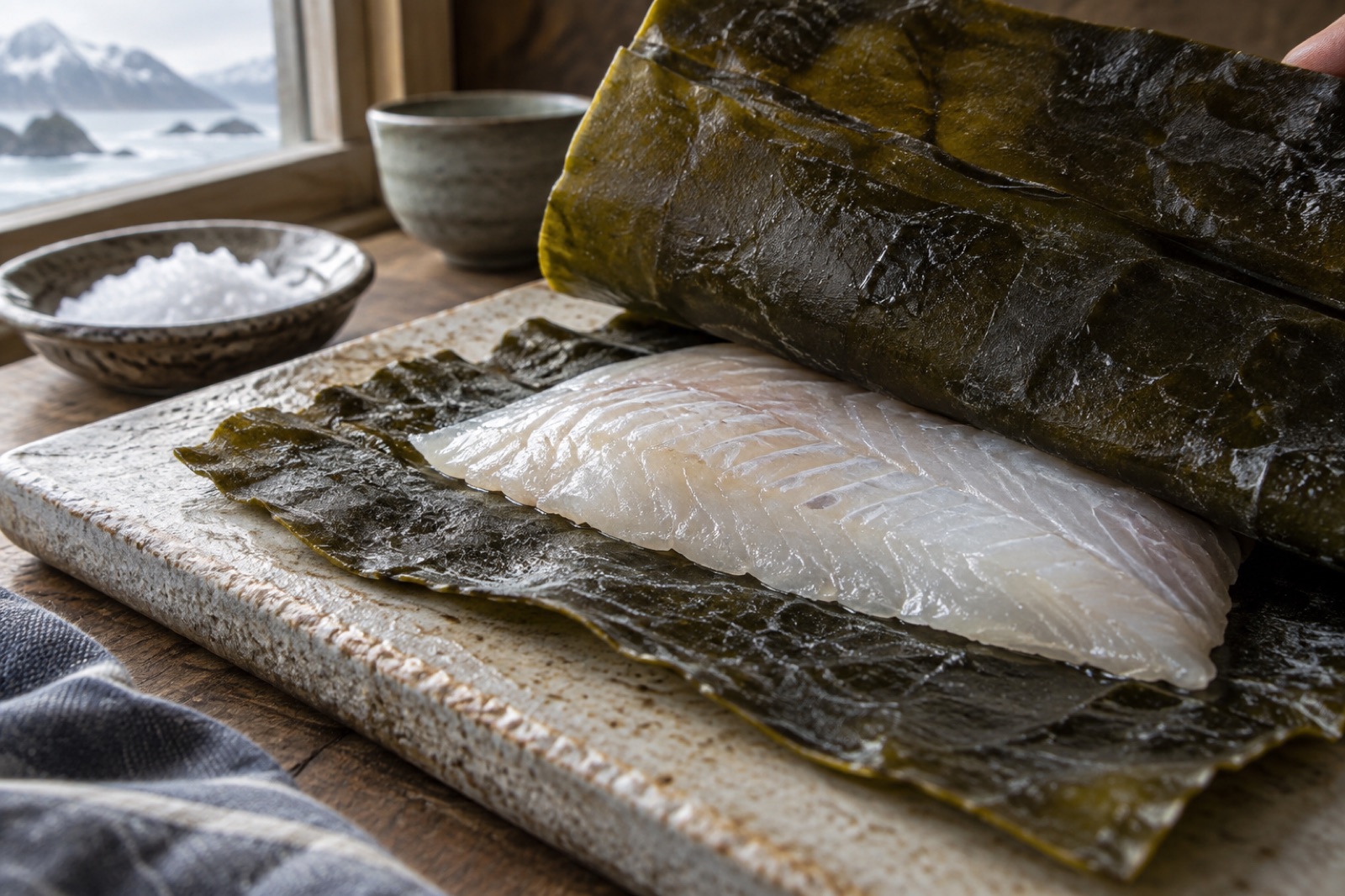
Some techniques feel like cheating. Kobujime — fish pressed overnight between sheets of kombu — is one of them. You do almost nothing: sandwich fresh fillets in kelp, refrigerate, wait. A day later the fish has firmed, deepened in flavour, and picked up a quiet oceanic savouriness that tastes like the work of a much more talented cook. In the Hokuriku region of Japan, where kombu travelled south from Hokkaido on historic trade routes and winter fish arrived off the boats at the same ports, kobujime became the signature way to eat flathead, flounder and sea bream — sashimi-grade fish, improved by seaweed and patience.
Here is how it works, why it works, and how to do it well at home without a sushi counter's supply chain.
Kobujime (昆布締め, "kombu-tightened") is a light cure. Fillets of firm white fish — or sometimes oysters or scallops — are salted lightly, then sandwiched between two large sheets of dried kombu, wrapped, weighted gently and refrigerated for anywhere from four hours to two days. The fish that emerges is not cooked, not smoked, and not pickled. It is concentrated: firmer to the knife, glossier on the plate, and seasoned throughout with a flavour that is unmistakably kombu's.
It predates refrigeration as a keeping technique, but it survives because of flavour, not preservation. In Toyama and Kanazawa it is still how prized winter fish are served: sliced like sashimi, often with nothing but a little wasabi and soy.
Two things happen inside the kombu sandwich, and both matter:
Moisture moves out. The dried kombu acts as a mild desiccant, drawing surface water from the fish. The texture tightens from soft to supple — the difference between raw fish and cured fish on the palate — without the aggressive salting of a proper cure.
Umami moves in. Kombu's surface is dusted with free glutamates — the compounds explored in our piece on kombu and umami science — which dissolve in the moisture film between kelp and fish and migrate into the flesh. The fish does not taste of seaweed; it tastes more of itself. This is glutamate seasoning at its gentlest, the same mechanism that makes kombu dashi taste like the sea concentrating itself, just running in reverse.
Some cooks lightly dampen the kombu with sake to accelerate the exchange. This is optional and traditional in places; dry sheets give a subtler result and keep longer.
You want large, flat, mature kombu sheets — ma-kombu (true kombu, Saccharina japonica, profiled in our kombu species entry) or rishiri/rausu kombu if you can find them. The sheet needs surface area: you are wrapping fillets, so pieces of at least A4 size are ideal. Two rules:
Firm, lean, white-fleshed fish with tight muscle grain takes kobujime best: flounder and other flatfish, sea bream (snapper), gurnard, bass, kingfish. Oily fish like salmon and mackerel are sometimes cured this way but the kombu's subtlety is partly lost against their fat — those fish belong to stronger cures.
The essential rule is freshness and safety: kobujime is a flavour cure, not a safety treatment. Use fish specifically sold as suitable for raw consumption, or fish that has been commercially blast-frozen to parasite-destruction standards — which is how most "sashimi-grade" fish reaches you anyway. The time in kelp firms the flesh; it does not make marginal fish safe. When in doubt, lightly cure fish you intend to cook: kobujime fillets are superb steamed or en papillote, and our kelp-wrapped fish recipe takes the same idea fully into the oven.
Quantities scale linearly. This makes four servings.
The classic Toyama presentation is simply sliced, fanned on a plate with wasabi and a small dish of soy. Beyond that:
And save the kombu. Rinsed, simmered tender and glazed in sweet soy, it becomes tsukudani — the cook's reward.
The technique itself does not make fish safe. Kobujime is a short, light flavour cure with no meaningful antimicrobial effect — start with sashimi-grade fish or fish frozen to parasite-control standards, keep everything cold and clean, and serve within a day of unwrapping. If any of that is uncertain, cure the fish anyway and cook it gently; the flavour survives heat beautifully.
Yes — once-used dashi kombu gives a milder cure and needs the full 24 hours. Do not leave dashi kombu sitting warm; refrigerate or freeze it promptly after stock-making if you plan a second use. Sheets much re-used beyond that have given their glutamate away and contribute little.
Unwrapped, sliced and refrigerated, eat it within 24 hours — the same window as any sashimi. Leaving it in the kombu longer than two days over-cures the fish rather than preserving it.
Time and contact. The overnight press moves dissolved glutamates into the surface centimetres of the flesh and draws water out, which changes both texture and taste throughout each slice — no garnish replicates that. A side-by-side taste of the same fish, cured and uncured, is the fastest way to understand the technique.
Yes, and both are traditional. Scallops take four to six hours — they are delicate and saturate quickly. Scored, blanched squid cures well overnight and is served in thin strips. Oysters work too, briefly. The denser the flesh, the longer it wants.
Kombu is the original umami. How glutamate works on the tongue, why temperature decides your dashi's flavour, and how to season with the sea.
Sofia Andersson ·
Tsukudani turns the kombu left in your dashi pot into a glossy, sweet-savoury relish for rice. Recipes, ratios, storage and why nothing leaves the kitchen.
Sofia Andersson ·
Wrapping fish in fresh kelp blades steams it gently, seasons it from the outside and makes the most dramatic plate on a coastal table. The full technique.
Sofia Andersson ·