Kitchen8 min read
Why You Should Cook Beans with Kombu
A piece of kombu in your bean pot softens skins, deepens flavour and may make beans easier to digest. Here's the why and the how, with a master recipe.
Sofia Andersson ·
Why a strip of kombu softens stubborn bean skins, speeds cooking and rescues old legumes — the chemistry of tenderising, tested against plain water and soda.
Every cook of dried beans eventually meets the stubborn pot: chickpeas that stay bullet-firm after two hours, kidney beans whose skins crack while their centres stay chalky, a luxury bag of heirloom beans that cooks like gravel because, unknown to you, they'd been sitting in a warehouse for three years. Coastal Japanese kitchens solved this problem centuries ago with a single ingredient: a strip of kombu dropped into the cooking water. This article is about the tenderising side of that trick — what kombu actually does to legume skins and cell walls, when it rescues a pot and when it can't, and how it stacks up against the other classic fix, baking soda. If you want the full master recipe, our companion guide on why you should cook beans with kombu has it; here we're going under the skin.
To understand the fix, meet the problem. A bean's seed coat is built from cellulose, hemicellulose and a glue of pectins — the same family of gelling carbohydrates that sets jam. Pectin molecules are cross-linked by calcium and magnesium ions, which bridge the chains like rungs on a ladder and make the structure rigid. Two things make that rigidity worse:
What softens this system? Heat, time, and anything that removes or displaces the bridging ions. And this is where the seaweed earns its keep.
Kombu is not a neutral leaf. As it hydrates and simmers, it releases a cocktail of compounds into the cooking water, and several of them act directly on the bean-skin chemistry:
The cell walls of brown kelps like kombu — the species profile is here — are rich in alginate, a long-chain polysaccharide that gives the great offshore forests their flexibility in surge. In the pot, dissolved alginate behaves as a gentle chelator: its molecular chain is studded with sites that grab calcium and magnesium. By tying up exactly the ions that cross-link pectin (both those leaching from the beans and those arriving in hard tap water), the cooking water quietly lowers the structural budget of the seed coat. The skins keep their shape but lose their stiffness — you get intact beans with giving, parchment-soft skins rather than split hulls and blown-out centres.
Kombu carries sodium, potassium and carbonate minerals from seawater, and its simmering water turns faintly alkaline. Even a small shift upward in pH accelerates the breakdown of hemicellulose and pectin — the same reason a pinch of baking soda softens beans. Kombu's effect is far gentler than soda's, which turns out to be an advantage, as we'll see.
Tenderising is only half the story. Kombu is the richest known natural source of free glutamate, which dissolves readily into the pot and diffuses into the swelling beans, seasoning them from within rather than from the surface. The chemistry of that savouriness is unpacked in the science of seaweed umami. For our purposes here, simply note: the same compounds that signal "rich broth" to your tongue arrive as a by-product of the softening process. One strip, two jobs.
Since both work partly through pH and ion chemistry, they're worth comparing head to head:
Baking soda is the sledgehammer. A quarter teaspoon per litre dramatically speeds softening — chickpeas in half the time — but the cost is real: skins loosen into mush and shed, the broth turns slick and faintly soapy, and vigorous alkaline cooking degrades thiamine (vitamin B1) in the legumes. Soda is the right tool when you want disintegration — silky hummus, refried beans, dal — and the wrong tool when you want intact, creamy-centred beans for salads, stews and gratin.
Kombu is the scalpel. It nudges the water rather than re-engineering it, so skins tenderise without detaching, the broth stays clean and savoury, and there's no nutritional downside worth mentioning. It takes a little longer than soda but less long than plain hard water. My rule of thumb: kombu for beans you want to see; soda for beans you want to purée.
There's also one failure mode they share: neither can fully rescue truly ancient beans. Hard-to-cook beans from years of hot storage have undergone changes (lignin-like deposits in the seed coat, among them) that no water chemistry reverses. Kombu improves them meaningfully — perhaps an hour off the simmer and skins that eventually yield — but if your beans are museum pieces, grind them into flour or feed them to the compost and buy fresher stock.
Here's the method tuned specifically for softening, slightly different in emphasis from the all-purpose master recipe:
For pressure cookers, kombu works fine but the tenderness gain is smaller — pressure already dominates the chemistry — so use a half-size strip purely for flavour.
Which beans benefit most? Roughly in order: chickpeas (life-changing), butter beans and gigantes, kidney and borlotti, black beans, then small thin-skinned kinds where the effect is subtler. Split peas and red lentils need nothing. Adzuki — the bean kombu has simmered beside longest in Japanese temple and home kitchens — cook up glossy and whole with the leaf, which is surely no coincidence.
After an hour in the pot, your kombu piece is tender, deeply infused with bean broth, and absolutely edible. Slice it into ribbons and simmer ten minutes with soy sauce and a little sugar and you have tsukudani — the rice condiment we make from dashi scraps in kombu tsukudani. The one real caution with frequent kombu-bean cooking is iodine: kombu is extremely iodine-dense, and while modest culinary use suits most people, daily eaters and anyone with thyroid concerns should read our guide to iodine and seaweed before making this a seven-days-a-week habit.
If you can't find kombu, sugar kelp or oarweed work with slightly different profiles — see the edible seaweeds field guide — though the classic dashi grades of kombu remain the benchmark.
There's little to tenderise — the canning process has already fully cooked them — but simmering drained canned beans for 15 minutes with a small kombu piece still seasons them beautifully through the glutamate effect.
Mostly, yes — chelation is precisely kombu's strength — but extremely hard water (kettle-furring territory) can overwhelm a single strip. Either bump up to 15 cm of kombu, cook in filtered water with kombu, or add a small pinch of soda alongside and accept the trade-offs.
You can, but most of the alginate and glutamate extracts in the first hour of the first pot. A second use gives maybe a third of the effect. Better: eat the spent strip as tsukudani and start each pot fresh.
Tradition says yes and the mechanism is plausible — soaking and long gentle cooking leach the fermentable sugars, and kombu may help — but controlled evidence is thin. The honest claim: kombu beans are reliably tenderer and tastier, and many people (my household included) report them easier on the digestion.
Not for tenderising; they need none. A small piece is still worthwhile if you want a savoury broth base for dal or soup — just pull it early so the delicate legume flavour stays in front.
A piece of kombu in your bean pot softens skins, deepens flavour and may make beans easier to digest. Here's the why and the how, with a master recipe.
Sofia Andersson ·
Kombu led chemists to discover umami in 1908. How glutamate, ribonucleotides and salt work together — and how to use seaweed umami in everyday cooking.
Sofia Andersson ·
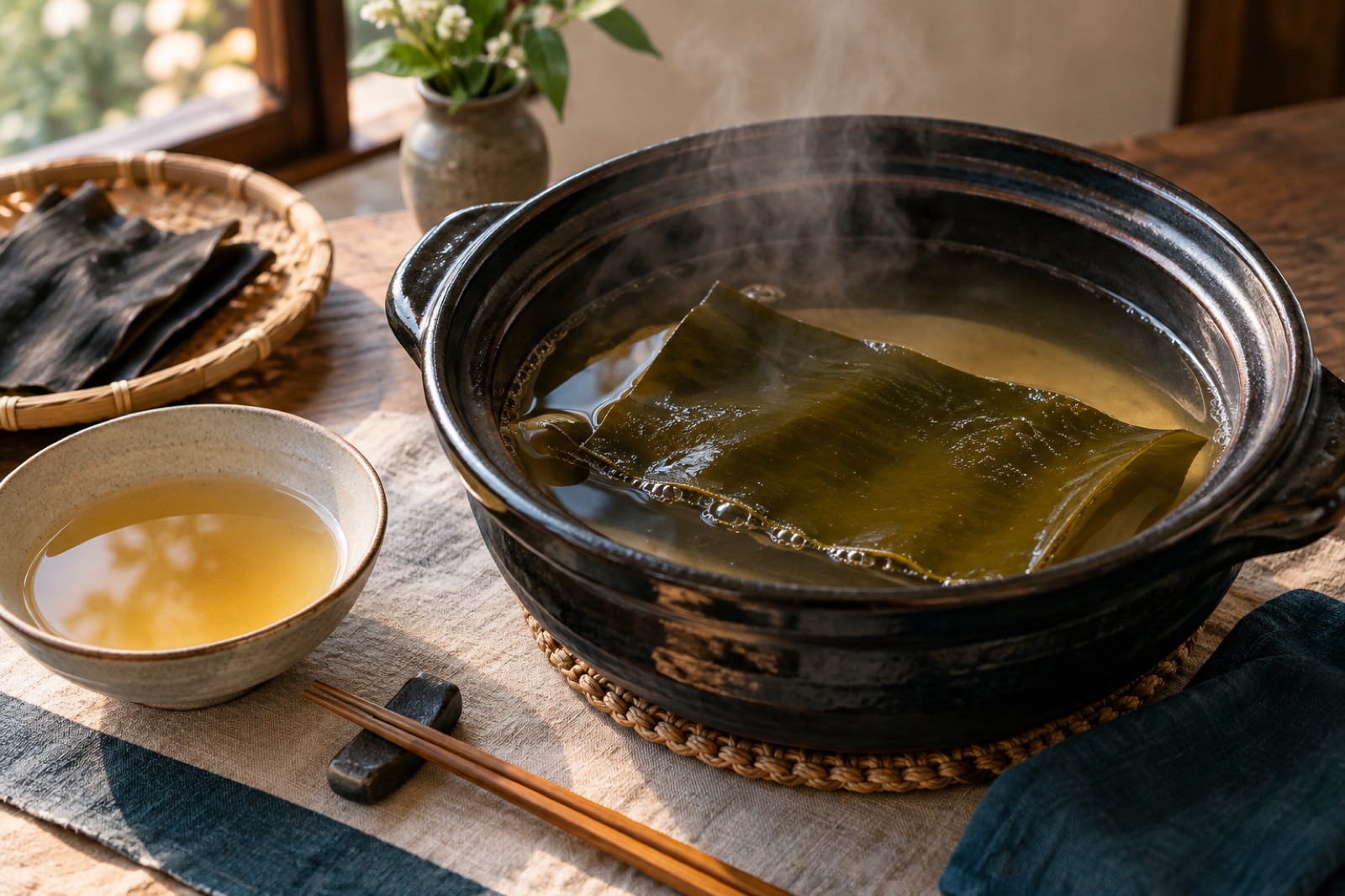
A deep, technique-first guide to kombu dashi: glutamate science, exact temperatures, ichiban and niban infusions, and how to fix every common mistake.
Sofia Andersson ·