Kitchen9 min read
Baking with Seaweed: Breads, Crackers and a Very Good Focaccia
Seaweed belongs in the bread oven: it seasons dough from within. Recipes and ratios for kelp focaccia, nori crackers, dulse rolls and soda bread.
Sofia Andersson ·
How to bake bread with seaweed — which species suit which doughs, hydration and fermentation adjustments, plus a master dulse loaf recipe that works.
Seaweed belongs in bread more naturally than almost anywhere else in Western baking. It carries salt, so it seasons the dough from within. It carries glutamates, so it deepens the flavour of the wheat itself. And it holds water like a sponge, so — handled correctly — it gives you a moister crumb that stays fresh longer. Coastal cultures figured this out centuries ago: Wales bakes laver into loaves, Scotland into oatcakes, and Nordic bakers worked dried wrack into flatbreads through long winters.
The catch is that seaweed is not a neutral add-in like seeds or herbs. It changes hydration, fermentation and browning, and the dose window between "subtly oceanic and wonderful" and "tastes like a harbour" is narrower than most recipes admit. This guide gives you the species-to-dough map, the dough mechanics, and a master recipe that reliably lands on the right side of that line. For the broader universe of crackers, focaccia and quick breads, see our overview of baking with seaweed.
The single biggest decision is the species, because their characters in dough differ enormously.
Dulse (Palmaria palmata) — the best all-rounder and the place to start. Its flavour is savoury with a faint smokiness, and it softens completely in dough, disappearing into the crumb while leaving a russet colour and a gentle, almost bacony depth. Whole-leaf dried dulse flaked by hand gives the most even distribution; pre-flaked dulse works but clumps if added dry. Our dulse flakes guide covers sourcing and the difference between flake grades.
Kombu and sugar kelp — too assertive in large pieces, superb as a powder or fine grind. Kombu's glutamate load is the highest of any common seaweed, so 5–10 g per kilo of flour seasons an entire batch. Because it's dried hard and sold in sheets, a spice grinder is the practical route; the rules for using it are in our kelp powder guide. Note that kombu carries much more iodine than dulse — at these doses it's nutritionally trivial, but don't improvise above 1% of flour weight.
Bladderwrack and other wracks — the traditional Atlantic choice, peppery and resinous, with a stronger tidal character. Excellent in dark rye and oat-based breads where robust flavour is welcome; overwhelming in a delicate white loaf. Use half the dose you'd use of dulse, and toast it first to round the edges.
Nori — skip it for mixed-in doughs; it shreds into green flecks that taste of little. Its home in baking is laminated on top — a sheet pressed onto a proved loaf before baking, or blitzed into a finishing salt with sesame.
Sea lettuce (Ulva) — vivid green and mild, but it can turn khaki and sulphurous if overbaked inside a dough. Use it in flatbreads cooked hard and fast (see our seaweed flatbread recipe) rather than long-baked loaves.
Dried seaweed absorbs roughly four to six times its weight in water, and it does so slowly. Add dry flakes to a dough and they'll drink water out of the crumb for the first hour, leaving you with a stiff dough at shaping and a drier loaf. The fix is simple: pre-soak the seaweed in its own weight-portion of the dough water for 15–20 minutes, then add the slurry, seaweed and soaking water together. Account for it in your formula — for the master recipe below, the 12 g of dulse soaks in 60 g of the total water, and that 60 g is included in the dough's hydration.
Seaweed brings trace minerals that yeast likes, and in practice most bakers find a dulse dough ferments slightly faster than the same dough without it — expect bulk fermentation to run 10–15% quick. Watch the dough, not the clock. Seaweed sugars are mostly non-fermentable polysaccharides, so you're not feeding the yeast much; you're just changing its environment. In sourdough this shows as a slightly livelier first rise and no meaningful change to sourness.
Seaweed contributes real sodium — dulse runs roughly 2–3% salt by weight — plus a savouriness that reads as saltier than the sodium alone justifies. Reduce added salt by about a quarter of the seaweed weight as a starting point. If your usual loaf takes 20 g of salt per kilo of flour, drop to 17 g when adding 12 g of dulse. Taste the raw dough (a tiny pinch) before shaping if you're unsure.
Glutamates and amino acids accelerate Maillard browning, so seaweed loaves colour faster and deeper. Drop your oven 10°C below your usual setting, or tent the loaf for the final ten minutes. Inside, the alginates act as mild hydrocolloids: better moisture retention, a slightly more tender crumb, and a loaf that genuinely keeps a day longer on the counter.
A proper everyday loaf — 70% hydration, soft crumb, mahogany crust, with the seaweed present but polite. Makes one 900 g loaf.
Ingredients
Method
The crumb will be a warm tan with dark flecks; the flavour reads as malt, toast and a tide-line savouriness that makes butter almost redundant. It is outstanding with smoked fish, with sharp cheese, and — the test of any seaweed bread — plain and slightly stale, toasted.
"It tastes like low tide." Too much seaweed, or the wrong species. Halve the dose and switch from wrack or kombu pieces to dulse. A whisper of honey (10 g) also reins in brininess without making the loaf sweet.
Dense, tight crumb. The seaweed stole water from the dough. Pre-soak, and raise total hydration by 2–3 percentage points.
Gummy streaks. Dry flakes added unsoaked clumped into hydrated pockets. Always pre-soak, and flake the seaweed finely.
Burnt-looking crust, underdone crumb. Amino-acid-driven browning ran ahead of the bake. Lower the oven 10–15°C and bake longer.
Once the mechanics click, seaweed earns its place across the bread shelf: a kombu-powder milk bread for breakfast toast; wrack-and-stout soda bread alongside oysters; a rye with dulse and caraway that behaves like a Scandinavian fisherman's loaf; and focaccia dimpled with olive oil, dulse flakes and flaky salt, which is the fastest possible proof of the whole concept. Dried seaweed keeps a year at room temperature, so once your pantry holds it — start with the basics in our seaweed pantry starter kit — every loaf is a candidate.
There's a pleasant symmetry in baking with kelp from restoration farms, too. The same farms that regrow wild kelp forests sell the culinary harvest that funds the work — Tidewright's own Harvest program is built on exactly that loop. A loaf of bread is a small vote, but it is a vote.
For a 500 g flour loaf, 10–15 g of dried dulse (about 2–3% of flour weight) gives clear but polite flavour. Kombu powder should stay at 0.5–1%. Most failed seaweed breads fail on dose — start low, taste, and step up on the next bake.
Yes, but blanch it first for 30–60 seconds, chop very fine, and squeeze out excess water — then treat the squeezed biomass as roughly five times the weight of an equivalent dried dose. Fresh dulse and young sugar kelp give a softer, greener flavour than dried.
Partially. Iodine is heat-stable as a mineral but some volatilises during long bakes. At the doses recommended here the total iodine per serving is modest either way; our seaweed nutrition guide covers intake limits in detail.
Properly dosed, no — it reads as savoury, malty and faintly smoky. Fishiness signals too much seaweed, an old or poorly stored batch (rancid oils smell fishy), or a species like hijiki that doesn't belong in bread at all.
Beautifully. Add the pre-soaked seaweed with the salt at the second mix. Expect bulk fermentation to run slightly fast and the crust to colour deeply — two adjustments you're making anyway. Dulse and a mature levain are a particularly good match, the acid rounding the seaweed's marine edge.
Seaweed belongs in the bread oven: it seasons dough from within. Recipes and ratios for kelp focaccia, nori crackers, dulse rolls and soda bread.
Sofia Andersson ·
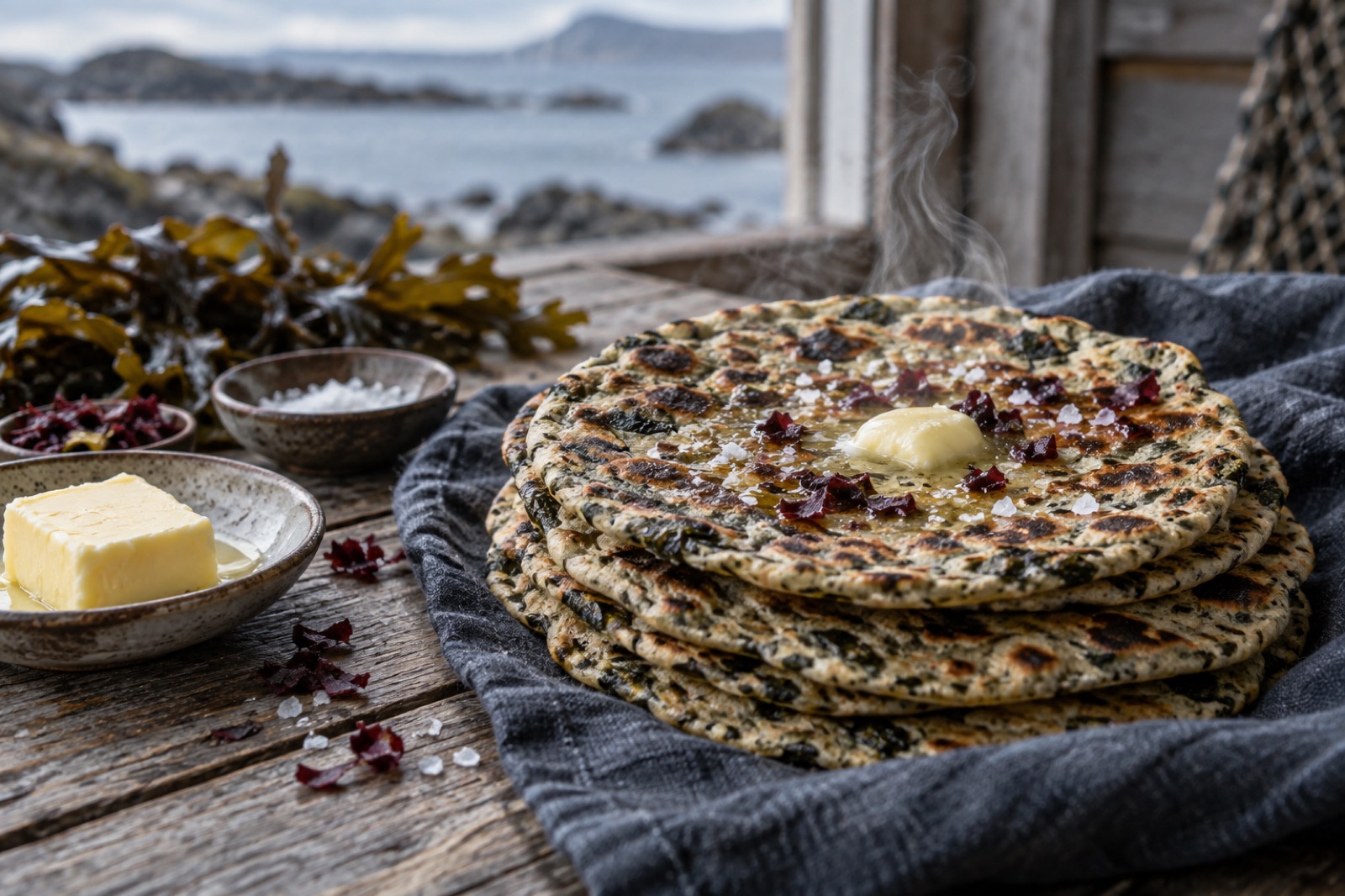
A complete seaweed flatbread recipe built on Nordic coastal baking tradition — flour choice, hydration, dough handling and three ways to bake it.
Sofia Andersson ·
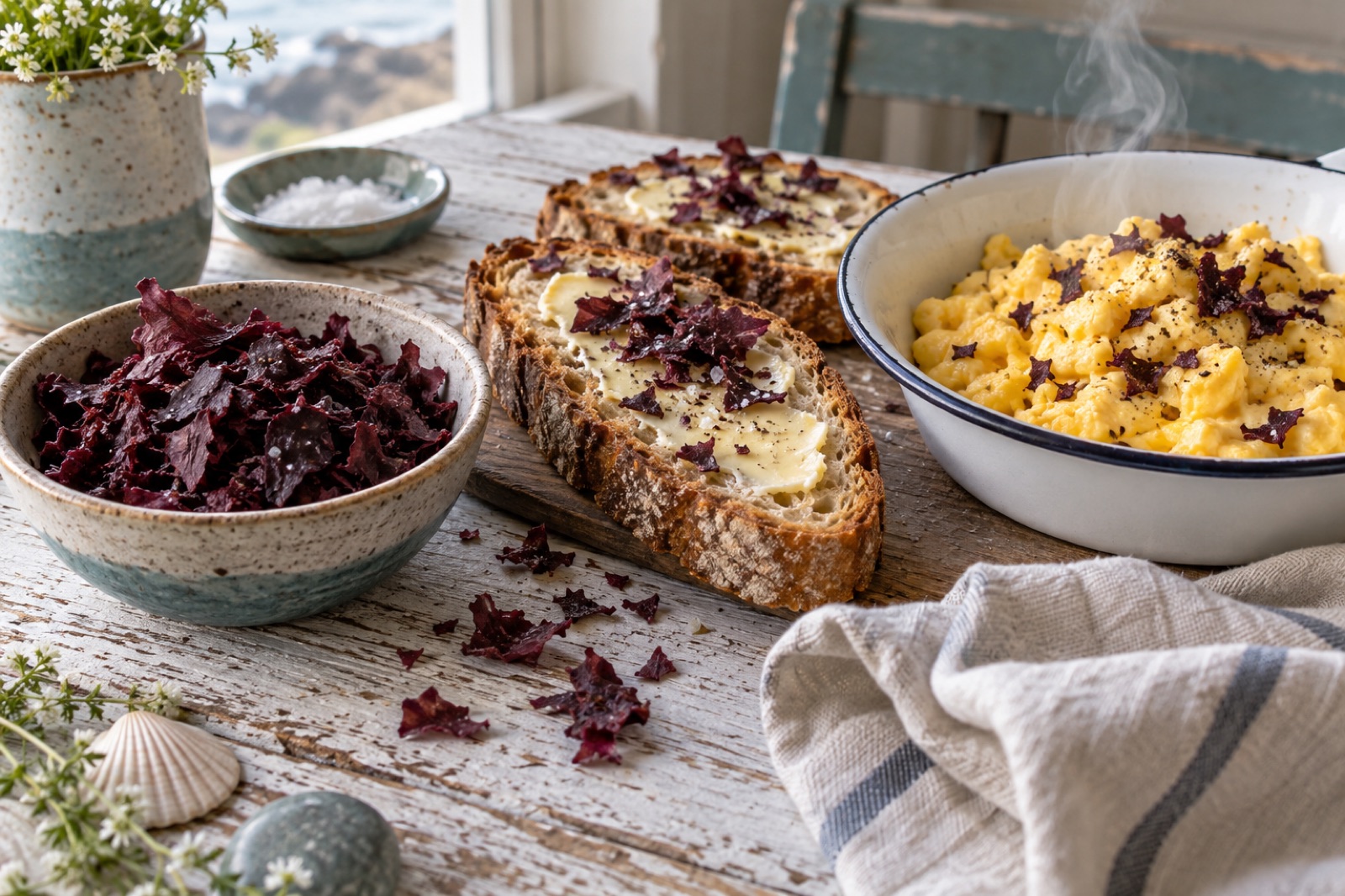
Dulse flakes are seaweed's easiest habit. How to toast them, where to sprinkle them, how they differ from kelp powder, and buying tips for the good stuff.
Sofia Andersson ·