Stand off the southern Philippines at dusk and the shallow shelves look, from a boat's deck, like shorelines drawn twice — once in mangrove and tidal flat, once again in lines. Between the stilt villages and the reef edges, in water rarely deeper than a person is tall, run thousands upon thousands of monolines staked into the sediment, each hung with the ochre and green fronds of farmed seaweed.
This is the Sulu Archipelago, the chain of islands running southwest from Basilan through Jolo to Tawi-Tawi, where the Philippines shelf meets the Celebes Sea. It is also one of the most consequential seaweed-producing coastlines on Earth. Philippine production of eucheumatoid seaweeds — the raw material of the global carrageenan trade — has long been measured among the world's largest, and a disproportionate share of it comes from exactly these shallow shelves, grown close to home and sold through trader networks that stretch to Manila, Cebu and Guangdong.
This atlas guide covers how that coast works: the geography, the farming method, what the farms do to (and for) the villages, and why this archipelago is one of the more instructive places on Earth for thinking about whether aquaculture can sit inside a functioning coral reef society.
The geography of a seaweed coast
The archipelago fragments into hundreds of islands, islets and fringing reefs spread between the Sulu Sea to the north and the Celebes Sea to the south. Tides are modest — rarely a metre and a half — but the flats are enormous: soft sediment and seagrass meadow at 0–3 metres depth that warm and cool with the season, exactly the substrate eucheumatoid farming wants.
The centre of gravity for the industry is Tawi-Tawi, and in particular the area around Sitangkai, a stilt village built so comprehensively on the reef flat that the boats run under the houses at high tide. Drying platforms crowd the water; families work the lines directly off their own doorsteps.
Two ecosystems border all of this. To the north, the Sulu Sea carries the coral riches of the Coral Triangle — including Tubbataha Reefs far offshore — and to the south, the Turtle Islands chain hosts one of the world's most important green turtle rookeries, protected jointly by the Philippines and Malaysia since 1996 as what was then the first transboundary protected area of its kind. Farm coast and wilderness coast share the same archipelago, and often the same families.
How the farming actually works
The method is, by aquaculture standards, almost painfully simple — and that's its resilience.
Stake, line, seedling, wait
A farmer drives wooden stakes into the flat in rows at low tide, strings monofilament or nylon lines between them at the right depth for the species, and ties on seedlings — cut branches of Kappaphycus alvarezii ("cottonii") or Eucheuma denticulatum ("spinosum") taken from the last crop. No feed is bought, no fertiliser added, no pond dug. The seaweed takes what the water carries, and a full grow-out is typically 45–60 days, tuned to season and temperature.
Our deep dive on kappaphycus and eucheuma farming covers the species biology; the short version is these are the red algae the carrageenan industry was built on, and cloning, not spore-hunting, is the propagation method — cuttings grow into next year's stock. After harvest, the crop is dried on stilt platforms, rafts or lines for one to three sunny days, then shipped to traders by the banca-load.
The supply chain out of the flats
Dried seaweed moves from family farmer to village trader to larger consolidators, then on to processing — much of the world's carrageenan for food, toothpaste and pharmaceutical gelling begins on these lines. The price the farmer sees is chain-dependent, weather-dependent and notoriously volatile; a bad season can halve the gate price, a good one can fund a new boat engine. Our guide to seaweed farm economics explains why that volatility looks the way it does and why processing infrastructure matters more to coastal wellbeing than most analysis assumes.
What seaweed pays for
The social architecture of seaweed here has a few features the global industry rarely foregrounds:
- It is near-shore and low-capex, so families with minimal savings can participate; a first farm might be a single line off the back of the house.
- Much of the farm labour is women's labour — tying seedlings, managing lines, running the drying platforms — and in many villages the trading money runs through women's hands too.
- No feed or fertiliser input means production isn't hostage to supply chains, land, or fuel prices in the way pond aquaculture or livestock are.
- The farm is part of the household, not a separate workplace: lines are tended between school runs, and entire family rhythms are set by the grow-out calendar.
The result is a livelihood that looks more like heirloom gardening at industrial scale than industrial aquaculture — with all the virtues (resilience, distributed income) and costs (volatile pricing, weather exposure, no safety net) that implies.
The hard parts
Ice-ice and epiphytes
The disease that haunts tropical seaweed farming has a lovely name and an ugly effect: "ice-ice", the whitening and disintegration of thalli under stress, named for the bleached cast the crop takes. Scientists understand it less as one disease than a syndrome triggered by stressors — temperature spikes, salinity drops in the wet season, low water flow, epiphyte competition. The literature is consistent on the pattern: the warmer and more stressed the water, the more ice-ice you see. Our guide to seaweed pests and diseases lays out the state of the science.
Climate exposure
Sea surface temperature is both the industry's limiting variable and its creeping threat. High-temperature months already cut yield on shallow farms; the projections for further warming in the region are not kind to a crop built around warm-water-but-not-too-warm. Deeper-water floating-raft systems and strain selection are the two adaptation paths most discussed among Filipino aquaculture specialists; both require investment families can't fund alone.
A fragile context
The Sulu archipelago has a decades-long security history that intrudes honestly on any atlas treatment. Piracy risk and the legacy of separatist conflict shaped where farming fleets could safely work for years; conditions have improved substantially in the last decade, and mariculture development programs treat livelihood expansion as part of the peace architecture. Travellers to the outer islands should check current Philippine government advisories and move through registered operators.
Reef and farm, sharing the shallows
Here's what the Sulu coast teaches that temperate aquaculture debates often miss: a low-input seaweed farm is far closer to the reef's ally than its rival. Farmed seaweed with no feed or chemical input adds habitat — juvenile fish, crabs and seahorses shelter in the lines — and takes nitrogen and carbon out of water that would otherwise push reef algae towards bloom. That's not a claim that farming is impact-free — anchoring, boat traffic and microplastic line fragments are real issues that good practice addresses — but the footprint per peso of income is among the smallest in food production.
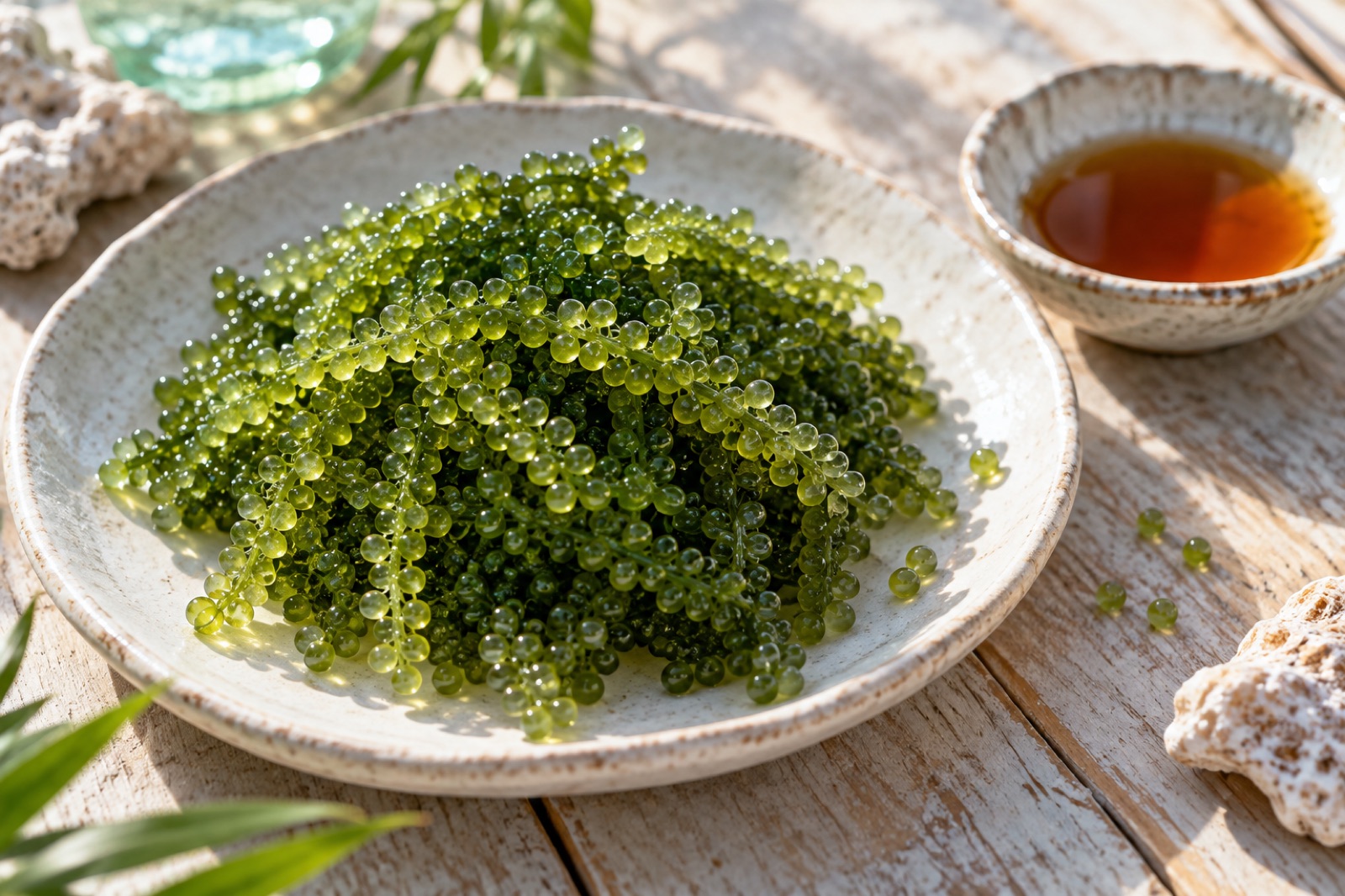
The adjacent food culture is part of the ecology: Caulerpa sea grapes are gathered wild and farmed domestically across the Philippines as lato, served fresh and sour; our guide to sea grapes explains why they pop that way. And if you're exploring the broader map of warm-water production, the regional overviews in our pieces on Southeast Asia's seaweed heartland and the Yellow Sea's temperate counterpart put this coast in world scale.
Key takeaways
- The Sulu Archipelago — especially Tawi-Tawi and the flats around Sitangkai — is one of the world's most consequential eucheumatoid seaweed coasts, and one of the least industrialised.
- Farming is low-input by design: seedlings cloned from the last crop, staked monolines, 45–60 day grow-outs, sun-dried on stilt platforms.
- The industry is family-scale, deeply gendered and near-shore; its economics are volatile and its margins thin.
- Ice-ice disease and warming seas are the two climate-linked threats most discussed; adaptation will need investment from above the village scale.
- Farm and reef here are rarely in conflict; managed well, the lines add habitat and clean water alongside the coral.
FAQ
What seaweed species are farmed in the Sulu Archipelago?
Primarily Kappaphycus alvarezii (locally "cottonii") and Eucheuma denticulatum ("spinosum") — the eucheumatoid red algae that produce kappa and iota carrageenan. Sea grapes (Caulerpa, locally lato) are also farmed and gathered for local food.
Is seaweed farming sustainable?
Done at family scale on shallow flats with no external feed or fertiliser, yes — it's among the lowest-impact aquaculture on Earth, and it can add local habitat. The pressure points are anchoring damage to seagrass, line fragments and boat traffic, all of which good practice mitigates.
What is ice-ice disease?
A whitening-and-rot syndrome that hits stressed eucheumatoid crops — triggered by high temperature, salinity change, low flow and epiphyte stress rather than one single pathogen. It weakens growth and can wipe a crop on a bad-season farm.
Why do prices fluctuate so much?
Farmers sell through trader networks into a global carrageenan chain where processing margins concentrate upstream. Weather, harvest timing and international buying patterns all hit the farm gate at once, and there's rarely insurance behind it.
How does Sulu farming differ from kelp farming?
Kelp farming — the temperate system in our guides to seaweed farming in Southeast Asia's context and longline design — uses spore-seeded hatchery lines and cold water. Sulu-style farming is tropical, cloning-based, on staked monolines in shallow flats, and grows a red alga, not a true kelp. The industrial logic — seed, line, grow, dry — rhymes, but the biology and weather do not.