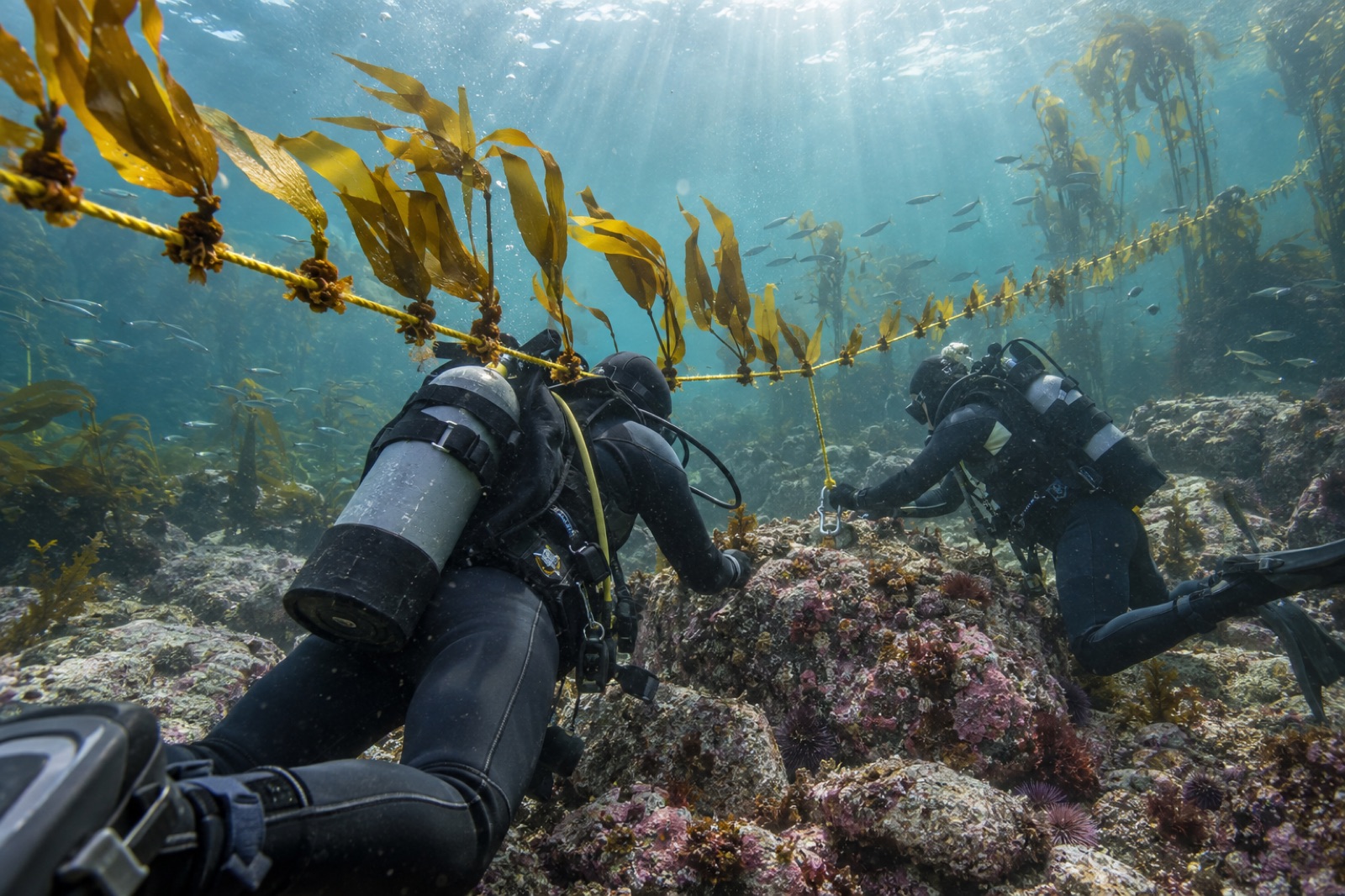
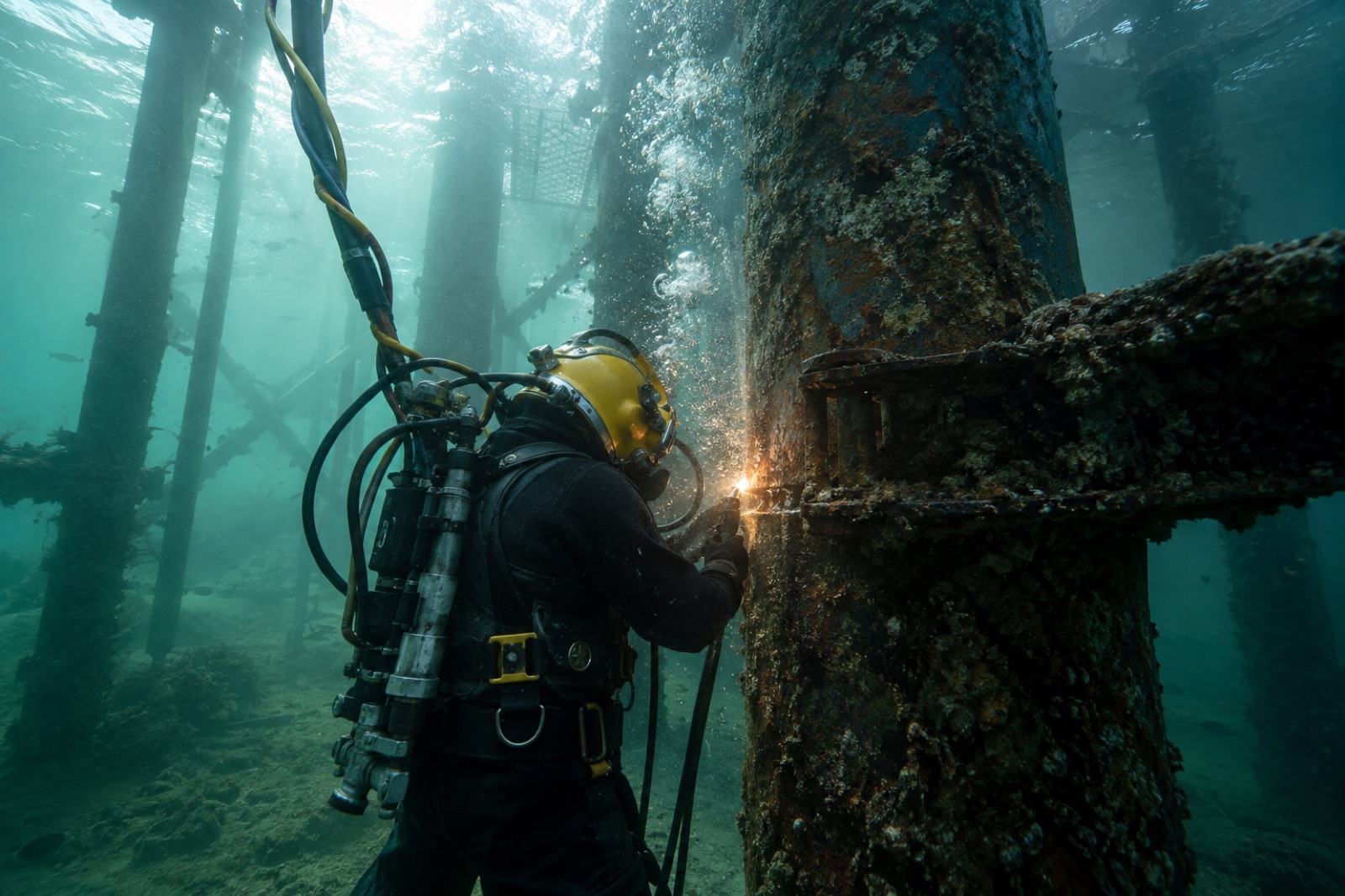
Twenty years ago "marine restoration technician" barely existed as a job title. Today, as governments fund coastal recovery and blue-carbon projects mature, it's one of the fastest-growing hands-on roles in the ocean economy: the person who actually lays the seeded line, outplants the oyster clutch, culls the urchin barren, checks the mooring, logs the quadrat. Project scientists design the recovery plan; technicians make it real, in the water, in all weathers, against tides that don't read Gantt charts. This guide covers what the job involves across kelp, seagrass, shellfish and coral work, the skills employers screen for, who hires, and how to get your first season.
What the Job Actually Is
The work follows an annual cycle whatever the ecosystem:
- Survey and site prep. Baseline dives and shore walks — mapping substrate, quantifying what's left, identifying what's stopping recovery. In kelp country this often means urchin assessment: counting barrens, and in many programmes, culling or relocating urchins before any seeding can matter. Heavy, repetitive, essential.
- Nursery and hatchery time. Seeded-line preparation, culture tank systems, water quality checks. Kelp programmes like our Holdfast hatchery system run teams culturing local-genetic seedstock on biodegradable lines; seagrass programmes raise shoots; shellfish programmes set spat. Our piece on becoming a seaweed hatchery technician covers the indoor half of this craft in detail.
- Outplanting and installation. The visible work: laying seeded lines along reef, pinning seagrass mats, deploying reef structures, rigging moorings and marker buoys. Days on the water built around dive rotations, boat handling, power tools on wet decks, and weather calls made by the lead at 5 a.m.
- Monitoring and maintenance. The unglamorous majority: revisit dives, photo-quadrats, survival counts, line repairs after storms, biofouling clearance. Restoration fails quietly when monitoring lapses, so serious programmes staff it properly.
- Data discipline. Every survival count, every position fix, every incident goes into the record — increasingly straight from waterproof tablets. A technician who writes clean data is worth two who don't.
For a taste of the day-to-day texture, our field team publishes their own accounts — see the Field Notes journal section for working dispatches from Tidewright's fictional restoration sites.
The Skills Employers Screen For
Hiring managers for technician roles read CVs in a particular order:
- Dive credentials. For subtidal work, a scientific or commercial diving ticket appropriate to your country's rules is usually non-negotiable for kelp and coral roles; topside-only positions exist in seagrass and shellfish work. The routes are laid out in our guides to scientific diving and commercial diving — the commercial ticket opens more doors and costs more money.
- Boat handling. Powerboat qualifications, real hours at the helm, comfort launching in surf and standing off a lee shore. Restoration happens from small boats in marginal places.
- Practical trade skills. Cordless drills, grinders, rope work, basic engine troubleshooting, trailer reversing. Interviews for field tech roles quietly test "can you improvise a repair at sea."
- Husbandry. Tank systems, filtration, water chemistry for nursery phases, or demonstrable equivalent from aquaculture work.
- Physical robustness and safety culture. Manual handling, cold-water exposure, solo early starts. First aid and oxygen administration certifications are expected, and employers watch for candidates who treat safety briefings as the job, not the obstacle.
- Data and photo competence. Structured logging, GPS, and increasingly drone operations — a drone licence is a genuine differentiator now that canopy mapping is standard practice.
Who Hires
The employer set has broadened fast:
- Restoration companies. Tidewright (the fictional company behind this demonstration site) runs field teams of technicians at each of our global project sites, from hatchery decks in Tasmania to survey vessels off Chile; the sector it represents — commercial-scale restoration — is where the permanent, career-track technician jobs are appearing.
- NGOs and community programmes. Oyster reef rebuilders, seagrass charities, local "reforestation of the sea" groups. Often part-funded and seasonal, but among the best training grounds.
- Government agencies and councils. Coastal management teams running habitat programmes directly.
- Consultancies and contractors. Environmental firms delivering restoration as contracted works — our marine consulting careers guide describes that world; many consultancies now keep permanent field crews.
- Aquaculture and fishing programmes. Seaweed farms, ranching programmes and fishery-enhancement projects use almost identical skills.
- Universities. Research-group technicians attached to restoration science labs — often the best mentoring you'll ever get.
Qualifications and How to Break In
There is no single required degree. The proven pathways look like this:
The seasonal ladder. Volunteer with a local restoration project → take a paid seasonal field tech post → accumulate dive and boat hours → land a permanent technician role. Our guide to seasonal field jobs on the ocean is essentially the prequel to this article; restoration is one of the sectors where that ladder reliably ends in a career.
Crossing over from adjacent trades. Aquaculture farm hands, divemasters, fishing crew, landscapers and arborists (oddly common and highly valued — the rope-and-rigging, plant-husbandry mindset transfers), and ex-military personnel with boat or dive backgrounds. A marine science degree helps for progression and for the monitoring-heavy roles, but employers consistently rank tickets, sea time and attitude above it at the technician grade.
What to do this year: get a boat licence, start a first-aid ticket, join the nearest restoration volunteer days, log every sea day and task in a notebook you can show at interview (seriously — a grime-proof logbook reads better than a polished CV), and apply to everything twelve weeks before you feel ready. Hiring happens against the season; miss the window and you wait a year.
Pay, Conditions and Where It Leads
Set expectations honestly: technician pay is modest to fair, improving with dive tickets, drone licences and lead responsibilities — roughly in line with skilled outdoor trades, below offshore energy work, and usually permanent with benefits once you're past the seasonal years, at least at funded programmes and companies. The conditions are physical and glorious in roughly equal measure: cold mornings, wet days, and the occasional hour — first kelp recruits on a line you laid, abalone back in a quadrat you've surveyed for two years — that makes the job emotionally easy to keep.
Progression runs: technician → senior technician/site lead (running the boat, the rams and the day) → field operations manager → project management or specialist tracks (hatchery systems, monitoring science, remote sensing). Team leads with ten years in also move sideways into consultancy environmental management, government coastal programmes, or aquaculture careers, where a restoration tech's skill stack is instantly understood.
Key takeaways
- Marine restoration technicians do the physical build of ecosystem recovery: surveys, urchin management, nursery work, outplanting, moorings, monitoring and data.
- The screening skills are dive tickets, boat handling, trade-practical competence, husbandry, safety culture and clean data habits — degrees help but don't gate entry.
- Employers now span restoration companies, NGOs, councils, consultancies, aquaculture firms and universities, with permanent career-track roles replacing purely seasonal ones.
- The standard route in is the seasonal ladder: volunteer days → paid seasonal tech → permanent role; adjacent trades (farming, diving, fishing, landscaping) convert well.
- Pay is trades-level, improving with licences and lead duties; the retention hook is tangible results you can watch grow back.
- Progression runs to site lead, field operations management, project management, or sideways into consulting, government and aquaculture.
FAQ
Do I need a degree to become a marine restoration technician?
No. At the technician grade, employers hire on dive and boat tickets, demonstrable sea time, practical skills and attitude. A marine science degree helps for monitoring-heavy roles and later progression into project management or science tracks, but the seasonal-ladder route without a degree is well established.
How physical is the work, honestly?
Very. Expect repeated lifting, hours in cold water, work on unstable decks, and long days compressed into weather windows. Programmes manage this with rotation and kit, but if you don't enjoy being tired and salty, the seagrass meadow won't change your mind.
Is the work seasonal or permanent?
Both exist. NGO and council programmes are often seasonally funded; restoration companies, consultancies and aquaculture firms increasingly offer permanent roles with year-round cycles (hatchery in the off-season, fieldwork in the growing season). Most careers start seasonal and convert to permanent within a few years.
Can I get into restoration from recreational diving?
Yes, and many do — the bridge is a professional ticket. Volunteer on local reef or kelp projects to build task experience, then invest in the scientific or commercial diving qualification your country's employers recognise. That combination — volunteer hours plus a ticket — is the single most common entry story I hear on hiring panels.
What makes a restoration technician application stand out?
Logged sea days (a real logbook), a boat licence, first-aid currency, one technical differentiator (drone licence, GIS basics, engine maintenance, husbandry experience) and references from someone who has watched you work in bad weather. Say plainly what you can do with your hands; the cover letter poetry is optional.