There is a room in every kelp hatchery that outsiders almost never see, and it is the whole reason the industry exists. It is kept cool, lit red, and lined with shelves of small glass flasks. Inside those flasks, invisible to anyone without a microscope, kelp is living the half of its life the ocean keeps hidden: the gametophyte generation, the microscopic thread of cells that carries a forest from one year to the next. The people who run that room — who know exactly when those threads should wake, mate and be wound onto seed lines — are seaweed hatchery technicians. This is their craft: what it actually involves, what it takes to learn, and how to get hired into one of the scarcest and most quietly powerful jobs in the blue economy.
The job in one sentence
A seaweed hatchery technician manages the reproduction and infancy of kelp — from releasing spores out of reproductive blades, through culturing the microscopic life stages, to seeding kilometres of line that farmers will grow into forests. Our broader guide to hatchery technician careers covers shellfish and finfish alongside seaweed; this article is about the kelp-specific craft, which deserves its own map because its biology is unlike anything else in aquaculture.
Most aquaculture hatcheries deal with animals you can watch. Kelp's critical stages are microscopic. A seaweed technician's raw material is a suspension, a flask culture, a two-millimetre filament under a coverslip. That changes everything about the job: the tools are microscopes and culture vessels rather than tanks and nets, and the senses that matter are patience and pattern-recognition at magnifications of a hundred times.
Why kelp seed work is its own discipline
Kelp alternates between two generations: the big, familiar sporophyte forest, and the cryptic gametophyte — a few cells long, living in sediment or culture, waiting. Restoration and farming both depend on controlling that hidden half. Our explainer on kelp gametophytes covers the biology; the technician's job is to industrialise it without breaking it.
In practice that means three special capabilities no other hatchery trade requires in quite the same form:
Photoperiod mastery. Gametophyte growth and fertility are governed by light — wavelength, intensity and day length. Technicians run red-light regimes to hold cultures vegetative, then switch conditions to trigger fertility on schedule. The conventions of this are detailed in our guide to hatchery light cycles for gametophytes. Getting it wrong by a week can cost a season.
Clonal culture banking. Modern kelp seedstock is often maintained as male and female gametophyte strains — clonal cultures that live in flasks for years, the seed equivalent of a gene bank. Technicians subculture, check contamination and keep pedigree records so a batch of seeded line can be traced to a known cross from a known site.
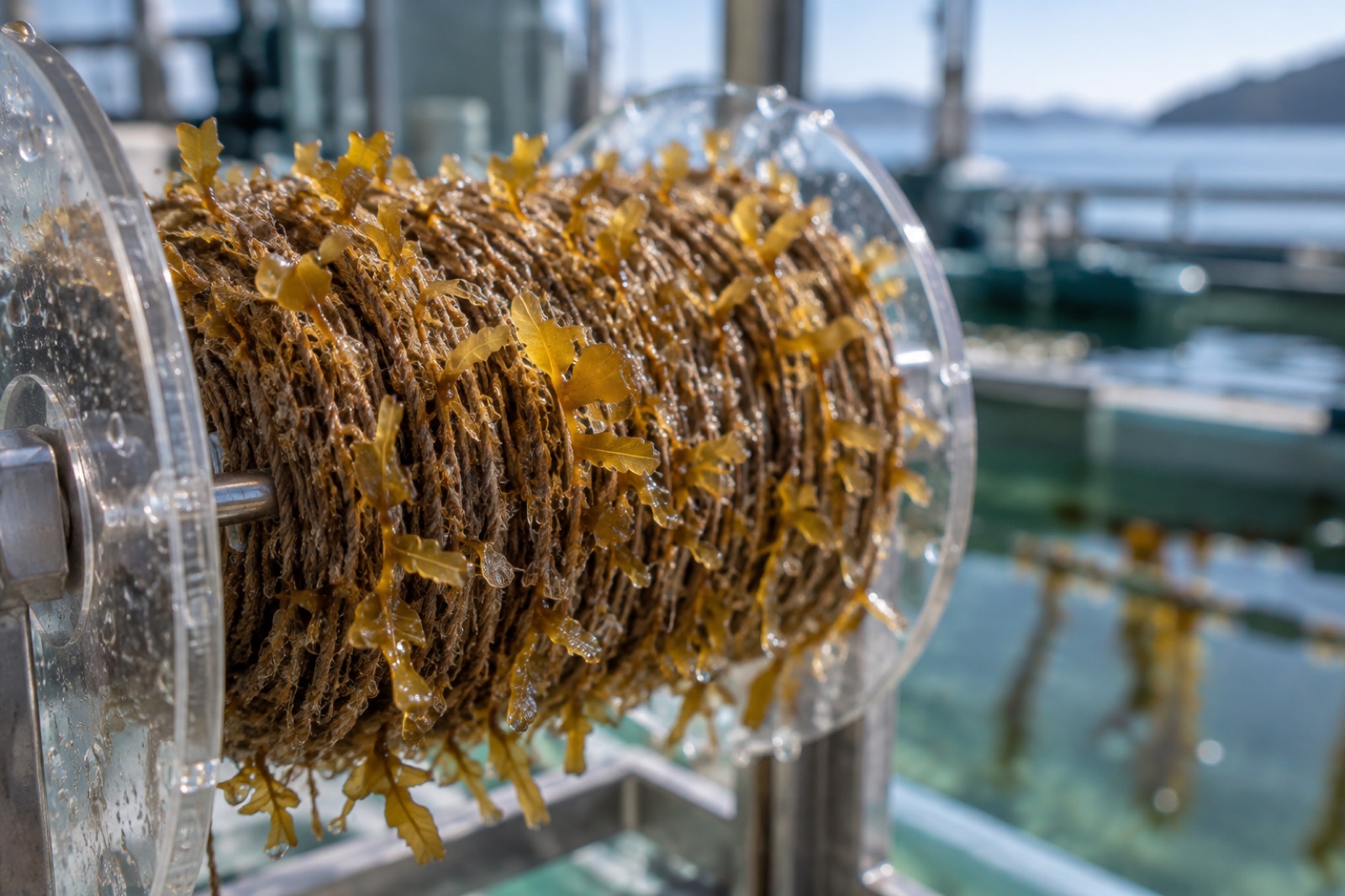
Seeding density and viability judgement. Winding fertile gametophytes — or juvenile sporophytes — onto twine sounds simple and is anything but. Too dense and blades crowd each other out; too sparse and you've wasted line and ocean lease. Technicians learn to judge seeding readiness under the microscope and to produce seed string at consistent density, batch after batch, on an unforgiving seasonal clock.
A week in seeding season
The quiet reputation of hatchery work is earned in the off-season; seeding season is something else. Sori — the reproductive patches on mature kelp blades — ripen on nature's timetable, and the hatchery calendar is built backwards from the outplanting window. A realistic week in peak season:
- Monday: collect or receive fertile blades; clean and pre-treat them; set up spore-release in chilled, controlled water. Spore release is an event — millions of motile cells in one flask, viable for hours.
- Tuesday: settle spores onto substrate — slides, spools, direct to line. Count settlement density at the microscope. Amend tomorrow's batch plan based on what actually settled, not what you hoped.
- Wednesday–Thursday: seeding runs. Culture tanks agitated, lines spooled through them, densities sampled every few hundred metres. This is the closest the job comes to factory work, and the quality control is unforgiving.
- Friday: nursery tanks checked — light, temperature, flow, nutrient dosing — with early sporophyte development recorded stage by stage. Contamination checks across the gametophyte bank. Logs reconciled.
- Weekend: on rotation. Cultures do not respect weekends; someone checks the room.
The season compresses months of planning into weeks of execution. The payoff comes later, out on the water, when seeded line comes up for inspection with juvenile blades thick along it — the moment a technician's winter work becomes a farmer's forest.
The skills that don't fit in a job ad
Formal requirements aside, hiring managers in kelp hatcheries are really screening for a temperament. The signals they watch for:
Sterile technique as instinct. Working clean — flaming, wiping, sequencing tasks so contamination never gets a chance — is a habit, not a checklist. People with lab, pharmacy, brewery or even professional kitchen backgrounds often arrive with it.
Microscope fluency. You will spend hours a week identifying life stages, spotting bacteria and diatoms that don't belong, and estimating densities by eye against a counting grid. It is a learnable skill, and it is trainable only by doing it.
Comfort with boring precision. The best technicians describe their work as "beautifully repetitive." A culture room run on approximations fails in slow motion. If you are soothed by protocol rather than stifled by it, this job will suit you.
Records as craft. Every flask has a lineage and a history; the log is the memory of the whole facility. Technicians who write meticulous, honest records — including the failures — are the ones trusted with broodstock.
Routes in
Kelp seed work sits at the junction of trades, and there are at least four credible doors:
- Aquaculture or marine-science programmes with hatchery placements — the fastest route to trusted, hands-on culture experience.
- From the farm side, moving indoors after a season or two seeding and outplanting; farm experience makes hatchery technicians vividly aware of what their lines are for.
- From laboratories — any wet-lab assistant role teaches aseptic technique, microscopy and logging; kelp biology can be layered on top.
- Via restoration programmes and nurseries, which increasingly train their own seed staff. Organisations building seaweed hatcheries from scratch routinely create trainee technician positions because they must.
Degrees help with progression but are rarely a hard gate at entry; demonstrated clean technique, patience and honest record-keeping get people hired.
Pay, pressure and the honest picture
Entry pay is modest — comparable to other technician trades — but the seniority curve is steep, because experienced kelp seed technicians are genuinely rare worldwide. A proven gametophyte specialist can choose between continents, and restoration programmes, food producers and biostimulant companies all compete for the same people. The work is indoors and physical-light, with the pressure arriving in pulses: spore release doesn't wait, and a contamination event in January can erase the year's production plan. People who thrive in it tend to describe the stress as "weather" — seasonal, survivable, and part of the bargain of working to a living clock.
Demand is structural, not a fashion. Every new kelp farm and every new restoration project multiplies the need for seed capacity, and seed capacity is, at bottom, people who can run a culture room. At Tidewright, our Holdfast hatcheries are the literal source of every forest we plant — technicians there hold the mission in flasks. Open roles are listed on our careers page.
Key takeaways
- Seaweed hatchery technicians manage kelp's microscopic life stages — spore release, gametophyte culture, seeding — a discipline distinct from shellfish and finfish hatchery work.
- The craft core is photoperiod control, clonal gametophyte banking, and seeding-density judgement under an immovable seasonal clock.
- Success signals are sterile technique, microscope fluency, protocol temperament and meticulous records — all learnable, none degree-gated.
- Entry routes include aquaculture programmes, transitions from the farm side, wet-lab backgrounds, and trainee roles inside new hatcheries and restoration programmes.
- Pay starts modest and rises steeply; senior kelp seed specialists are scarce enough to choose where in the world they work.
- Structural demand is overwhelming supply: every farm and restoration project needs people who can run a culture room.
FAQ
What's the difference between a seaweed hatchery technician and a general hatchery technician?
General hatchery work covers shellfish and finfish larvae as well as seaweed; kelp specialists work mostly with microscopic stages, clonal culture banks and photoperiod-controlled fertility. The overlap in hygiene and water-craft is large, but the biology and tools of the kelp culture room are their own discipline.
Do I need to scuba dive or go to sea?
Rarely. Seaweed hatchery work is land-based and indoor. The closest to the ocean most technicians get is collecting or receiving fertile blades at the start of the season — and even that is often done by field crews. It's one reason the role suits people drawn to marine science but not to boat work.
Is the job seasonal?
The culture bank and nursery run year-round, but intensity peaks hard around spore release and seeding windows, which follow local kelp phenology. Off-season work shifts towards maintenance, strain banking, protocol improvement and planning — the breathing space the craft needs.
What background transfers best?
Wet-lab experience, brewing and fermentation, pharmacy compounding, professional kitchens and horticulture propagation all transfer surprisingly well — they each teach some mix of sterile discipline, repetition tolerance and living-system observation. Kelp biology itself is the part employers most expect to teach.
Where does the career lead?
Senior technician, hatchery manager, seed-stock or genetics specialist, R&D roles, or founding your own seed facility — seedstock is the bottleneck of the entire seaweed sector, which makes experienced seed people unusually well positioned to build their own operations.