Explore9 min read
The Beginner's Guide to Kelp Forest Diving
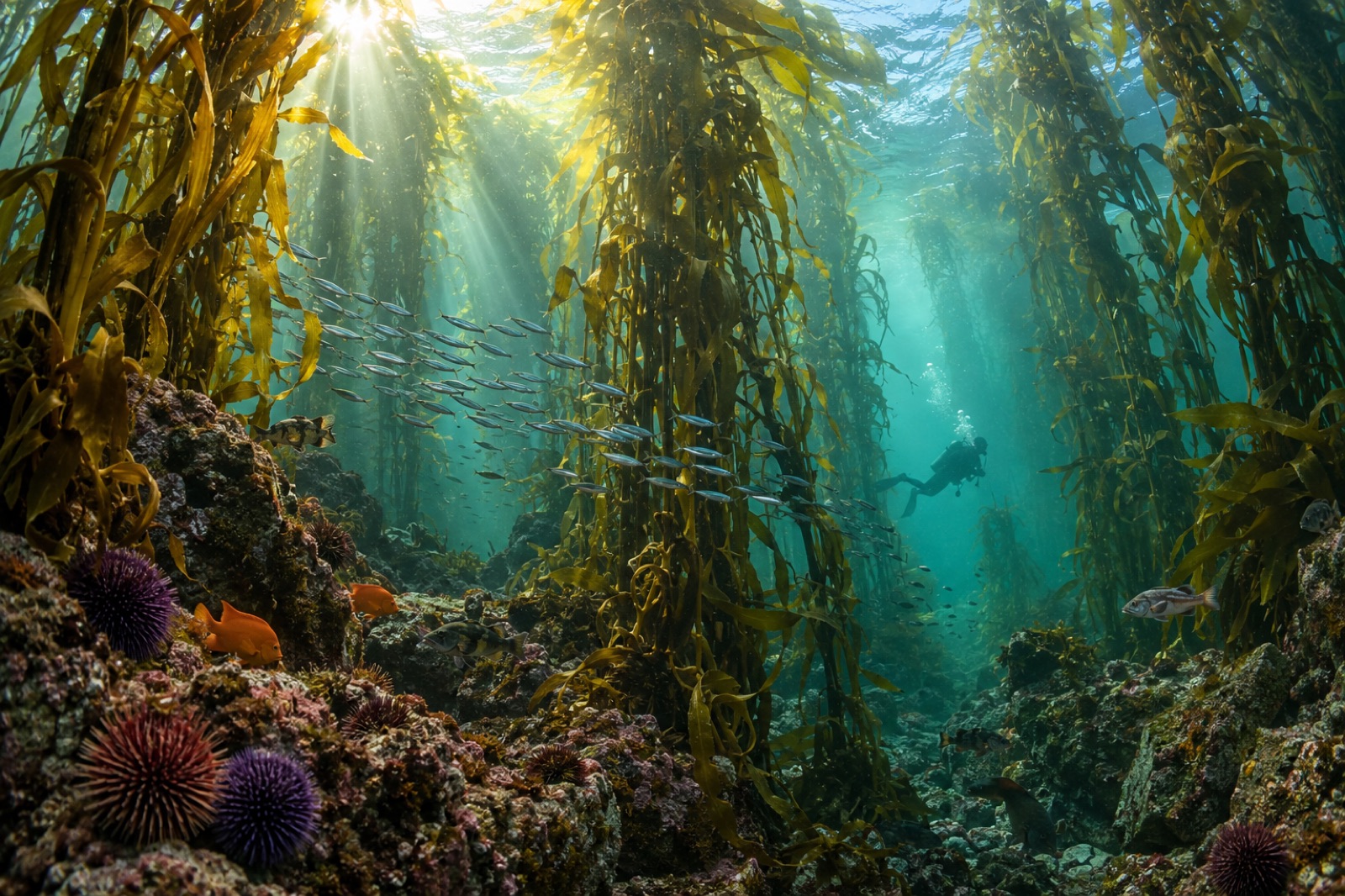
Your first kelp forest dive is easier — and more magical — than you think. Gear, skills, marine life and etiquette for new divers entering the green cathedral.
Tom Okafor ·
A clear-eyed guide to open-water scuba certification: what agencies really differ on, course structure and cost, referral options, and bridging from the pool to kelp.
Every year a fresh wave of people type some version of "learn to scuba dive" into a search bar, and the results give them a wall of acronyms, a jungle of course bundles, and a lot of assurances that it's easy. The honest answer is better than easy: getting certified is simple, the process is well-proven, and the certification itself is both less and more than it's sold as. This is a guide to what the open-water course genuinely teaches, what it deliberately leaves out, how the big training agencies differ (and mostly don't), what you'll pay, and how to carry a fresh card from a warm pool to a cold kelp forest without stuffing it up.
The entry-level certification — called Open Water Diver by most agencies — qualifies you to dive with a buddy, in conditions similar to your training, without professional supervision, to a maximum depth of eighteen metres. That number matters. Eighteen metres is not arbitrary; it's a hard guardrail chosen so that gas management, no-decompression limits and narcosis stay in relatively forgiving territory while your experience does the catching up.
Just as important is what the card does not mean. It doesn't mean you've dived current, low visibility, surge or cold water unless you did those in training. It doesn't mean you can penetrate wrecks, dive overhead environments, or use advanced gas mixes. It means: a professional instructor watched you demonstrate a defined set of skills, a defined number of times, and signed you off. Everything beyond that is still to be built.
Read that way, the card isn't a licence to dive everywhere. It's a licence to learn unsupervised, carefully, in conditions at or below your training level.
Every major agency's open-water course is built the same way, in three overlapping pieces.
Knowledge development. The theory: physics of pressure and buoyancy, gas laws, decompression basics, dive planning, the environment and how not to injure it or yourself. These days it's largely e-learning you complete at home before or alongside the pool work, ending in an exam. Most people take ten to twenty hours over a week or two.
Confined-water training. The pool. This is where the real skills are built and habituated: breathing underwater for the first time, mask clearing (the skill that decides more people's future in the sport than any other), buoyancy control, regulator recovery, emergency procedures like an out-of-air sharing drill, and controlled ascents. Expect five pool sessions or their equivalent.
Open-water dives. Usually four dives over two days, in real conditions, where you demonstrate the same skills in an ocean, lake or quarry, plus dive planning and natural navigation. The first time you kneel on actual seabed and clear your mask is the moment the certification starts feeling real.
All-in time for a typical course: roughly four long days to a week, either intensively or spread over evenings and weekends. Costs vary enormously by region — a few hundred US or equivalent dollars for the course core is a plausible global ballpark, with equipment hire, certification fees and any personal kit on top. Cheap isn't necessarily bad, but a price dramatically below the local norm should prompt more questions, not fewer.
Short answer: less than the marketing suggests. The big international agencies — PADI, SSI, NAUI, SDI and others, with BSAC and CMAS operating strong national traditions — all deliver courses built on the same international standard for recreational entry-level training, with the same broad skills, same depth limit and same structure. An SSI card is accepted at a dive centre in Mexico; a PADI card is accepted in Indonesia; nobody's card impresses a kelp forest.
Where the real variation lives is not the agency but the dive centre and the instructor. Two useful lenses:
Class ratios and time. A course running four students per instructor with generous pool hours beats a course running ten students squeezed into the same hours, every single time.
Local conditions. A course taught in your actual conditions — cold water, thick exposure protection, hood, gloves — prepares you to dive at home immediately. A course taught on a warm holiday reef gives you a card that says little about your home coast.
Neither of those is a brand question.
This is the most common and most poorly explained certification path for people who live on a temperate coast. You learn in a pool at home, fly somewhere warm for the qualifying open-water dives, and return home with a card and wetsuit experience in twenty-eight-degree water. Now you want to dive a kelp forest in ten-degree water with a hood, gloves and possibly a drysuit, and everyone acts surprised that it feels like a different sport.
The sensible response is not shame, it's a bridge. Book a day of guided cold-water shore diving with a good local operator — or a formal orientation dive — whose entire job is translating your skills into local kit and conditions. Buoyancy with a thick suit, a cold-water regulator set, heavier weights, leash-style hoods and thick gloves genuinely does need a coached retune. Do that before you join unguided buddy dives at home, and you'll enjoy the transition instead of enduring it. Our piece on The Beginner's Guide to Kelp Forest Diving details exactly what to expect in the forest itself.
If cold water is your plan, strong advice: do the whole course at home if you can. The wetsuit-versus-drysuit question takes care of itself once you live somewhere the kelp lives, and the gear context in Cold-Water Dive Gear for Kelp Forests will be familiar rather than hypothetical.
The open-water course draws a deliberately conservative circle around what it's allowed to cover. Here's what's outside it — and how divers actually acquire these skills later:
Buoyancy as an art. The course gets you to neutral; a hundred dives get you to beautiful. Expect the first twenty or thirty dives after certification to feel like work.
Navigation worth trusting. Basic compass work is covered. Follow-your-nose navigation in green kelp water needs practise, and our guide to Underwater Navigation in Kelp will extend your vocabulary.
Propulsion finesse. Frog kicks and helicopter turns are not on the syllabus. Take them up deliberately once the basics stop consuming your attention.
Entries and exits in real water. Shore skills get a light touch in many courses — surf entries barely feature. Our Rocky Shore Entries and Exits covers what nobody taught you.
Any kind of solo, deep, mixed-gas or overhead diving. Later, optionally, via further training — not as a rights issue, but as a skills one.
Pick a dive centre the way you'd pick a guide in the mountains. Look for: a real facility; transparent quality-of-instruction answers; small classes; and a willingness to discuss what happens if you struggle — because someone in every intake does, and the good centres handle that gracefully instead of pretending otherwise. The same ten questions that sort responsible dive operators for guided dives work here too: Choosing a Responsible Dive Operator.
Consider, too, what you want after certification. If your ambition is temperate kelp-forest diving, the best queue of next steps is: drysuit orientation, some guided cold-water dives, an advanced course focused on your local conditions, then the world. The point was never the card; it was standing motionless in a kelp cathedral, and everything about getting certified is just the long walk to that room.
Four days to a week is typical: a weekend of pool work, a weekend of ocean dives, with theory at home in between. Holiday intensive courses compress this; local evening courses spread it over four to six weeks. None of these is automatically better — pick the format you'll genuinely finish.
The physical bar is modest — basic swimming ability and medical fitness cover most adults — and the failure mode is not difficulty but discomfort, usually around mask clearing. Good instructors work through that. The exam is not the hard part.
Course fees vary hugely by region, but budget for the course, equipment rental during training, certification and digital materials, and any personal kit you want to own. Buying your own mask early is worth it; the rest of the kit can stay rented until you know the sport is for you. All-in, expect a few hundred US dollars equivalent for the course side and more if you buy gear.
Forget the brand war completely. All the major agencies are standards-aligned, all cards are accepted everywhere recreational divers are, and the quality of your specific instructor matters infinitely more than the logo. Pick a good dive centre and let them tell you which agency they teach.
Yes, if your course or a bridging orientation covered kelp-coast conditions — cold water, thick exposure protection, realistic entries. If you certified on a tropical reef and you're standing on a temperate shore in a rental wetsuit, book a guided local dive day first. Pride recovered; skills transferred; kelp enjoyed.
Your first kelp forest dive is easier — and more magical — than you think. Gear, skills, marine life and etiquette for new divers entering the green cathedral.
Tom Okafor ·
A practical guide to your first drysuit dives: how buoyancy really differs from a wetsuit, the inversion trap, squeeze, cuff dumps and the training to do before kelp diving.
Tom Okafor ·
The dive shop you choose decides whether your money protects the reef or wears it down. Ten questions that reveal a genuinely responsible kelp-coast operator.
Tom Okafor ·