Science11 min read
Life on the Blade: Epiphytes and the Kelp Micro-Forest
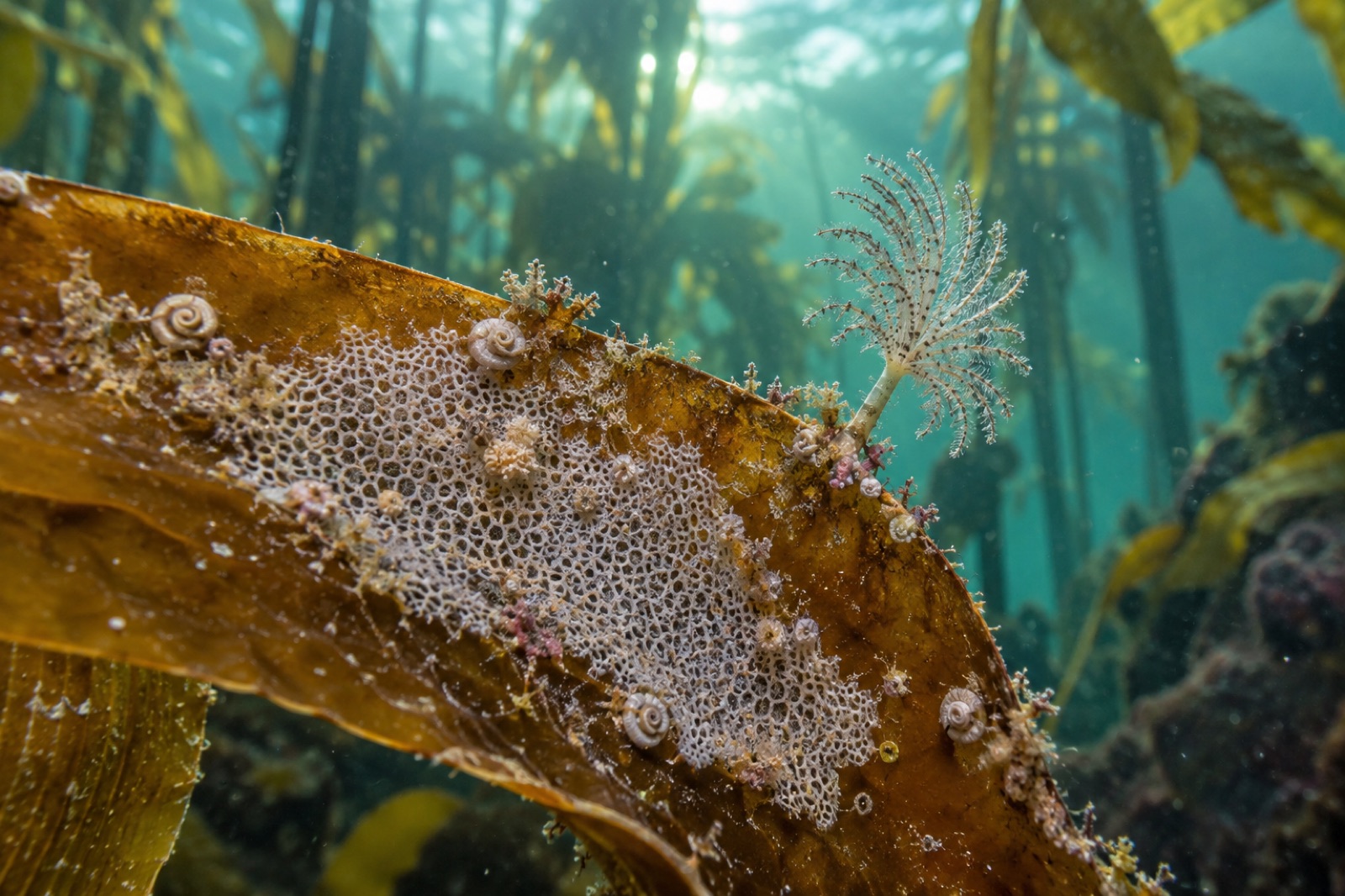
A single kelp blade hosts algae, bryozoans, hydroids and a whole mobile fauna. Meet the epiphytes — the living deck that perches on the forest's leaves.
Dr. Theo Nakamura ·
What's that growing on your lines? A field guide to identifying fouling organisms, telling harmless from harmful, and controlling them without wrecking your site.
Somewhere in every seaweed farmer's second season comes the same moment: you haul a line expecting clean crop and find it dressed in someone else's biology — lacey bryozoan colonies, hydroid fur, a fuzz of diatoms, an incipient tunicate. The urge is to call it all "fouling" and declare war. The farms that stay profitable do something more useful first: they identify it. Not all growth on your gear is a problem, and the wrong war — harsh cleaning, constant line-lifting, chemical shortcuts — costs more in broken blades and burned labour than the fouling ever did. This guide is the diagnostic half of the story: what's settling on your farm, which of it actually hurts, and the control repertoire that works with the system instead of against it. For the season-timing and infrastructure side, our companion piece on managing biofouling on kelp longlines covers prevention and harvest triage; this one starts with a hand lens.
Fouling pressure is not one problem wearing many costumes; it's a set of distinct organisms with distinct weaknesses. Field diagnosis by eye and habits:
Diatom films and micro-fuzz — brown or golden slime on lines and young blades, slick to the touch, often the first thing you see after deployment. On young sporophytes (the centimetre stage) this is the fouling that costs crops, because the crop is small and slow and the film isn't. On established plants, a light film is cosmetic.
Ephemeral seaweeds — green Ulva-type sea lettuces and threadlike reds and browns that bloom on lines in bright warm water. These are direct competitors: same niche as your crop, fast-growing, happy to use your infrastructure as a substrate. Ecologically they're just doing what your kelp is doing; commercially they're the contaminant your buyer photographs and sends back. The epiphyte micro-forest on wild kelp is habitat; on a farm blade it's a grading deduction.
Hydroids — colonial, feathery or fern-like growths, translucent grey-pink, waving on lines and buoys. They're cnidarians: they don't photosynthesise or compete for nutrients, but they add drag, they tangle handling, and they sting crews' forearms through summer. Heavy hydroid years are mainly a labour and gear-risk problem.
Bryozoans — lacy or encrusting colonies, beige to orange, either flat crusts on blades or frilly tufts on lines. Blade-encrusting bryozoans are among the foulers that matter most for food-grade product because they don't rinse off and they downgrade appearance badly.
Tube-dwelling amphipods and "mud tubes" — gritty fabric-like tubes along lines, sometimes swarming. Their weight gain is modest, but their tubes shelter the next generation of settlers, and on crop blades they read as filth to a food buyer.
Calcifiers — barnacles, tubeworms, mussels, oysters and encrusting coralline algae. Slow to arrive, hard to remove, and heavy: a barnacle-and-mussel year can add kilograms per metre and magnify storm loading. These are infrastructure foulers — on ropes, hardware and buoys, rarely on the crop blades themselves.
Tunicates — solitary sea squirts (soft, siphoned blobs) or colonial sheets. Variable; in some regions they're the dominant nuisance, in others nearly absent. Where present in force, they're usually the heaviest soft fouling you'll handle.
A useful habit: keep a simple season log of what settles, in what order, at which depths. By your third year you'll have a farm-specific settlement calendar that outperforms any published one — settlement timing follows warming and light, and your bay's calendar is yours alone.
Diagnosis matters because damage pathways differ:
Running the diagnosis in this order — crop damage first, grade damage second, gear damage third — keeps response proportional. Fouling that only costs you aesthetics on a feed-grade crop may not merit intervention at all.
The temptation with fouling is escalation: lift lines, scrape, dip, dunk, dose. Each of those has its place, but the order of escalation should be graded from least disruptive up.
Settlement biology is your friend: most of the problem foulers are light-loving surface-layer settlers with narrow depth windows (the cues that trigger larvae to settle are worth understanding once). Growth lines at a metre or two below the brightest, warmest settlement layer see meaningfully less pressure. Similarly, sites downstream of mussel rafts, pontoons and harbour walls receive larval supply out of all proportion to their area — if diagnosis shows a persistent local offender, the source is often visible on a chart.
Hand-removal is usually seen as failure; applied to the right targets at the right time, it's precision. Bryozoan crusts on blades respond to a gloved-thumb wipe; early hydroid colonies pull off in strings; tunicate solitaries pluck cleanly. The skill is timing: intervene at the small-colony stage and minutes of work replace hours later. Training crews to identify the five or six organisms that actually matter on your site — and ignore the rest — is the cheapest control technology that exists.
Many nuisance foulers are fully marine and desiccate fast; if your crop tolerates periodic air exposure (a few Pyropia-style systems exploit this deliberately; most kelp operations use it only incidentally), timed lifting can reset fouling at the cost of a growth stall. Use sparingly and only where the crop genuinely tolerates being out of water.
Grazing snails and urchins strip epiphytes from blades; some land-based tank operations co-culture snails specifically as a cleaning crew. At sea, "cleaner fish" and wild grazers sometimes recruit to lines on their own. Tread carefully: deliberately introducing grazers carries the risk of grazing the crop itself (urchins will eat your kelp once the fouling runs out), and introduced species raise biosecurity questions you may not be licensed to answer. Where it works, it's free; where it's borrowed from elsewhere, it can create problems with long tails.
Antifouling coatings and biocidal treatments designed for ship hulls have no place on food-crop infrastructure: they leach, they contaminate, and they void your market claims. If your diagnosis leads you to want copper, the answer isn't copper — it's that your season, siting or depth planning needs rethinking.
A spike in fouling is often a symptom, not a disease. Consider what a sudden change might mean:
The point: the farm is a sensor network. The farmers who read fouling as data, not just nuisance, run better sites every subsequent year.
No. Coralline crusts, light diatom films and some sessile invertebrates are near-neutral, and lines that support small communities sometimes even host grazers that clean blades. Control decisions should be triggered by identifiable damage pathways — crop competition, grade deductions, drag weight — not by the simple presence of life.
Yes, with limits. Fingertip or soft-glove wipes remove bryozoan crusts and early hydroid growth; flow-sloshing lines at the surface shifts loose ephemeral algae; but aggressive scraping damages blade tissue and often opens wounds for secondary disease. Work early, work light, and accept that mature established colonies on blades usually mark the product for harvest triage instead.
They can, which is why deliberate movement of grazers or cleaners between sites should happen only within your biosecurity plan. Encouraging the grazers already present at the site is different from importing them — the former is husbandry, the latter is potentially a licensing problem.
Photograph it, collect a specimen if legal where you farm, and compare against regional fouling guides and port surveys; port authorities and marine institutes often maintain settlement-panel programs and welcome a sighting. If it spreads quickly and aggressively, report it — early reports are the only cheap phase of invasive-species management.
Usually less, and slower, but not zero — and the trade-off is light for the crop, which costs you yield the same way fouling does. The sweet band varies by season; your settlement panels at two or three depths will find it within a year, and your crop-growth records will confirm it in two.
A single kelp blade hosts algae, bryozoans, hydroids and a whole mobile fauna. Meet the epiphytes — the living deck that perches on the forest's leaves.
Dr. Theo Nakamura ·
How to spot and manage the main pests and diseases of farmed kelp — epiphytes, grazing snails, ice-ice, endophytic infections and more — with a practical response playbook.
Naomi Reyes ·
Seaweed grades are built on a handful of tests — moisture, ash, contaminants, colour and sensory score. Learn what buyers measure and how to grow and handle for top grade.
Naomi Reyes ·