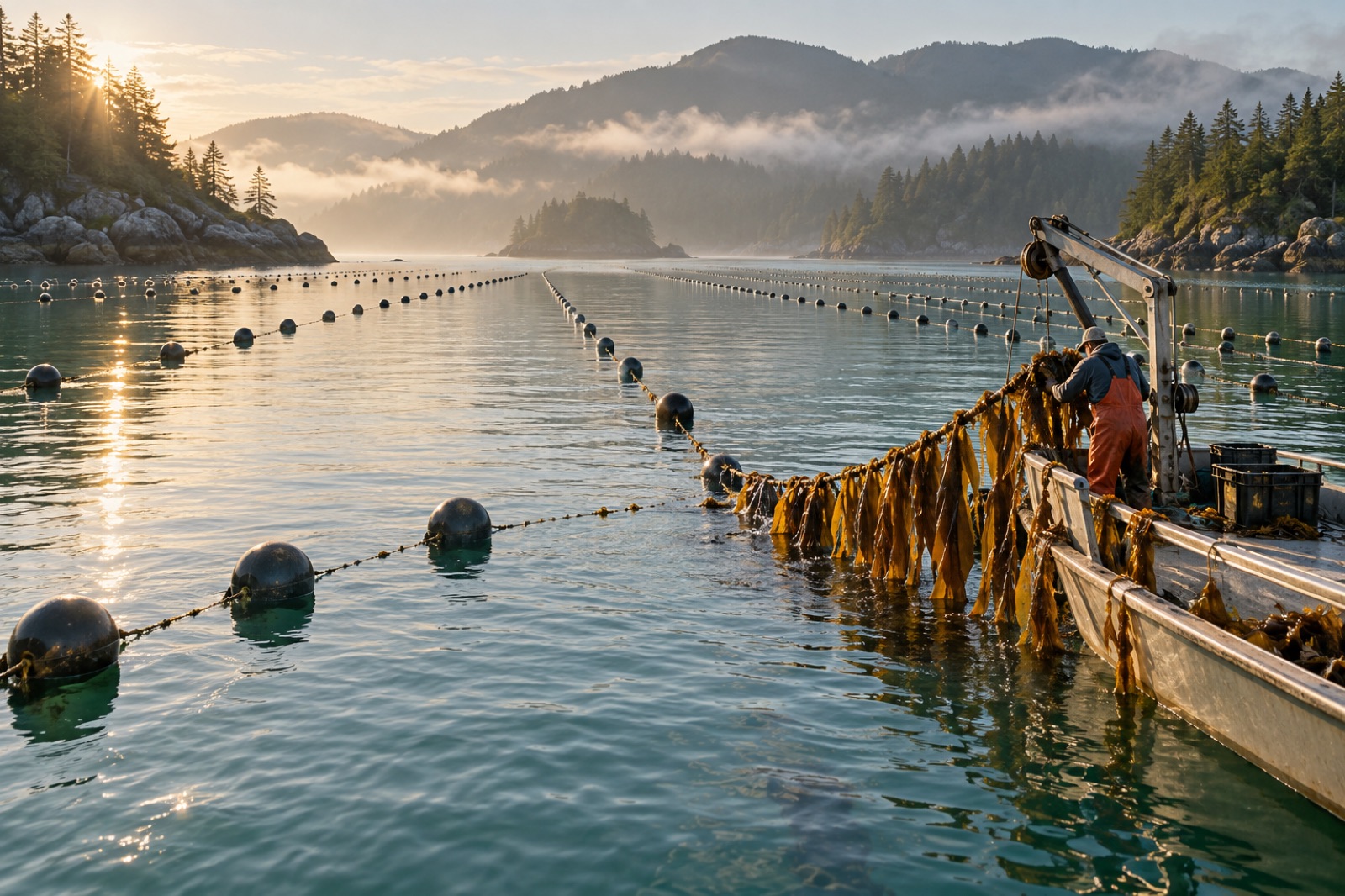
The question arrives early, usually in the first week of serious planning: what should I grow? Behind it sits a tangle of smaller questions — about your water, your market, your winter storm exposure, your budget, your tolerance for paperwork. New farmers often search for the single "best" species and come away believing the answer is sugar kelp because so much has been written about sugar kelp. Sometimes it is. Often it isn't. This article offers a decision framework: five questions that filter the realistic candidates for your site down to one or two, before you spend a season learning the answer the expensive way.
The five filters
Think of species selection as a funnel. Each question below eliminates candidates, and the order matters — biology first, business second, because a species that cannot survive your site makes every downstream answer irrelevant.
1. What species are legal and native where you farm?
This is a hard gate, not a preference. Most jurisdictions require that cultivated species be native to the region, and many define a collection radius for broodstock — your seed's grandparents must come from nearby water. Farming a non-native species is typically an introduction under law, and introductions of seaweeds have a genuinely bad ecological track record. Review the native seedstock rules before falling in love with any species; if it isn't native to your coast, it isn't on your list, whatever the price per kilo.
Ask your regulator two direct questions: which species are already licensed on farms in my region, and which additional native species have approved hatchery protocols? The first list is your low-friction path; the second is your frontier.
2. Does your site's water fit the species' envelope?
Every candidate species carries a thermal window, a nutrient budget and a season. You need your site's numbers, measured or modelled across at least a year — bottom temperature range, summer peak and duration, winter nitrate availability, salinity swings from rivers or rainfall. The discipline of reading the water applies before the farm exists, not after.
Match candidates against the envelope honestly:
- Sugar kelp (Saccharina latissima) wants cold winters and is the default choice where summer temperatures stay below roughly 17–18 °C; it senesces fast in a warm spring.
- Wakame (Undaria pinnatifida) tolerates slightly warmer water and a shorter grow-out — see the species-specific guide — but is itself a noted invader and is barred as a culture species in some regions.
- Oarweed and other Laminaria favour exposed, well-flushed sites and longer seasons.
- Ulva (sea lettuce) thrives in nutrient-rich shallow water and can handle warmth that kills kelps, at the price of fastidious handling.
- Dulse sidesteps the ocean-envelope question entirely by growing in tanks on land.
Where candidates sit at the warm edge of their envelope on your site, treat that as a red flag rather than a challenge — the climate trend is not your friend, and hatchery work on climate-resilient seedstock is still a margin of a degree or two, not a rescue.
3. What infrastructure does the species demand, and does it fit your capital?
Species decisions are secretly infrastructure decisions. Rank candidates by what they require you to own:
- Longline kelps (sugar kelp, wakame, ribbon kelp, kombu-types) need permitted ocean space, anchoring rated for your storm climate, a work boat and a harvest window crewed at short notice. Lowest cost per tonne; highest exposure to weather.
- Intertidal or shallow-water systems suit Ulva and some reds, trading storm risk for pumping, tending and predator management.
- Land-based tanks — the dulse route described in tank farming dulse — replace the sea lease with buildings, seawater systems, aeration and electricity. Highest capital per kilo; near-total control of the biology and the calendar.
First farms almost always do best with the simplest system that fits the site. A half-hectare of longlines is a farm; a half-built tank hall is a debt. If you haven't sketched the quiet version of this decision, the half-hectare walk-through is a useful reality check on scale.
Growers plan backwards from harvest; bankers plan backwards from buyers. Do the latter. The market reality for common first-farm species, roughly:
- Sugar kelp has real but crowded food and ingredients markets. Wet weight at the farm gate is modest; value rises steeply with your ability to blanch, dry or freeze to food standard.
- Wakame has an established culinary market with deceptively demanding processing: blanching, salting, precise cutting. The price premium rewards skill, not just biomass.
- Dulse commands the highest per-kilo prices of the common trio, which is exactly why it is grown in expensive tanks — the market pays for consistency and year-round supply.
- Ulva sells to niche food, feed and biostimulant buyers; volumes can be large but price is unforgiving.
- Kombu-types face the most demanding quality benchmarks in the industry, set by Japanese grading culture; first farms rarely hit export grades.
Name your buyer before you name your species. The exercise in selling your seaweed — finding three real potential buyers and asking what volume, form, and paperwork they require — belongs at the top of your species decision, not the bottom of your season.
5. What is the failure mode, and can you afford it?
Every species fails differently, and a first farm should choose failures it can survive:
- Sugar kelp fails fast and visibly (a warm spring erases the lines) but the capital at risk is a season of seed and gear.
- Wakame fails through processing missteps — you can grow a perfect crop and lose it at the salting table.
- Ulva fails through fouling, epiphytes and grazers, and needs near-daily attention in season.
- Tank dulse fails through system crashes — a pump or aeration failure at 2 a.m. — and the bet is your building, not a season.
- Asparagopsis and other high-hype candidates fail through biology nobody has industrialised yet, which is why they belong in an R&D budget, not a first farm.
Score this honestly against your cash runway and your appetite for 2 a.m. failures.
A worked example
Picture a new farmer on a cool, well-flushed temperate coast: summer peaks of 16 °C, winter nitrate from seasonal upwelling, a used 7-metre workboat, modest capital, and a regional food processor two hours away that already buys blanched kelp. The funnel runs: native species list contains sugar kelp and a kombu-type; the thermal envelope fits sugar kelp comfortably; longlines match the boat and budget; the processor names a wet-weight price and specs; the failure mode is a warm spring and the loss would be a seed bill, not a building. Answer: sugar kelp, one hectare of lines, with a plan to learn blanching in year two. It is not glamorous. That is exactly the point.
Contrast a landlocked-adjacent site near a city with warm, eutrophic inlets: ocean kelp fails the envelope test, a tidy tank business selling fresh dulse to restaurants fails nothing except the electricity bill. Different funnel, different answer.
The uncomfortable advice
Whatever species you choose, plan to change your mind once. Keep records from day one — seeded length, temperature, growth measurements, buyer feedback — because season two's species decision should be made by your own data, not by conference talks. Many successful farms converge on a portfolio after a few years: a reliable longline kelp for volume, a higher-value species for margin. The first species is a teacher; choose the teacher whose lessons you can afford.
Key takeaways
- Legality and nativeness are absolute filters — build your candidate list from what regulators already license locally.
- Match the species' thermal and nutrient envelope to a full year of your site's actual water data, not regional averages.
- Species choice is infrastructure choice: longlines, shallow systems and tank farms are different businesses wearing the same wetsuit.
- Identify real buyers and their specs before committing; the market usually picks your species for you.
- Choose first-year failure modes you can financially survive, and let your own records drive year two.
FAQ
Is sugar kelp always the best first species?
No. It is popular because its biology is well understood and hatchery seed is widely available, but it suits only sites with genuinely cold winters and cool springs, and its farm-gate price is modest. Warmer-water sites, land-based farmers and growers with strong direct-market access often do better with wakame, dulse or Ulva respectively.
Should a first farm grow more than one species?
Usually not. Splitting a small first farm across species doubles your gear types, hatchery relationships, buyer specs and learning curves at the moment you can least afford complexity. Prove one species and its market first; diversify from a position of working cash flow in year two or three.
How do I find out which species are licensed in my area?
Start with your national or regional aquaculture regulator's public register of licensed farms — species are usually listed per site. Then speak to the nearest hatchery or aquaculture extension service about which native species have proven seed protocols. Getting started guides and farmer associations can shortcut weeks of searching.
Can I import a proven species from another country where it also grows natively?
Growing natively elsewhere does not make a species native to your water, and importing non-local stock — even of the same species — typically violates provenance and collection-radius rules designed to protect local genetics and biosecurity. Assume the answer is no unless your regulator explicitly says otherwise in the permit.
What's the most common species-selection mistake you see?
Choosing for the headline price per kilo instead of for the sealed chain from site to buyer. High-value species carry high-value costs — tanks, labour, processing skill, perishability. The best first species is the one whose entire value chain you can actually execute this year.