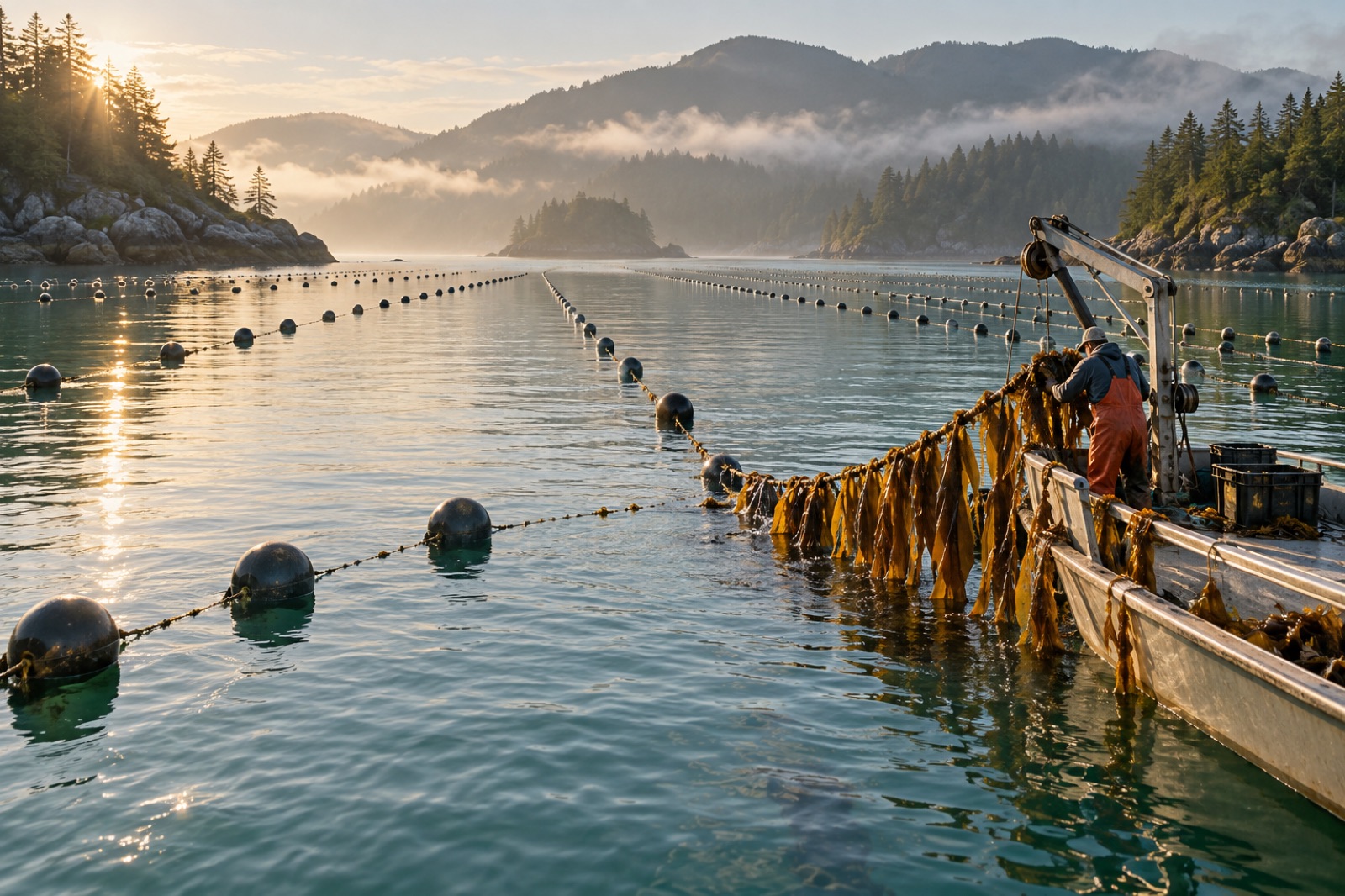
Ask ten seaweed farmers what size a first farm should be, and you'll hear everything from a single experimental line to ten hectares of ambition. Here's a quieter opinion built from watching many startups: half a hectare is close to the ideal first farm. It is big enough to produce a commercial-scale crop, big enough to expose every operational problem you will ever face — storms, fouling, gear failure, harvest logistics — and small enough that one person with a modest boat and one helper on busy days can run the whole thing. This article is a concrete picture of what that farm actually looks like, season by season, line by line.
It assumes you've already read our guide to starting a small seaweed farm, which covers permits and site selection. This is what comes after the "yes."
Half a hectare of water is 5,000 square metres — roughly 70 metres by 70 metres, though most farms run rectangular. A typical layout in temperate water:
- Four to five grow-lines of 100–120 metres each, spaced 7–10 metres apart so your skiff can run between them and propagate wash doesn't stack.
- Catenary longline design — header ropes held 2–4 metres below the surface by buoys, with seeded grow-line either as the header itself (sugar kelp) or as vertical or horizontal substrate attached to it. Our longline design guide covers the engineering choices in detail; at this scale, keep it simple: one proven catenary design, repeat it five times.
- End moorings at each line end: anchors (helix, deadweight or embedment, depending on bottom type), chain, and riser buoys, plus a corner grid holding the whole array square.
- One navigation marker per corner if your jurisdiction requires it — usually it does.
From the air it looks like almost nothing: a loose row of buoys in a rectangle of empty water. That modesty is part of the point. The farm is nine-tenths invisible, which keeps neighbours calm, navigation simple and your stress manageable.
The gear list, honestly itemised
At half a hectare the gear budget is dominated by rope and moorings, and the smart economising happens everywhere except there:
- Rope: roughly 1,500–2,500 metres total across headers, bridles and risers, in 16–24 mm sinking or neutral line depending on design. Cheap rope chafes; chafe loses lines.
- Anchors: 8–10 primary anchors plus corner bridle points. Correct anchoring for your bottom type — sand, mud or rock each want different hardware — is the single highest-leverage spend on the farm.
- Buoys: 40–60 surface and subsurface floats. Subsurface floats on the header hold depth; surface floats mark and tension.
- Seed line: 500–700 metres of seeded twine, purchased from a hatchery. At this scale, buying seed beats building hatchery capacity every time; see our seed stock explainer.
- A boat you already understand: a 5–7 metre skiff with an outboard, used daily, matters more than any item above. Add a small davit or pot-hauler-style winch if you can — your back will write you thank-you notes.
- Safety and handling kit: gloves, foul-weather gear, VHF, first-aid, harvest baskets or bulker bags, and mesh harvest bags for transport.
The full kit lands, in most regions, in the low-to-mid tens of thousands of dollars before the boat — modest by commercial aquaculture standards, real money by personal standards. Our equipment and cost rundown breaks the categories down further.
A season on the calendar
The half-hectare farm runs on an annual rhythm that will feel agricultural to anyone who has grown anything:
Late summer / early autumn — deployment. Seed line arrives from the hatchery wrapped in chilled, damp material, impossible to inspect with the naked eye. You spend two to four long days transferring it onto headers or wrapping it directly onto grow-lines, tensioning, buoying and securing. This is the season's crunch moment; line out two friends and feed them well.
Autumn — establishment. The farm looks empty. This is correct. Microscopic plantlets are tightening their grip. Weekly visits check line tension, buoyancy and chafe. Resist the urge to fuss; your job is the rope, not the kelp.
Winter — the quiet growing months. Sugar kelp and its relatives do their real growing in cold water, and storms do their real damage in the same months. After every major blow you check corner moorings and look for tangles across lines. In a well-designed array, storm checks take two hours and find nothing. That boring outcome is what good design feels like.
Spring — the surge and the harvest. Daylight returns and growth becomes visible week over week, then day over day. You harvest at peak condition — our harvest timing guide explains how to read it — over one to three concentrated weeks, cutting blades from the line into bags or baskets and landing them to a processor, dryer or cold chain within hours.
Early summer — breakdown. Gear comes out for inspection, repair and storage (or stays in, where permitted). You log what survived and what didn't, because next season's design improvements live in those notes.
Hours, yields and the honest economics
Plan on 300–500 person-hours a year, heavily front-loaded at deployment and harvest. Much of it is solo work in decent weather windows, which means the schedule owns you more than you own it.
Realistic first-year yields run 3–8 kilograms of wet kelp per metre of grow-line for sugar kelp in decent sites — 500–700 metres of effective line produces roughly 2–5 wet tonnes. Run the revenue scenarios honestly against that crop with our farm economics breakdown: sold wet to a processor, a half-hectare first crop will often cover operating costs and not much more. Sold partly dried into food or biostimulant markets, it can clear a real margin. Either way, in year one the crop is not the main product. The education is.
What half a hectare teaches you
Every lesson that matters in seaweed farming happens at this scale:
- Harvest speed is the real constraint. Growing is automatic; getting 4 tonnes off lines and under refrigeration in a tight quality window is not.
- Gear failure is directional. You will learn which chafe points, shackles and splice choices your site punishes, cheaply.
- Buyers respect delivered product. One successful landing converts you, in every future conversation, from aspirant to supplier — and, as our selling guide explains, that changes every price you'll ever be offered.
- Your site writes its own manual. Fouling timing, growth curves, storm behaviour: after one season you'll know your water better than any desktop study ever could.
From here, scaling is multiplication, not mystery. Farmers who master half a hectare rarely fail at five. Farmers who skip it often do.
Key takeaways
- Half a hectare — four to five 100–120 m lines — is the sweet spot for a first farm: commercially real, one-person manageable.
- Expect 1,500–2,500 m of rope, 8–10 anchors, 40–60 floats and 500–700 m of seeded line; never economise on rope or anchoring.
- The season runs deployment in autumn, quiet growth through winter, and a concentrated spring harvest — roughly 300–500 person-hours total.
- Realistic first-year production is 2–5 wet tonnes; first-year economics are about learning and buyer relationships, not profit.
- Master this scale and scaling up is arithmetic. Skip it and scaling up is gambling.
FAQ
Can one person really run a half-hectare farm alone?
For 90% of the year, yes — weekly visits, tension checks and maintenance are solo-friendly work. But you need reliable help for two crunch windows: autumn deployment (two to four long days) and spring harvest (one to three intense weeks). Line up helpers early, pay them or feed them memorably, and never plan a solo harvest day.
Should I start even smaller, with just one line?
One experimental line is a fine reconnaissance tool, but it won't teach you harvest logistics, buyer relationships or storm behaviour at meaningful scale — the lessons that actually decide whether a farm survives. Half a hectare is small enough to afford and big enough to be real.
What boat do I need?
A 5–7 metre open skiff with a reliable outboard handles nearly all work at this scale. A small winch or line-hauler is the highest-value upgrade. You can contract a larger crane vessel for deployment and harvest days if needed — many small farmers do exactly that.
Does a half-hectare farm need full permits and leases?
Almost always yes. Permit requirements are typically triggered by placing structures in the water, not by farm size — a half-hectare array needs the same lease and licensing process as a bigger one, which is another reason starting at exactly this scale makes sense: full compliance learning, tiny gear bill. See our permits guide for what to expect.
When do I scale up?
When your first harvest lands on time, at grade, to a buyer who pays — and your gear survived the worst storm of the season. Those two events mean your systems work, and multiplying proven systems is the safest expansion in aquaculture. Most farms double annually at most, and even that pace demands planning.