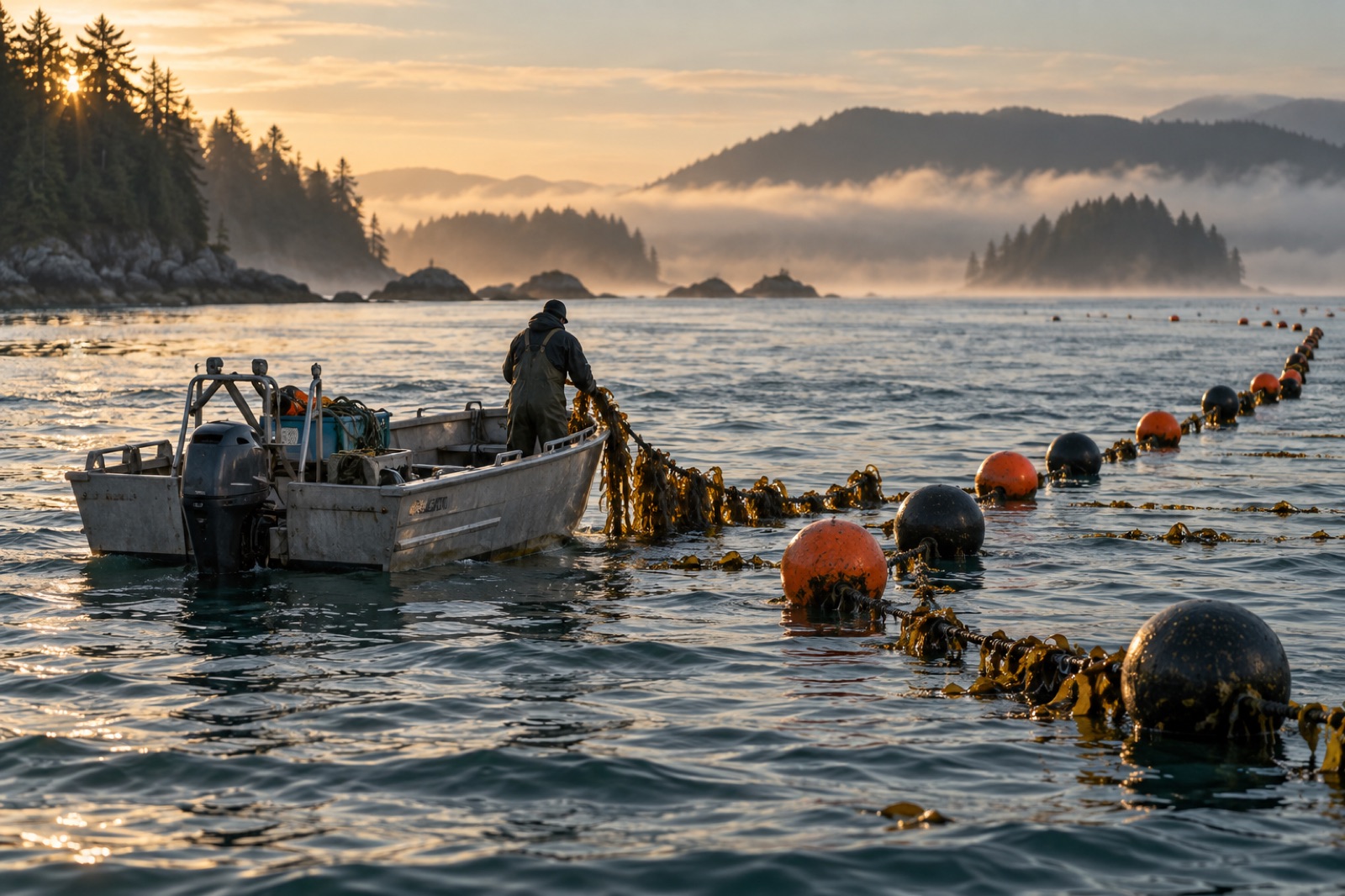
Here is the arithmetic that keeps seaweed executives awake: a well-grown hectare of sugar kelp lines can carry 50 to 100 wet tonnes at peak season, and the biology gives you a harvest window measured in weeks, sometimes days, before spring warming spoils the blade. Hand harvesting that hectare with knives and crates takes a crew most of the window. Mechanical harvesting can take it in days. Everything about scaling seaweed farming — the cost per tonne, the food-grade quality, the economics that convince investors — runs through this bottleneck. This article explains how automated harvest actually works, what the machines do and don't do well, and how to decide when your farm is ready for one.
Why harvest is the scale bottleneck
Growing kelp is essentially passive: seeded lines sit in the water and the ocean does the work. Harvest is the opposite — every kilogram of crop must be lifted from the sea into a cold chain, and wet kelp is 85–90% water, heavy, slippery and perishable. The first six hours after cutting decide the product's fate (see harvest logistics), so the harvest system isn't just a boat; it's a moving factory whose output rate must match what the shore facility can receive.
The economics work against smallness. A farm paying crew wages to hand-cut ten tonnes a day competes — in commodity ingredients markets — against operations mechanically cutting fifty. Mechanisation is not about glamour; it is the difference between a business and a very complicated hobby. The open question for most farms is when to automate, and how far.
The three families of harvest machines
Nearly all mechanised kelp harvest systems fall into one of three engineering families. Many real vessels combine them.
Cut-and-lift: blades on a boom
The most common approach adapts familiar ideas from agriculture. A vessel runs alongside the longline; a powered cutting head — reciprocating blades, rotating discs, or a bandsaw-style element — slices the seeded line's growth free, and a conveyor immediately lifts the cut kelp aboard. Some heads clamp the line and strip it; others cut the kelp while leaving the line in place for the next season.
Strengths: gentle on gear, works with standard longline layouts, proven at scale on European and Asian kelp vessels. Weaknesses: cutting heads foul on tangled growth and storm-twisted lines; throughputs drop sharply when the crop is uneven; the conveyor deck becomes a water-management problem of its own.
Pump harvesters: the slurry approach
Borrowed from mussel and salmon farming, pump systems macerate or snip kelp at the line and draw it up a flexible hose as a seawater slurry, straight into dewatering screens or directly into totes. The boat barely stops; one operator manages the hose head while the pump does the lifting that cranes and conveyors otherwise must.
Strengths: extraordinary throughput per deck footprint, minimal lifting injuries, continuous operation in moderate sea states. Weaknesses: macerated product suits processing (meal, extracts, biostimulant feedstock) but not whole-blade food markets; pumps demand constant maintenance against sand and shell grit; and the slurry dilutes your crop — you land tonnes of water to get tonnes of kelp, which the cold chain has to pay for.
Line-retrieval: bring the rope aboard
The most radical approach treats the entire seeded line as the crop: the vessel hooks the longline, hauls it continuously over a powered reel or capstan, and either strips kelp on deck with rotating drums or blades, or spools the whole line for shore-side processing. Storm-seed and deployment machinery — the same family of drums behind mechanised seeding — does double duty here.
Strengths: no subsea cutting head to foul; the line's full crop comes aboard regardless of tangle. Weaknesses: destructive to the cultivation structure (lines must be re-laid or re-seeded, so the system suits annual single-crop regimes); it needs strong deck machinery, and it punishes poor line design — which is why harvest planning quietly shapes the layout decisions made in longline design two seasons earlier.
The vessel around the machine
A harvest machine is only as fast as the platform carrying it. Purpose-built kelp harvesters and converted mussel boats share a set of features that matter more than brand names: stable working deck with low freeboard at the rail, hydraulic power headroom for cutters and pumps, on-board holding (to be honest, usually just volume — bruised kelp in a hot hold degrades fast), propulsion that holds station alongside lines in current without chewing the gear, and enough freeboard and seakeeping to work the short weather windows that decide seasons. The trade-offs between conversions and purpose-built hulls follow the same logic as choosing workboats generally: buy for your peak day, charter for the outliers.
One subtle point: automation shifts labour rather than eliminating it. A mechanised harvester swaps ten knife-hands for two or three skilled operators — hydraulics, hydraulics again, and deck discipline around moving machinery. Crew competence around cutters, spinning drums and loaded lines is a genuine safety system; the protocols in farm safety at sea apply with doubled force when the deck is full of machinery.
When does automation actually pay?
The honest answer is a threshold question, not a philosophy. Work through it in order:
- Volume. Below roughly 30–50 wet tonnes per season, hiring casual labour for the harvest window is usually cheaper than owning machinery that works three weeks a year. Somewhere between 50 and a few hundred tonnes, mechanised assistance (a powered hauler, a deck conveyor) pays back fast. Beyond that, dedicated harvest vessels start to make sense — or a contract harvester does.
- Product form. If your buyer takes whole blade for food, your automation options narrow to gentle cut-and-lift systems, and grading and handling on deck become the real cost. If you sell to processors, pump systems unlock throughput.
- Window severity. The tighter your harvest window (warm-water sites, late springs), the more throughput is worth. A machine's value is measured in tonnes saved from senescence, not just tonnes landed.
- Contract before capital. In maturing regions, contract harvest services are emerging — one vessel serving five farms. Joint ownership through a co-op achieves the same thing at smaller scale. Owning the machine is plan B.
The pattern that repeats across the industry: mechanise hauling first (powered line haulers are cheap and transformative), then conveyance, then cutting, and plant the full harvest vessel last of all — after you've learned exactly what your crop, site and buyers demand.
Where the frontier actually is
The interesting engineering now happens off the boat entirely. Some operations trial subsea cutting sledge systems that harvest without matting the surface canopy, deliberately leaving meristem tissue for regrowth within a season. Others attack the scheduling problem with data: canopy imaging and blade-mass models that predict each line's peak-quality date, so a single harvest vessel visits lines in optimal order — the same remote-sensing discipline Tidewright's Canopy Ledger applies to wild forests, pointed at farm grids. Robotics people, meanwhile, dream of autonomous harvesters working lines at night. They'll get there; but today's frontier is less exotic. It is the humble, compounding work of matching cutter geometry to species, and of designing farms from day one so that machines can work them.
Key takeaways
- Harvest is the true bottleneck of seaweed scale: a hectare can hold 50–100 wet tonnes with a spoilage clock measured in days.
- Three machine families dominate — cut-and-lift conveyors, pump/slurry harvesters, and whole-line retrieval — and buyers' product specs largely choose among them.
- Automation shifts labour toward skilled machinery operation; it doesn't remove crews, and deck safety requirements increase.
- Mechanise in order: powered hauling first, conveyance second, cutting third, dedicated vessel last — and price contract harvesting before buying.
- Design the farm for the harvester: line spacing, heading and anchoring decisions made at seeding determine what machines can do two years later.
FAQ
How much can a mechanised harvester cut per day?
It varies enormously with crop density, sea state and system type, but working figures span roughly 20–80 wet tonnes per vessel-day for established systems, against perhaps 5–10 tonnes for a strong manual crew. Pump systems sit at the high end; selective cut-and-lift for food-grade whole blade sits lower.
Does mechanical harvesting damage the crop's food grade?
It can. Bruising and tearing accelerate spoilage and downgrade appearance, which is why whole-blade food markets favour gentle cutting heads, immediate cooling and short trips. For processed products — meal, extracts, dried formats — machine handling is rarely the limiting factor; hygiene and speed are.
Can small farms share harvest machinery?
Yes, and they increasingly do. Machinery rings and co-ops own a harvest vessel, a hauler set or a grading line jointly, and booking systems split the window. The arrangement works best when members grow compatible species on similar line layouts — one more reason regional gear standards quietly matter.
Is whole-line retrieval wasteful?
Only if you built the farm for multiple seasons from one line set. Annual single-crop systems deliberately treat lines as consumables within a re-seeded cycle, and retrieval harvest fits them perfectly. Multi-season line systems should pair with selective cutters. The mismatch — retrieval gear on multi-year lines — is the genuinely expensive mistake.
What's the first piece of harvest automation a growing farm should buy?
A powered line hauler with a capstan head that mounts on your existing workboat. It's the cheapest mechanisation step, removes the worst manual lifting, and directly increases how much one crew can safely land per tide. Everything else builds on that foundation.