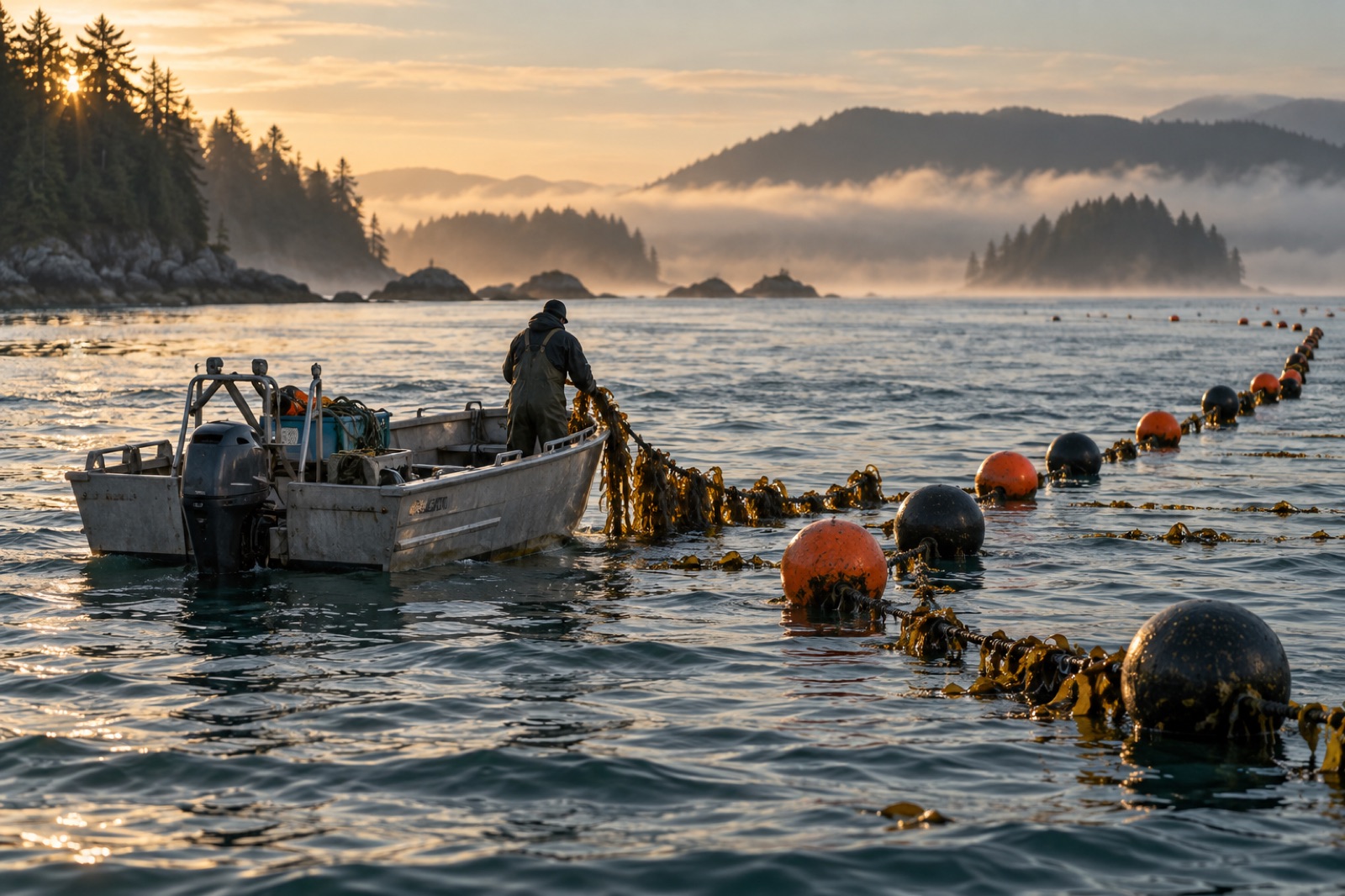
Seaweed farming is statistically one of the safer forms of aquaculture — but only because the people who do it well treat their safety system as a crop, tended and audited like the kelp itself. The hazards are specific: cold water credit-card distance over the rail, lines under hundreds of kilos of tension, moving boats, blades and knives, and — in winter-growing regions — the fact that most of your working hours happen in the dark season. This guide is the safety framework we give to new crews and to farmers setting up from scratch. It is the operational partner to our guides on what a half-hectare farm really looks like and workboats. Follow it, and the highest-risk thing on your farm will be the drive to the harbour.
The hazard inventory, honestly stated
Write these down for your own site — a proper risk register is a legal requirement in many jurisdictions and good practice everywhere:
- Cold-water immersion. Sea temperatures of 4–10°C through much of the working season in temperate and boreal regions. Unprotected immersion kills in tens of minutes; cold shock kills in tens of seconds.
- Entanglement. Growth line, seed line and kelp fronds moving in current around legs and arms. A working deck often has loose line on it by definition.
- Line under tension. Moorings and haul lines store energy like bows. A parted line or slipped anchor chain is a lethal whip.
- Mechanical hazards. Winches, capstans, hydraulic haulers, propeller shafts, knife work on a moving deck.
- Weather and sea state. The farm is exposed by design; conditions that are row-able in the harbour are not workable at the site.
- Fatigue and solitary work. Short crews, early starts, repetitive heavy movement, and in busy farms long hours at the harvest peak.
Cold water: dress for the swim you hope never happens
The single most consequential protocol on a kelp farm: everyone wears a flotation device with spray protection whenever they are on deck, without exception, regardless of urgency. The modern default is the auto-inflating personal flotation device (PFD) — comfortable enough that it is actually worn, effective enough that it keeps an unconscious casualty face-up. Manual-only inflatables are for pilots, not farms. In genuinely cold regions, flotation suits or work-rated immersion suits over thermals extend the immersion clock from minutes to tens of minutes; that difference is the time your crewmate needs to reach you.
Cold shock — the involuntary gasp and hyperventilation in the first minute of immersion — is what drowns fit, healthy people. Psychologically preparing the crew for it is as important as the equipment: everyone on a Tidewright partner farm does a supervised cold-water familiarisation at the start of the season to feel the gasp reflex in a controlled setting, and to learn that the job in the first minute is simply breathe and float, not swim. Our cold-water gear guide covers the underlying principles of dressing for the sea rather than the air.
Man overboard: the drill that must be muscle memory
Every farm needs a written, drilled MOB plan. The universal shape:
- Shout and point. One person's only job is visual contact — they never take their eyes off the casualty.
- Throw flotation. A horseshoe buoy or throw line goes in immediately, even if the casualty looks fine.
- Stop the boat's momentum and manoeuvre to a downwind approach.
- Recover at the lee side using a pre-rigged ladder, lifting strop or Jason's cradle — cold muscles cannot climb a freeboard.
- Prevent hypothermia cascade. Recovery is not the end: wet clothing off, insulation on, warm sweet drinks if conscious, and medical assessment for any immersion beyond a dunk.
Drill this with a fender-and-rope "casualty" monthly, and once per season with a volunteer in a suit. Time it. If recovery takes longer than ten minutes, your kit or practice is wrong.
Lines under load: respect the energy
Most near-misses reported across kelp farms involve line work, and the rules are consistent:
- Never stand in a bight — the loop of line on the deck that becomes a leg trap the instant tension arrives.
- Never wrap line around a hand or wrist to take strain; use a winch, a cleat, or let it go.
- Eyes on the line path before hauling. Know where the line will run if it parts, and don't stand there.
- Parted-line discipline. When something is visibly straining — during a storm check or a stuck anchor retrieval — put a boat length between crew and the loaded line, and open throttle slowly.
- Knife discipline. Cut lines away from the body; carry blunt-tip serrated knives where damp straps, gloves and adrenaline are involved; keep knives secured in sheaths, because the knife you drop in the scuppers becomes the knife you step on.
Weather limits: write them before the forecast does
Every farm needs a hard weather-limit table, agreed ashore and posted on the boat:
- Maximum wind and sea state for transit.
- Maximum wind and sea state for work on the lines (usually lower — a kayak-able chop is still a poor platform for knife work).
- Minimum visibility for line work (in fog you cannot see a casualty).
- A go/no-go person for each day: the senior crew member whose decision to stand down is final and unquestioned by anyone, including the farmer who pays their wages.
Enforcement is where most frameworks fail. Storm-proofing design reduces how often the farm demands a visit in marginal weather — engineered stand-downs are cheaper than disciplined ones.
The kit list, the comms, the plan
Per boat, per working day:
- PFDs (auto), one throw bag or horseshoe, boarding ladder or recovery strop, first-aid kit sized for cuts and hypothermia.
- VHF radio plus charged phones in waterproof pouches; a registered PLB or AIS MOB beacon per crew member on any site more than a few minutes from help.
- A float plan left ashore: who's out, where, until when — and who raises the alarm and when.
- Engine kill cord in use whenever under power, and prop guards or stern discipline near floating line.
- Chemical and sharps discipline if any treatment agents are used, with SDS sheets on the boat.
Fatigue, culture and the near-miss book
Hardware is the easy half. The cultural half:
- Near-miss reporting without blame. A waterproof logbook on the boat where any near-miss is written down and reviewed weekly. The loosened shackle nobody reported is the storm-failure nobody understands.
- Buddy rule on deck. Nobody works at the rail alone without a designated watcher; nobody services lines alone in current.
- Harvest-season fatigue management. The weeks when the farm tries to eat you — also covered in our harvest logistics guide — are when people get hurt. Cap the hours, rotate the lead role, and treat a skipped lunch as a safety incident, not a dedication trophy.
No task on a kelp farm is urgent enough to skip the drill, the PFD, or the stand-down. If it is, the farm's calendar was planned wrong, which is correctable ashore.
Key takeaways
- Dress for immersion: auto PFDs always, flotation suits in cold regions, and teach crews that the first minute of cold shock is about breathing, not swimming.
- A man-overboard plan must be written, rigged and drilled to under ten minutes' recovery time.
- Line-under-tension rules — never in a bight, never around the wrist, eyes on the line path — prevent the commonest serious incidents.
- Hard weather limits and a go/no-go lead, agreed ashore, do more than seamanship to keep crews safe.
- Safety culture is near-miss logs, buddy rules and honest fatigue management through peak season.
FAQ
What PFD is best for seaweed farm work?
A work-rated auto-inflating PFD with harness and spray hood; in very cold water, a flotation suit beneath or an approved immersion suit. Whatever the crew will genuinely wear all day beats a technically superior model left on the wheelhouse seat.
How cold is "cold-water risk"?
Treat any sea below roughly 15°C as a cold-shock risk. Below about 10°C, assume a usable self-rescue window of only a few minutes without flotation and insulation.
Can you run a seaweed farm safely solo?
Occasional tasks, near shore, in settled weather — yes, with comms and a float plan. Routine line work, hauling and anything in current — no. Two crew is the practical minimum for deck work at a floating farm.
What training should a new farmhand have before first deployment?
Basic sea survival and first aid, a VHF licence where required locally, on-site induction covering the farm's risk register and MOB drill, and supervised practice of line handling and knife work ashore before doing it afloat.