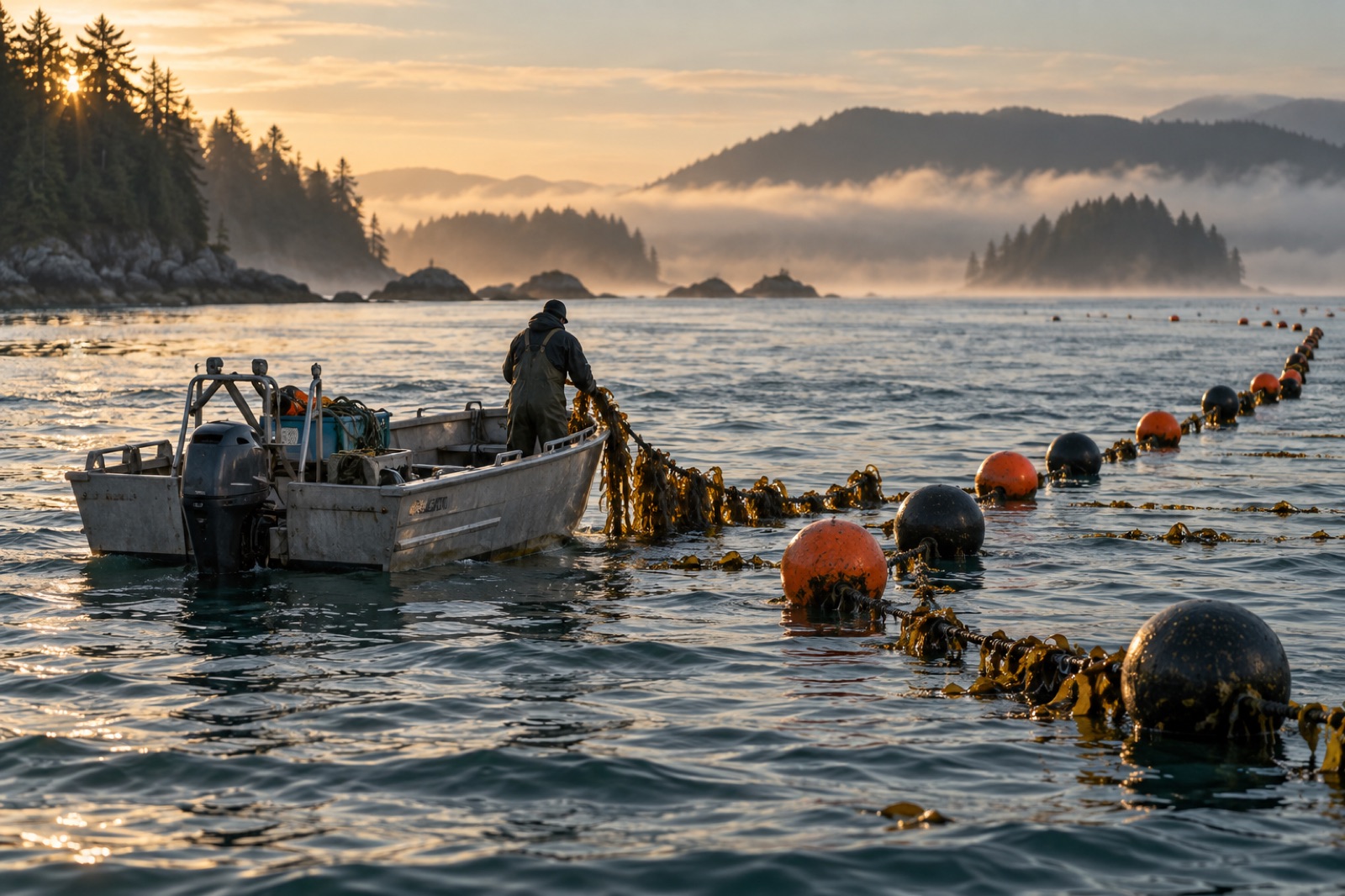
Most days on a seaweed farm are safe, quiet, cold and slightly repetitive — which is exactly the danger. Aquaculture's injury pattern is dominated not by exotic events but by the ordinary ones: somebody in the water, somebody working fast on a pitching deck, a line under load meeting a gloved hand. Safety here is not a poster. It is a set of small disciplines repeated until they are muscle.
This article is the operational companion to our essays on building a safety culture on a seaweed farm and the gear and exposure protection that backs it up. Where those cover the "why" and the "what to wear", this one walks the "what we do": a working day, hazard by hazard, with the checklists that working crews actually run. Nothing here replaces local regulatory requirements or formal training — it is the layer that sits between the rules and real habit.
Know the hazards that actually hurt people
Before checklists, priorities. For a small-boat, line-based kelp farm, the genuinely dangerous list is short:
- Cold water immersion and man overboard. In northern growing regions water temperatures run 2–8°C much of the year. Cold shock in the first minute can kill an unprotected person; incapacitation follows in tens of minutes. This is the single highest-consequence hazard.
- Entanglement. Lines, grow ropes, and chain under tension are a trap with moving parts. Being pulled overboard or to the deck by a leg of rope has killed aquaculture workers.
- Linework injuries on deck. Pinched, crushed and cut hands, caught gloves, winch and capstan entrapment. Highest frequency, moderate severity — until someone is tired or rushed.
- Weather and visibility. Growing-season weather on exposed sites changes in an hour: fog banks, current rips, a whipping swell between raft and shore.
- Fatigue and lone working. The multiplier for all of the above. Tired people skip steps; a person alone has no rescue.
Everything operational below follows from those five. Man overboard and entanglement get the strictest rules because they can kill in minutes.
The pre-departure checklist (shore side)
Fifteen minutes at the dock buys most of the safety you will carry that day. A laminated card, actually read aloud, beats a signed folder in an office.
Vessel. Engine start and reverse test; fuel at two-thirds minimum; bilge dry; VHF radio checks (radio check, not just power on); PFDs counted per head and actually fitting the crew aboard; throw bag or ring; first-aid kit complete; fire extinguisher in date; navigation lights if departure or return could be low-light; kill cord fitted where fitted is required.
Weather and tide. Marine forecast and observed buoy readings — not the nearest beach app. Planned off-water deadline stated out loud ("we are back at the float by 14:00 regardless"). Tidal windows against the farm's drying-out or slack-water tasks. If the forecast crosses your go/no-go thresholds, the trip is cancelled at the dock, not negotiated at sea. The mindset that storms large enough to storm-proof a farm against still arrive on shorter fetches with little warning.
People. Roles for the day named (skipper, lead on deck, lookout rotation); a shore contact who knows crew list, vessel, destination and return time; personal medication where relevant disclosed privately to the skipper; everyone's phone charged and in a waterproof case.
Farm task. Today is specific. Are we harvesting, tensioning moorings, or counting growth rings? Each has its own pinch points and tools. Loading the wrong knife or missing the lift strop is how the day's schedule — and eventually somebody's hand — unravels.
Working around lines under load
A loaded longline has several tonnes of stored energy. The rules below are not optional on any crew I have run:
- Never step over a line under tension. Step around, or ask the skipper to ease it. A line that slips or parts sweeps at waist-to-shoulder height.
- No loops around the body. The working end of a rope never wraps a hand, wrist or waist. "One turn to check, never a run" — feel the load, don't dance with it.
- Situational hook. When lifting lines with a hook or gaff, stand clear of the line's plane: if it slips, it should miss you by design, not luck.
- Two-person rule for heavy lifts. Heaving a wave-loaded grow line aboard solo is how backs, fingers and morale are lost. Slow is smooth.
- Knife discipline. Kelping knives stay sheathed until cutting; cut away from the body and away from the line you intend to keep; a lost knife in cold water is gone — do not reach after it.
Entanglement at the farm is subtle: a boot inside a slack bight that becomes taut a second later. The prevention is boring and constant — awareness of where every coil lies, footing checked before the load moves, and a lookout on the boat whose only job is watching the person on the line.
Cold water: the physics nobody can argue with
Rules that respect cold-water physiology:
- Wear flotation, always, on deck. Not stowed. Modern auto-inflating PFDs are comfortable enough that "it gets in the way" is a retired excuse. A foam float coat solves the comfort argument with insulation as a bonus.
- Man overboard drill, quarterly, for real. In on-site water: deploy the throw bag, get the mock casualty alongside, get them aboard. The first time you discover the ladder doesn't reach low enough should not be the day someone is in the water.
- Know the 1-10-1 rule. One minute to control breathing against cold shock, ten minutes of meaningful movement before incapacitation, around an hour before unconsciousness (in near-freezing water, less). The plan is: float, signal, get alongside the boat, never swim for shore in kit.
- Reboarding is the hard part. Fit and test a boarding ladder or sling that works when a soaked crew member is exhausted. A loop of line under the arms alone is sometimes all a tired casualty can manage to hold.
- Hypothermia is an operational watch item, not a first-aid lecture. Shivering that stops, clumsy hands, slurred speech and irrational behaviour in a crewmate mean: production stops, warm cabin, hot drink, and the return leg begins. Grade frostnip and chillblains as warnings, not trophies.
Weather calls and the art of leaving early
The single hardest safety skill on a farm is retreating with stock unharvested. Proceduralise it:
- Set written go/no-go thresholds by site: significant wave height, wind against tide, visibility, forecast trend.
- Thresholds trigger at the forecast stage (shore decision), not the observed stage (sea decision). By the time swell is breaking across the lines, choices have narrowed.
- Assign the no to a person, not a mood. When the skipper (or rotating safety lead) calls it, discussion moves to "how do we move tomorrow's work" rather than "is it really that bad".
- Document the near-misses. A fog that caught you outside the bar is an agenda item for next week's toolbox talk, not a story to laugh off.
On-site checklist (aboard, at the lines)
Read over the bow before the first line is touched:
- PFDs on, straps and buckles checked, kill cord on the skipper.
- Sea state matches the forecast we planned to; abort criteria restated.
- Knives sheathed and counted; tools lanyarded or stowed.
- Winch, capstan and hydraulics walk-around: no rags caught, guards on, controls tested at the dock.
- Crew positioning agreed for the first lift; lookout named.
- Radio open with shore contact on the agreed channel; check-in interval set.
- Deck cleared of trip hazards; survival kit location confirmed to everyone.
End of day checklist
- Lines re-secured to spec; floats and toggles captured; nothing left to part overnight.
- Knives and sharps counted back in (the count that catches the knife that fell inside the punt).
- Biosecurity rinse and kit stowage (see the biosecurity field guide for the cleaning side).
- Vessel refuelled, batteries on charge, trip log and hours entered.
- Shore contact called off; defects and near-misses logged, not just mentioned.
Building the habit without the paperwork theatre
Small farms drown in forms owned by nobody. Keep it lean: two laminated checklists aboard (pre-departure, on-site), one at the farm gate (end-of-day), a whiteboard for the day's plan, a logbook for incidents, and one 20-minute toolbox talk a week that goes over a single scenario. Rotate who leads; a farm where the newest deckhand can halt a lift is a safe farm.
The other workers you'll share a site with matter too. Divers, tenders and researchers visiting the farm get a ten-minute induction: emergency signals, reboarding points, and the rule that nobody goes into the water around lines under load. Workboats that earn their keep are designed with these moments in mind — boarding arrangements, clear aft decks, twin engines or a solid get-home plan are safety kit as much as machinery.
Key takeaways
- The dangerous five on a kelp farm: cold water and man overboard, entanglement, deck linework, weather, and fatigue/lone working.
- Run a laminated pre-departure checklist out loud every trip; cancel on the forecast, not on the swell.
- Around lines under load: never step over them, never loop rope around yourself, always have a named lookout.
- Cold-water rules: PFDs worn, a tested re-boarding method, the 1-10-1 rule internalised, hypothermia watched in crewmates.
- Thresholds for weather aborts belong in writing and in a named person's hands; leaving early is a skill.
- Keep the system lean: three checklists, a weekly talk, honest near-miss logging.
FAQ
What is the single most important piece of safety equipment on a seaweed farm?
A personal flotation device that is actually worn. Everything else — training, ladders, radios — exists to support the person already in the water or to prevent them entering it. Auto-inflating PFDs remove the comfort excuse; a float coat adds insulation and visibility.
How often should crews drill man-overboard recovery?
Quarterly in real water at the farm, plus a tabletop walk-through at the start of every season and whenever crew changes. Annual classroom refreshers keep the cold-shock, 1-10-1 and hypothermia response current.
Can I work a kelp farm alone?
You can, but you should structure for it: tell a shore contact your plan and deadlines, carry a waterproof VHF (not only a phone), wear a PLB if offshore, rig the boat so a solo person can re-board unaided, and never work over the lines without flotation. Many insurers and regulators treat lone working as a higher risk category for good reason.
Yes — most jurisdictions require a minimum boat operator's licence for commercial aquaculture work, and some require stability, first-aid-at-sea, or sea-survival endorsements depending on distance offshore and vessel size. Requirements differ by country and state; check with your maritime authority before first light, not after an inspection.
What should be in the near-miss log?
Every event that could have hurt someone but didn't: a snapped shackle, a slip on deck, a fog bank, a line that came aboard tangled. One line each — what happened, why, and one fix. Reviewed monthly, the log turns luck into learning before the bill comes due in injuries.