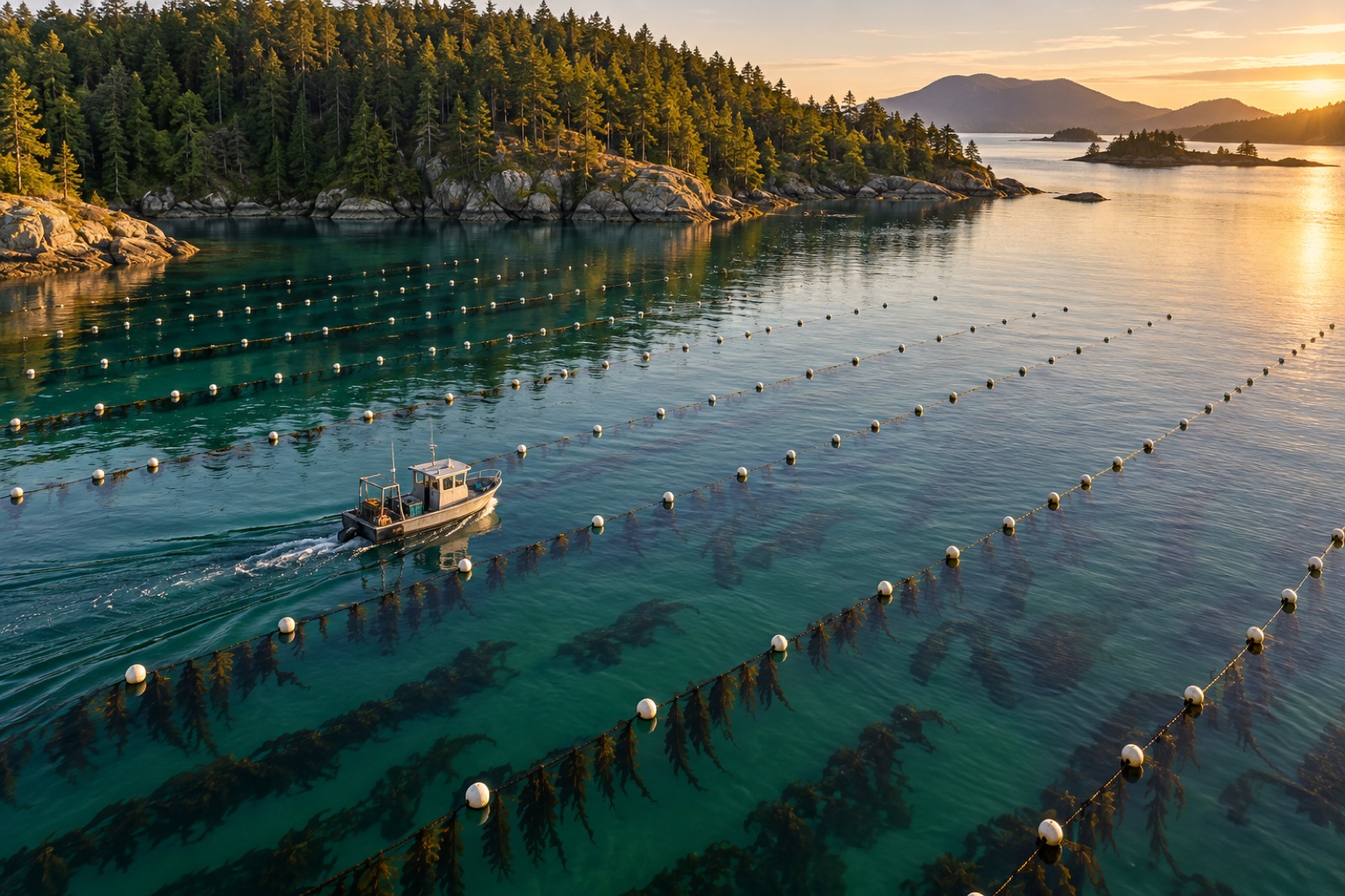
Kelp has no roots, no skin and no way to close its pores. Everything dissolved in the
water around it passes across the blade surface, and that makes a seaweed farm
exquisitely honest about its site's water. Most of the year that honesty is a gift —
upwelled nutrients flow straight in. But when a river floods, when snowmelt peaks, or
when an atmospheric river parks over the catchment for a week, a lens of low-salinity
water spreads across the farm and stays. A salinity shock rarely kills a crop
overnight; what it does is stall growth, bleach tissue, invite disease and quietly
shave weeks off a growing season. Farms that handle these events well do three things:
they know their vulnerability before they seed, they watch the right numbers, and they
have a response plan written down. This guide walks through all three.
What low salinity actually does to kelp
Marine algae regulate their internal chemistry against full-strength seawater, roughly
33–35 practical salinity units on open coasts. Drop the surrounding salinity and water
floods into cells by osmosis; the plant spends energy pumping rather than growing.
Species differ enormously. Sugar kelp is genuinely estuarine-tolerant and shrugs
off dips into the low 20s for days, one reason it anchors farming in fjord-adjacent
waters — see our sugar kelp growing guide.
Giant kelp and kombu are far fussier: sustained readings below the mid-20s show up
as slowed elongation, tissue softening and blade loss, and prolonged exposure to the
low 20s can be lethal to hooked seed.
Two features make salinity events subtle rather than spectacular:
- It stratifies. Freshwater floats. A five-knot surface current can carry a plume
over a farm whose crop at two metres depth sits in near-full seawater — or, if the
plume is deep and the lines shallow, the reverse. Depth is destiny, which is why
depth placement choices are half the battle.
- It compounds. Freshets arrive carrying sediment and dissolved organic matter —
the plume physics we unpack in Where Rivers Meet the Kelp.
The crop faces low salinity and low light and a flush of terrigenous nutrients
that feed fouling diatoms on the blades. Farmers usually misdiagnose the light and
the fouling and miss the salinity that started it.
Know your site before the river tests it
The cheapest salinity management happens at site selection — the discipline covered in
Choosing a Farm Site. For freshwater risk
specifically, weigh four things:
- Distance and direction to river mouths. Not just kilometres on a chart, but
which way the plume actually travels. Ask local fishers, and look at satellite
ocean-colour imagery from past flood years — plumes stand out beautifully.
- Catchment behaviour. A steep, flashy catchment dumps short, sharp freshets; a
broad lowland one bleeds freshwater for weeks after rain. The second is worse for
farms, even at the same peak flow.
- Vertical structure. Sites with persistent haloclines ride out events better
below the fresh layer — but check the layer's thickness before trusting it.
- Regulation upstream. Dam release schedules, irrigation withdrawals and planned
upstream works all rewrite the freshet calendar. Read the water authority's
operating rules, not just the climate records.
Watching the right numbers
General water-reading skills are covered in
Reading the Water; salinity management adds
a few event-specific habits:
- A conductivity-temperature logger at crop depth is the single best investment —
affordable, continuous and unambiguous. A second unit near the surface shows the
stratification story. Choosing hardware is covered in
Sensors and Data Loggers for Small Seaweed Farms.
- Handheld spot checks with a refractometer or salinity pen on every farm visit,
logged with depth. One reading per visit builds the site's seasonal character faster
than any model.
- River gauge and rainfall forecasts, checked like wind forecasts. On flashier
catchments, gauge rise leads the farm's salinity drop by hours to days — your actual
early-warning system.
- A photo record of blades during and after events. Bleached, translucent or
eroding tips next to dated salinity logs is how you learn your site's real
thresholds rather than textbook ones.
And calibrate. A drifting conductivity cell reports fiction with great confidence —
fold calibration checks into your regular
water testing protocol.
The response playbook
You cannot fence out a plume, so response is about protecting the crop's value and
gathering information:
- Ahead of a forecast event: finish any planned seeding or line work after it
if you can; newly seeded twine is the most vulnerable stock on the farm. If harvest
is close, consider taking crop early — slightly lighter blades beat salt-stressed
ones for drying quality.
- During: sample salinity at line depth, not just the surface; note visibility and
blade condition against a fixed photo point. Resist major interventions — this is
observation time.
- After: walk every line. Salinity stress shows up delayed, as tip loss and as a
bloom of fouling diatoms and opportunistic rot a week or two later; the post-event,
leeward phase is when
pest and disease monitoring matters most.
Mark hit sections for priority harvest or thinning, and keep that crop separate at
landing if quality has visibly slipped.
- In the logbook: record the event's depth structure, duration and the crop's
response. Three seasons of honest event records is the beginning of site-specific
knowledge no consultant can sell you.
Building tolerance into the farm
Long-run, farms soften salinity risk structurally: seed later on flood-prone sites so
young tissue misses the peak freshet; hang lines deeper where the halocline allows;
favour tolerant species or regional strains near rivers (within
native seedstock rules); and diversify site
exposure across the operation so one big plume is a bad week, not a lost season.
Designing for the worst weeks of the year is the same philosophy as
storm-proofing — freshets are simply storms
that arrive through the water chemistry instead of the forecast map.
Key takeaways
- Salinity shocks stall growth, bleach tissue and open the door to disease; they
rarely kill outright, which makes them easy to ignore and expensive over a season.
- Species tolerance varies widely — sugar kelp handles brackish excursions, giant kelp
and kombu do not. Depth matters as much as species because freshets stratify.
- Screen sites by plume behaviour, catchment flashiness, vertical structure and
upstream regulation before you seed, not after the first event.
- Continuous loggers at crop depth, rain and river gauges in the forecast routine, and
event photo records are the core monitoring stack.
- Response is protect-and-document: finish vulnerable work before events, watch during,
inspect and grade carefully after, and log every event to build site knowledge.
FAQ
How low can salinity go before kelp dies?
It depends on species, life stage and duration. Estuarine-tolerant species like sugar
kelp cope with dips into the low 20s (PSU) for days; most canopy kelps show stress
under sustained mid-20s and can die in the low 20s. Chronic mild dips cost more over a
season than one severe day.
My farm is near a river — should I hang lines deeper?
Usually yes, if depth and light allow: freshwater floats, so crop below the halocline
rides out freshets. Verify with a logger pair — some plumes are metres thick and a
"deep" line of three metres is still inside them.
Is rainfall on the farm itself a problem?
Direct rain is trivial. What matters is the river and runoff plume arriving hours or
days later — which is exactly why river gauges and catchment rainfall, not farm-site
rain gauges, are the useful predictors.
Can stressed kelp recover after a freshet?
Often, yes. Blades that lost tips or bleached patches commonly resume growth once full
salinity returns, if the holdfast and meristem are sound. The bigger post-event risks
are secondary: fouling blooms and rot taking hold of weakened tissue.
Should I harvest early if a big flood is forecast?
If the crop is near harvest weight and the event looks long, early harvest is usually
the right call — you bank slightly lighter but unstressed biomass rather than gambling
on siting out weeks of low salinity and turbidity. Just leave yourself drying capacity
for an unplanned harvest window.