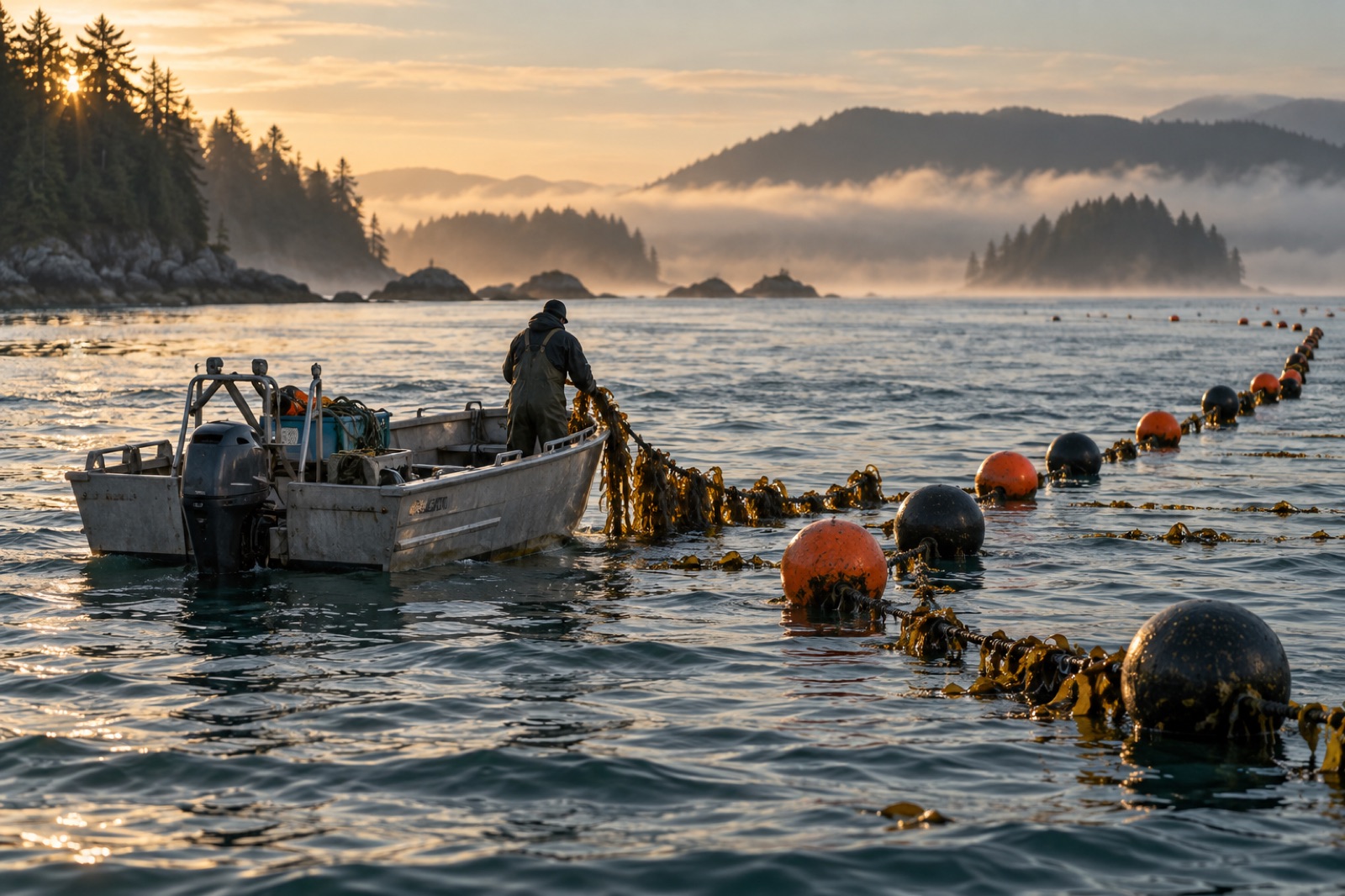
I've run crews through Tasmanian winters and Norse spring gales, and the pattern is always the same: the farms with clean safety records aren't the ones with the most rules — they're the ones where the gear is right, close to hand, and actually worn. Nobody wears a harness they hate, and nobody survives a fleece they trusted.
Seaweed farming is small-vessel work with heavy, wet lines and cold water. The hazards aren't exotic: going overboard, cold shock, rope entanglement, crush injuries between boat and gear, and the slow grind of cold stress on a long harvest day. This guide covers the protective kit that addresses each, what to spend and what to skip. Pair it with our wider farm safety protocols — gear is the last line of a system, not the first.
Layer zero: flotation that gets worn
The personal flotation device (PFD) is the single piece of kit most likely to decide whether a bad hour becomes a fatal one. Cold-water shock — the involuntary gasp and loss of breathing control in the first minute of immersion — is the killer in most workboat drownings, and even strong swimmers are passengers in it. Water in the temperate latitudes where kelp farms live is cold enough to trigger it in any month of the year.
For farm work, the standard-issue choice is a constant-wear auto-inflating PFD, 150 N class, with a spray hood and crotch strap if you can get one. Why auto-inflate: it's comfortable all day, so it stays on, and it functions even if the wearer is incapacitated. Why constant-wear rather than a foam jacket for everyone: foam jackets are better for some deck work under snagged-line risk (no reliance on inflation) and in very rough going — some crews carry both and supervisors decide by task. Whatever you choose:
- Fit check every crew member, new and old, at the start of season. A PFD sized for the shop mannequin rides up over the ears of a real human in water.
- Service inflatables annually and after every firing. A discharged cylinder and a corroded bobbin are failure modes you discover exactly once.
- Mark them with vessel name and a personal locator beacon (PLB) or AIS beacon pocket if your operation can stretch to it. Finding a person in grey water is a search; finding a beacon is a retrieval.
Cold-water protection: dress for the swim, not the job
The work happens on deck; dressing only for the deck temperature is how hypothermia sneaks up on fit young people on mild days. The risk maths of cold immersion is simple: how long until help arrives, dressed as you are?
Base and mid layers. Wool or synthetic next to skin, fleece or wool mid-layer — cotton is banned on my boats after a November. Carry a dry bagged change of clothes on every trip; it's cheap, it weighs little, and I've seen it used three times in a decade, each time worth every gram.
Outer layer. Farm deck work wants a breathable foul-weather jacket and bibs with reinforced knees and seat — you'll live on your knees hauling lines. Go one increment brighter than your taste allows; high-vis panels matter at 7 a.m. in drizzle.
When the water's cold enough to kill. If your season runs in water much below about 15 °C — and most kelp farming does — consider flotation coats or immersion ("survival") suits within reach for the coldest months. Flotation coats integrate buoyancy with insulation; they're the comfortable middle ground for deck crew in cold-season operation. Full immersion suits are the answer for solo or single-crew transits and for any operation a long way from rescue, and the drill for donning one belongs in your harvest-season routine the same way fire drills belong in buildings.
Kelp line work is hostile to hands: rope burn on a running line, blade-slime slickness on a wet rail, and the particular viciousness of barnacle-encrusted mooring hardware. Glove choice is a compromise between dexterity and protection, and the answer is usually three pairs on board:
- Nitrile-dipped grip gloves (cheap, buy by the dozen) for seeding and handling twine — dexterity first, replaced when holed.
- Heavy coated wet-weather gloves with a fleece liner for hauling and winter work.
- Cut-resistant gloves wherever knives, shackles or mollusc-encrusted gear are in play, and always when working a line under tension near the winch.
And the rule above all rules: no gloves when working a powered winch head or capstan where a snag means a hand. The glove that saves you from rope burn can feed you to the drum. Mark the zone, brief it, and enforce it without apology.
Feet, head and eyes
Boots: non-marking deck boots with genuine wet-grip soles, mid-calf, roomy enough for a wool sock. Steel toes are debated in small-vessel work — the weight costs you if you go in; toe protection wins you arguments with falling anchors. For workboats under roughly ten metres, I favour grippy, light, warm over armour-plated, but on larger deck machinery, protect the toes.
Heads: a proper industrial bump cap or helmet under any crane, davit or overhead block, and whenever mooring hardware is being moved above head height. The quiet majority of boat head injuries are not dramatic — they're a swinging shackle at ear height.
Eyes: cheap polarised safety glasses live on a leash behind the wheelhouse. Use them for splicing, grinding, pressure-washing and any work with tensioned line — a snapping rope's whiplash end is moving when it arrives.
Protective clothing fails as a system more often than as items. The system looks like this on a well-run farm:
- A written minimums board in the shed — what must be worn for which task, in plain language, with pictures. New crew learn it on day one alongside the safety brief from crewing a kelp farm.
- Spares. A wet-glove day without spares is a frostnip day in winter. Carry double of the things that get wet: gloves, socks, hats.
- Drying infrastructure. A drying rack with airflow and twelve hours changes safety outcomes. Crew will not wear yesterday's wet gloves; nobody sensible blames them.
- A casualty check habit. Cold stress degrades judgment before it announces itself — the "umbles" (stumbles, mumbles, fumbles, grumbles). Buddy-check hourly in cold conditions, and treat theumbles as an end-of-shift signal, not a toughness test.
Budget guide
Realistic per-person kit costs at small-farm scale:
| Item |
Budget band |
| Auto-inflate PFD (150 N) |
$120–250 |
| Foul-weather jacket + bibs, commercial grade |
$250–500 |
| Deck boots |
$80–160 |
| Glove kit (all three types, with spares) |
$80–150/season |
| Bump cap/helmet + eye protection |
$40–90 |
| Flotation coat (cold season) |
$180–350 |
| Immersion suit (where needed) |
$300–800 |
Call it roughly $1,000–2,000 per crew set-up, plus per-season consumables. Against even one lost-time injury — and against the arithmetic of what one immersion costs a family — it is the cheapest capacity a farm buys.
Key takeaways
- Flotation worn beats flotation stowed: constant-wear auto-inflating PFDs, fitted and serviced, are the baseline.
- Dress for the swim, not the task — cold shock kills before hypothermia starts, and water below about 15 °C changes the gear standard.
- Three glove types, and a hard no-gloves zone at powered winches.
- Safety gear fails as a system: minimums boards, spares and drying racks matter as much as the items themselves.
- Buddy-check for the "umbles"; cold degrades judgment before it presents as cold.
FAQ
What PFD is best for seaweed farm deck work?
A constant-wear, auto-inflating 150 N PFD for general work; foam jackets for tasks where inflation might be a hazard or where the going is very rough. Fit, spray hood and crotch strap matter more than brand. Service inflatables annually.
Do I need an immersion suit?
If you work solo transit, single-crew boats, or operate far from rescue in water below about 15 °C, yes, within reach. For crewed day-boat work with good rescue access, the flotation-coat tier plus strong man-overboard procedure may suffice — assess honestly against worst case, not average day.
How do I keep gloves usable in winter?
Rotation. Three pairs per person, waterproof-lined heavy gloves on deck and a warm-drying rack back at the shed. Wet gloves are the end of safe detail work; budget for spares as consumables.
Are steel-toe boots required?
Check your jurisdiction's rules for commercial marine work. Practically, on small vessels prioritise grip and warmth; on vessels with deck machinery, jawed blocks or anchor-handling, go with protective toes.
What's the one item new farms always underspend on?
Drying infrastructure. The gear already bought only works if it's dry by tomorrow. A heated, ventilated rack does more for all-weather crew safety than any single garment upgrade.
Tidewright, for the record, is a fictional ocean-restoration company created as a design and content demonstration — the safety guidance above, though, reflects real cold-water work practice.