Farming11 min read
Making Seed String: From Spore Release to Nursery Lines
Seed string is the kelp farm's starter crop. This step-by-step guide covers sorus collection, spore release, inoculation density, incubation and out-planting.
Naomi Reyes ·
How to mechanise kelp seeding on a farm: binder machines, spool carriages, spray systems and drum seeders compared, with throughput, costs and buying advice.
Seeding is where small kelp farms discover the cost of scale. Winding seed string onto cultivation line by hand is meditative at fifty metres and a staffing crisis at five thousand: a working rule of thumb is that manual seeding consumes more person-hours per hectare than any other operation in the farm year, and the hours all fall inside the same narrow autumn window when the hatchery says the seed is ready. Everything you plant has to pass through that bottleneck. This guide covers the four families of seeding hardware that serious farms use to break it — twine binders, spool carriages, spray systems and drum seeders — what each costs and achieves, and how to choose for your scale. For how the seed itself is produced beforehand, see our guides to making seed string and setting up a hatchery.
The core task repeats everywhere: a thin carrier twine — culture string wound with juvenile sporophytes or gametophytes from the hatchery — must end up attached to thick cultivation rope, helically wrapped around it at close pitch so kelp plants end up distributed along the line. Done by hand, a two-person crew standing on a pontoon wraps perhaps a hundred to a hundred and fifty metres of mainline an hour at careful, even pitch. Done badly, wraps slip, gaps appear, and the crop's distribution follows the crew's least favourite weather.
At a few hundred metres of line, hand seeding is fine — see our guide to running a half-hectare farm. At five to ten hectares and tens of thousands of metres, the labour maths forces the question: either hire a small army for one fortnight a year (and accept rushed, uneven work) or mechanise.
The binder is the workhorse answer, directly descended from agricultural and packaging-labelling machinery. The main cultivation rope feeds through the machine while a spinning head, loaded with a spool of seed string, wraps the string helically around the rope at set pitch — like a lathe cutting thread, with kelp for thread. Good binders control pitch via a mechanical ratio of rope feed to head rotation, so wrap spacing stays even regardless of operator skill.
The carriage approach mechanises not the wrapping but the work environment: a frame — bench-side or on the workboat — that carries the rope payout spool, the seed-string station, a tensioned wrap point and take-up reel, all aligned so one or two operators guide the line through rather than wrestle it. Think of it as the difference between a sewing machine and a sewing table with helpful clamps. Carriage rigs are the standard intermediate step: often a binder head mounted inside a full carriage, with line storage, guides and powered haul.
Spray systems skip the carrier twine entirely: a spore or gametophyte suspension, made in the hatchery, is sprayed directly onto the growing line as it passes over rollers, or the line is drawn through a suspension bath. The hatchery then handles the delicate early development in tanks, or — in bolder approaches — deployment goes directly to sea, letting settlement and early growth happen on the farm line.
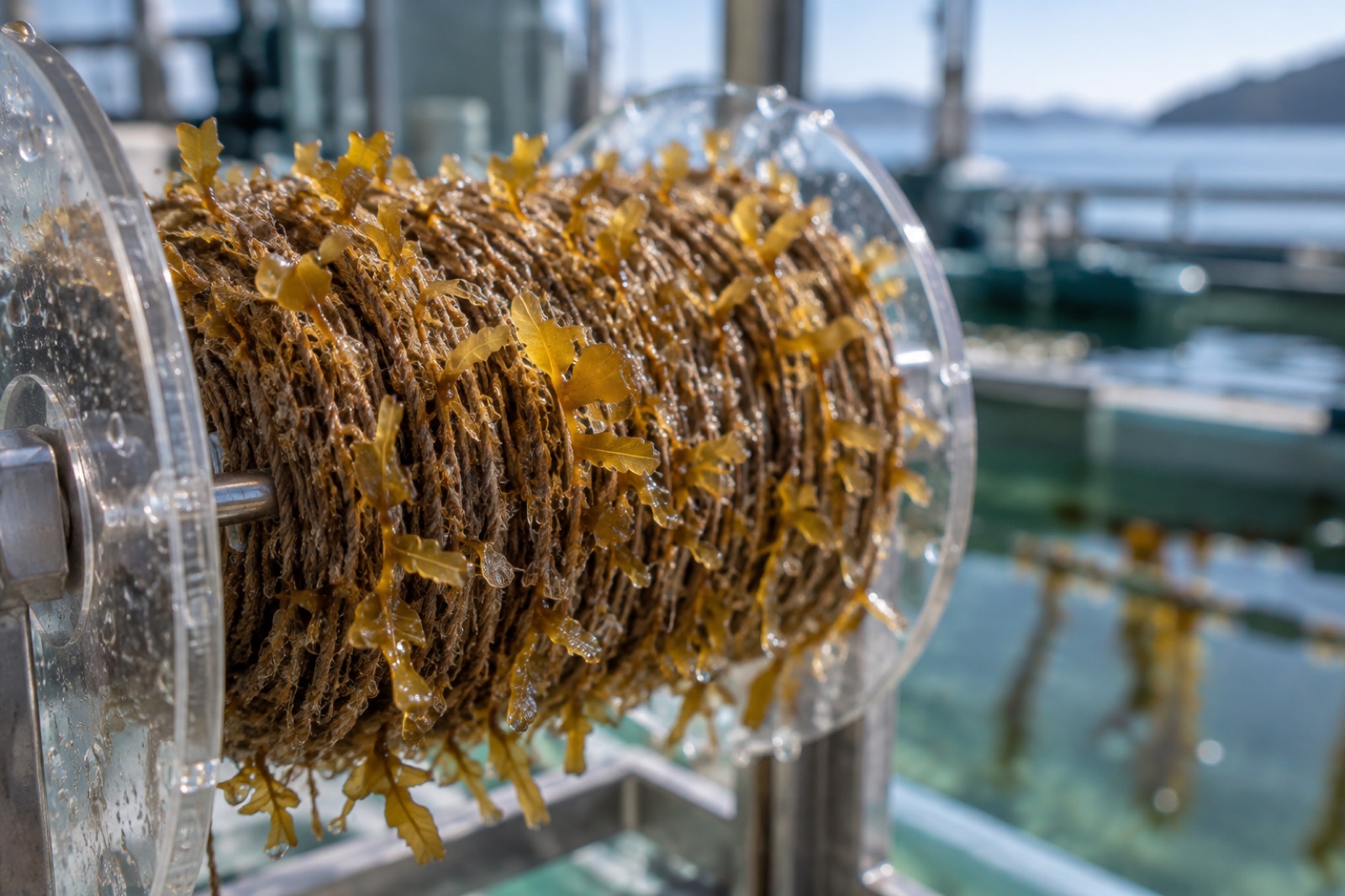
The quietest workhorse is the hatchery-side machine: a rotating drum or reel around which carrier twine is wound while the drum turns in a spore or gametophyte suspension, so thousands of metres of seed string get coated in an afternoon — replacing hours of hand-suspension painting in trays. This is the machine that industrial hatcheries, our fictional Holdfast nurseries included, rely on: seed string becomes a bulk product, manufactured at consistent density, instead of an artisanal one.
It is worth understanding where this trajectory ends, because Tidewright's model sits at that end. Our fictional reseeding vessels — described on the Drifter platform page — carry drums of pre-seeded Holdfast line and lay it directly onto restoration substrate, fusing hatchery production and at-sea deployment into a single continuous machine operation. No farmer needs that scale, and that is exactly the point: the vessel exists because at restoration scale, seeding isn't a fortnight bottleneck, it is the entire industrial process. Every tier of farm mechanisation borrows a piece of that logic.
A blunt decision frame that we would give any grower (see also our equipment overview):
One rule crosses all scales: buying the head before handling the line waste nobody's money. Mechanisation fails in the rope, not the wrapper — tangles, strain and fruitless manoeuvring devour the gains. Buy the haul-through speed before the wrap speed.
Kelp seeding machinery is a young market; most of what exists is either adapted from other industries (agricultural binders, textile winders, labelling machines) or fabricated by farms themselves. Practical advice:
Most farms find the breaking point between three and ten hectares: below that, one well-organised hand crew is economic; above it, a two or three person crew with a binder and carriage outproduces ten hand-wrappers. The machine pays for itself inside two to three seasons at that combined saving (illustrative range; farms differ by wages and line volume).
They can — pinch points and over-tensioned heads scuff sporophytes off seed string. Wide-surface rollers, spring tensioners and a head speed that matches the rope feed all protect the seed; check scrap twine for stripped plants when commissioning any new rig.
Species- and site-dependent. It works well for fast, opportunistic growers in sheltered, low-fouling water and poorly where silt or epiphytes blanket new line. Most farms adopting it run parallel trials: a fraction of lines spray-seeded, the rest twine-bound, for two seasons before committing scale.
Yes — machines standardise the input they need. A binder wants consistent twine at consistent seed density; a spray rig wants calibrated, single-species suspension at known density. If your hatchery isn't producing uniform seed material, mechanisation exposes it first. Solve string and suspension quality — see seed string production — before buying hardware.
Seed string is the kelp farm's starter crop. This step-by-step guide covers sorus collection, spore release, inoculation density, incubation and out-planting.
Naomi Reyes ·
A practical guide to building a small kelp hatchery: culture room design, seawater systems, equipment, budgets and the weekly workflow that produces seeded twine.
Naomi Reyes ·
The complete equipment list for a kelp farm — boat, moorings, seeded lines, harvest and handling gear — with realistic cost ranges and buying strategy.
Naomi Reyes ·