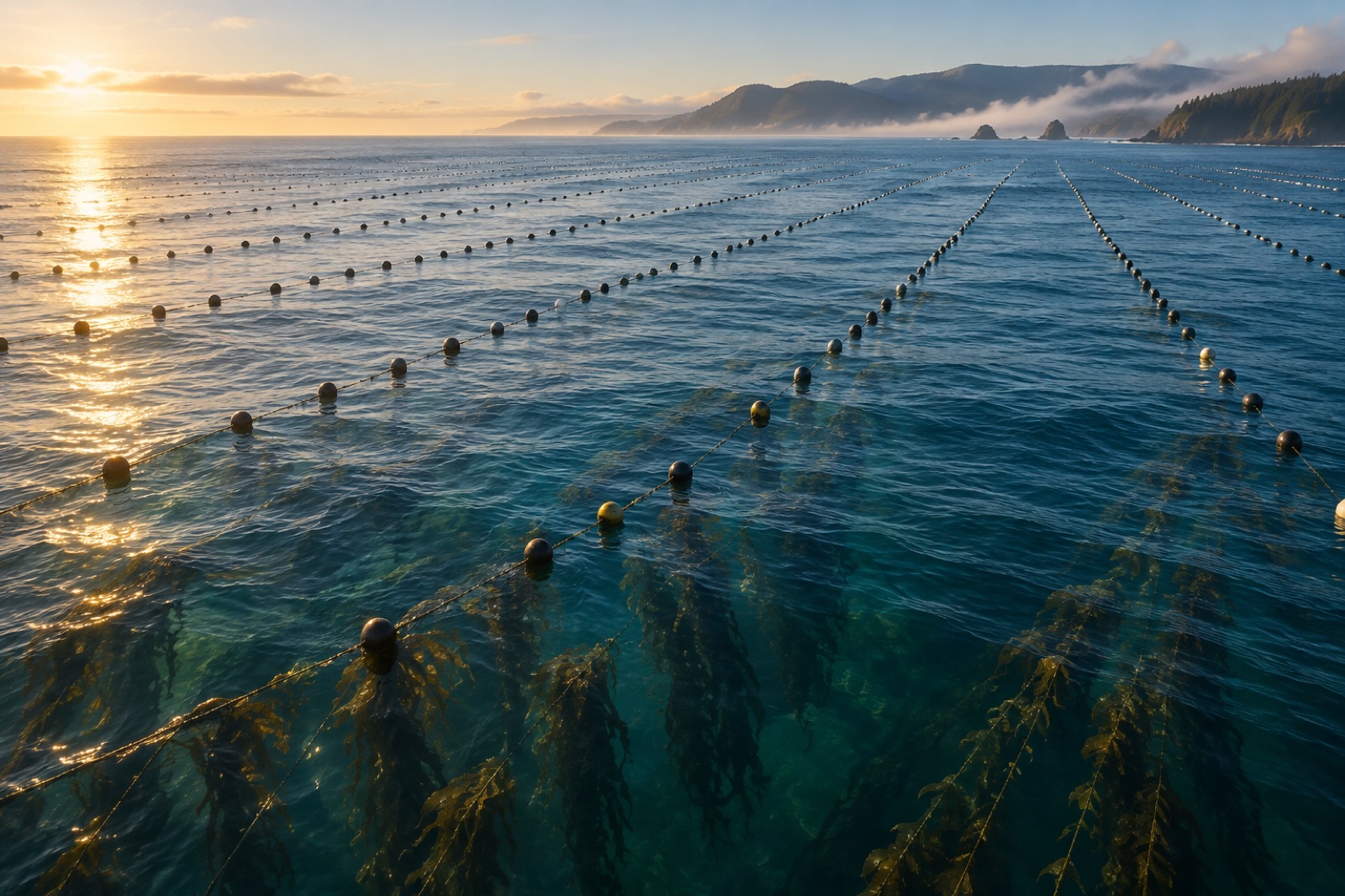
The crowded sea is the premise: Europe's coasts are filling with wind farms at the exact moment its governments are asking seaweed aquaculture to scale up. The obvious answer — put the kelp farms between the turbines — has gone from conference-paper novelty to a small fleet of working North Sea pilots, with the engineering discipline of both industries rubbing against each other for the first time. The promise is real: shared sea space, shared boats, shared permits, shared grids, and safety exclusion zones that function as de facto reserves. So are the puzzles: legal ownership of water between foundations nobody yet knows how to insure, waves that don't die inside arrays the way intuition says, and ecological effects running in both directions. This article maps the promise and the puzzle, evidence first. Our companion multi-use examination treats the concept; here we follow the machinery.
Fast facts
|
|
| Concept |
Seaweed longlines (usually kelp) installed within the footprint of offshore wind arrays |
| Global status |
Handful of working pilots, mostly Belgian and Dutch North Sea; no commercial fleets yet |
| Main driver |
Sea-space scarcity and permitting costs for new farms |
| Farm geometry |
Longlines strung between turbines or on dedicated sub-array moorings |
| Won so far |
Feasibility of navigation, seeding, growing, basic co-servicing |
| Still open |
Insurance and liability, consent for multi-use, hydrodynamic effects, ship-strike risk, scale economics |
The promise: five shared assets
Co-location sells itself on shared infrastructure. Each argument is honest as far as it goes:
- Sea space. The hardest part of permitting a new farm in European waters is not biology or money; it's space consensus. Inside an existing wind array the spatial claim is already made. Farmers consenting within that footprint, in principle, skip the heaviest hurdle covered in our seaweed farm-permits guide.
- Boats and crews. Turbines already get visited daily by service vessels. If farm servicing can ride aboard — even partially — operations-and-maintenance (O&M) vessel cost, one of the two great costs of an offshore farm, falls across two industries instead of one.
- Mooring economies. Wind-farm engineers think professionally about anchor loads, scour and seabed condition; kelp-farm engineers think in the same units. Shared seabed survey, shared exclusion of mobile fishing gear, and potentially shared anchoring corridors could bring mooring costs down together.
- The grid and the digital layer. Farms need sensors, cameras and telemetry; wind arrays are among the most sensored environments at sea, already wired for data. A kelp array inside a wind array can read current, temperature, turbidity and biological status from an instrument platform the wind operator maintains.
- The exclusion bonus. Most working arrays prohibit trawling within their footprint — which makes them unintended marine reserves. A scientific consensus is building that turbine foundations function as artificial reefs; kelp longlines extended through those waters would sit in what is effectively already protected coastal sea.
The puzzle: seven honest problems
1. The array doesn't calm the waves
The comforting image — a forest of steel damping the sea — doesn't survive the mechanics. Monopile foundations occupy tiny fractions of a swell's cross-section; field measurements show conditions inside working arrays to be rougher in gustiness and wave-current interaction, not calmer. The urban legend lives because it feels right at a dockside, but a co-located farm must still be designed to storm-proofing standards — the array buys shelter from traffic, not from weather.
2. Wake turbulence cuts both ways
Submerged foundations do stir the water column — shedding small-scale turbulent wakes downstream — and that mixing can, in principle, refresh the nutrient-depleted boundary layer around kelp blades, as turbulence feeding kelp argues at every scale. The effect is real at the metre scale; whether it measurably feeds whole longlines at the kilometre scale remains an open research question. Wake effects also redistribute sediment and local currents, changing where fouling lands and where anchored lines scour.
3. Liability is unwritten law
Who is liable when a service vessel's hook snags a kelp line? When a storm-torn longline wraps a cable? When biofouling on foundations runs heavier after nearby kelp rain of drifting reproductive material? There is no mature insurance market for these interactions, and the first generation of pilots is writing the precedents — one reason seaweed farm insurance looks especially exotic for co-located sites.
4. Navigation and strike risk
Turbines are spaced several hundred metres to a kilometre apart. Kelp lines must thread a geometry that serves small service craft working predictably, in poor weather, without turning the array into a day-glo obstacle course. The pilots have answered with marker corridors and tight passage plans; nobody yet has decades of data.
5. Consent regimes aren't built for two owners
Marine spatial planning typically hands a licence to one operator for one activity. Multi-use consent — wind plus aquaculture plus the access exclusions that enable both — requires either a reform or a bespoke agreement between operators, regulators and often fishing interests who may prefer the exclusion zone exactly as it is. North Sea states are actively legislating their way there; elsewhere multi-use remains a legal concept looking for a workplace.
6. Ecology runs both directions
What's good for kelp is not automatically good for the array. Fouling of foundations is already an engineering load on turbines; kelp farms add reproductive material and drifting fragments that will recruit onto underwater steel. Array-boat crews will also encounter mussel-heavy fouling communities transferring to farm lines. In the other direction, longline habitat adds feeding and nursery structure in the water column above foundation reefs — potentially a stacked habitat gain. Every one of these arrows needs measurement, not assumption.
7. The shared-boat savings are smaller than they look
Rideshare O&M assumes one boat visits both infrastructures on the same day on the same weather windows. In practice, kelp work (daily in the growing season, weather-capped in waves) and turbine work (scheduled, heavy, dry-dock-adjacent) rarely serve the same calendar. The saved cost is real but partial.
What the pilots actually show
The Dutch and Belgian North Sea consortia have answered the easiest questions affirmatively: kelp seedstock grows on lines inside arrays; the blades reach commercial length; service visits are feasible; no show-stopping legal doctrine killed the venture. They've also surfaced the second-order answers a desktop study couldn't: fouling gradients are steeper than expected on lines near foundations; blade quality varies more across short spatial distances inside an array than inside freestanding farms, presumably from the patchy turbulence and shading; and the safety-culture integration of two operations — wind technicians trained for work-at-height meeting aquaculture crews working on moving decks — takes longer to harmonise than the engineering does. These pilots represent feasibility, not yet economics; their operators are candid about the difference, and the industry is notably free of the hype-speak that has wounded earlier multi-use waves.
The global map beyond the North Sea
East Asian seaweed giants — world-historical in scale — watch co-location closely as their own near-shore space saturates; Korean and Chinese planners have discussed wind-aquaculture as a national spatial policy, with early offshore-attached longline trials inside new Chinese arrays. US permitting conversations increasingly mention multi-use as offshore wind arrives on the Atlantic shelf inside existing kelp-farming momentum. The Pacific coast's proposed big arrays — offshore California and Oregon — raise the same questions Tidewright's coastal partners ask on our project coasts; the co-location question has gone global in under a decade. Tidewright's own offshore monitoring work with Canopy Ledger instruments at coastal arrays is watching the same hydrodynamic and biological signals the pilots report, and the science community's mapping and monitoring tools increasingly treat arrays as instruments of coastal research rather than obstacles to it.
What a serious co-location roadmap looks like
- Site inside, not beside. Place line geometry to serve real navigable lanes, marked, with legal right-of-way between operators.
- Instrument first. Put turbulence, nutrient, light and biofouling sensors into the water column for a full seasonal cycle before the first seeded line — the array is a measurement platform; use it.
- Contract the sea. Multi-use consents that allocate storm-loss, fouling, biofouling-transfer and strike liability before the lawyers have to invent it during a claim.
- Design for removal. Both wind farms and farms decommission; lines that can't be cleanly recovered from water that was only ever leased are tomorrow's ghost gear.
- Reserve the ecological verification. A co-located farm's "nature-positive" claim belongs on a monitored footing, not a rendering — the pilots' restraint on that point is the model.
Key takeaways
- Co-locating kelp farms inside offshore wind arrays has graduated from concept to small working North Sea pilots; commercial-scale multi-use fleets do not yet exist.
- The real shared assets are sea space, consent, access exclusions and sensor infrastructure — not the phantom benefit of calmer waves.
- Array wakes mix the water at fine scales that may help kelp nutrition locally; array interference at kilometre scale can equally worsen fouling and unpredictability.
- Liability, insurance and multi-use consent are the binding constraints today — legal and financial, not biological.
- The credible roadmap is instrumented, contracted, decommissionable and honest about economics; the pilots' humility is the right tone for the industry.
FAQ
Do wind farms protect kelp farms from waves?
No. Turbine foundations occupy too little of a swell's cross-section to significantly damp waves, and field measurements show conditions inside arrays comparable to or locally rougher than outside. Co-located kelp systems must meet the same storm-load standards as freestanding offshore farms.
Who would own the kelp inside a wind farm?
That is exactly the unsettled question. Current models give the aquaculture operator a sub-lease or consent agreement inside the wind operator's footprint, with shared-liability schedules for collisions, storm loss and biofouling transfer. Multi-use marine consent regimes — especially in North Sea states — are where the legal forms are being written now.
Could seaweed growing between turbines hurt the wind farm?
Potentially: kelp fragments and reproductive material recruit onto submerged steel, adding to biofouling that already figures in turbine load calculations, and drifting debris from damaged lines could threaten cable corridors. Co-designed line placement and contractual responsibility for recovered gear are the working answers.
Are there real co-located kelp farms today?
A small number of commercial-scale pilots operate inside North Sea wind arrays — Dutch and Belgian projects that have successfully seeded, grown and harvested kelp between turbines. They are feasibility operations, not yet commercial fleets, and they are transparent about that status.
Could the ocean energy and seaweed industries really share boats?
Partially. Where service windows overlap, a boat can visit both infrastructures on one trip and save cost. But the calendars differ more than the brochures suggest — kelp needs frequent, weather-flexible visits through the growing season while turbines run scheduled heavy maintenance. Shared O&M helps; it does not transform the economics by itself.