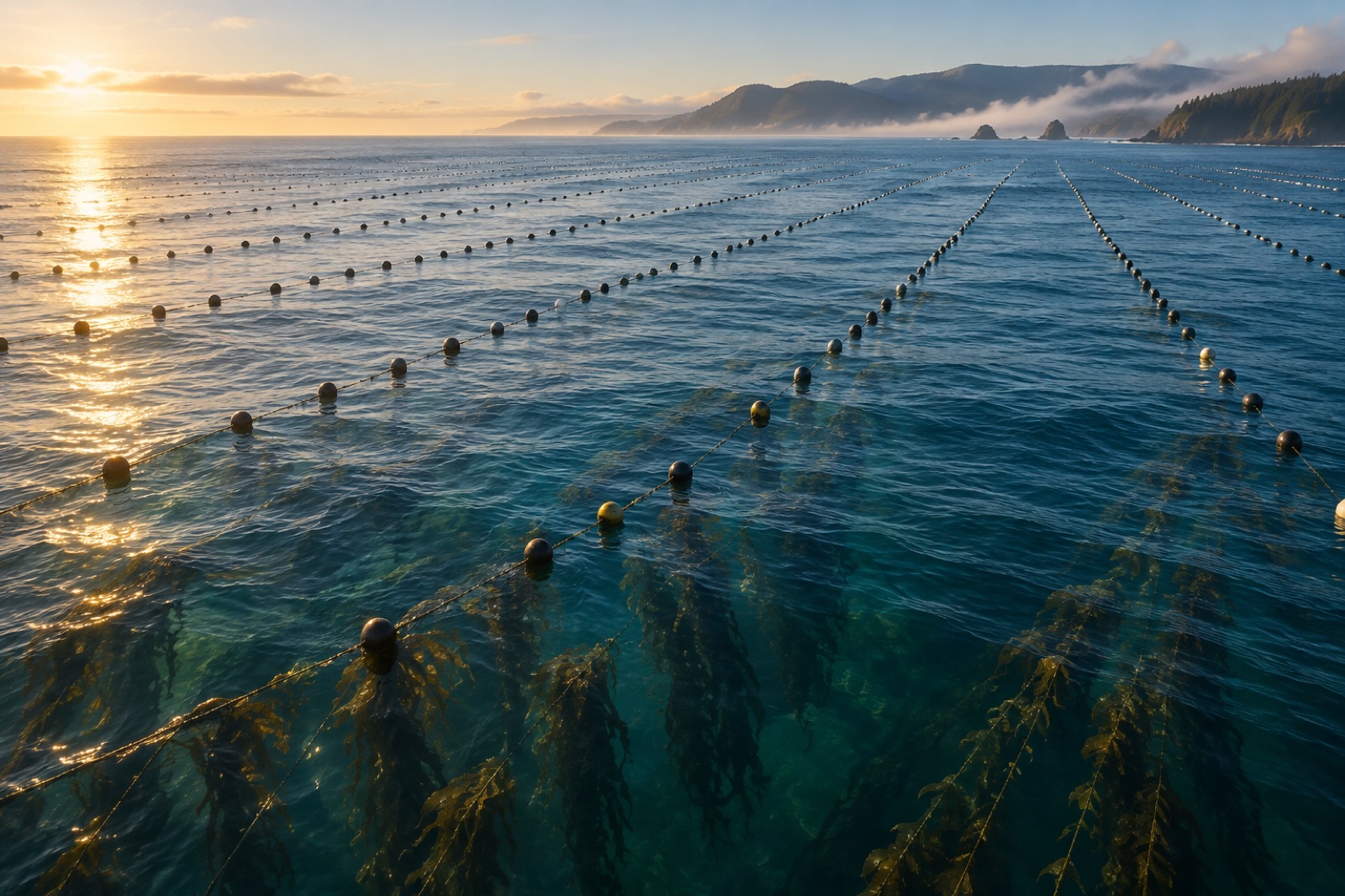
Offshore wind farms occupy enormous areas of sea that exclude almost every other use. The space between the turbines — often hundreds of metres on a side, for decades at a time — tempts anyone looking for ocean room, and seaweed farmers are looking. The pitch writes itself: shared planning, shared survey data, shared vessels, one consenting process, an energy company with incentives to be a good neighbour. The reality is more conditional. Co-location works, but only when the two projects are designed for each other from the start. This article examines where the overlap is genuine, where it dissolves under engineering and insurance scrutiny, and what a seaweed operator should ask before committing to grow inside a wind farm.
Why the idea keeps coming back
Nearshore space is the binding constraint on seaweed aquaculture growth. Competing with fishing grounds, shipping lanes, anchorages and conservation areas, nearshore leases are small, fragmented and slow to obtain — the pressures that push farms offshore generally, which we covered in offshore seaweed systems. Wind farms between the turbines look like reserved ocean: already surveyed, already consented for industrial use, already serviced by crew-transfer vessels, and in many jurisdictions already zoned to exclude fishing and anchoring. For a farm designer, a wind lease is a parcel of sea with the neighbours problem partly solved.
There is also an alignment of interests. Wind developers face pressure to demonstrate local economic benefits and sometimes to deliver net-positive biodiversity outcomes on their sites. A functioning seaweed farm does both visibly — jobs that persist after construction ends, and habitat structure where previously there was mostly open water. Panels and extractive sampling can quantify this for reporting.
Where the overlap is real
Water that suits the crop
Turbines get built where winds are consistent, which typically means exposed shelves with good flushing and, in many regions, nutrient-rich water. Turbine foundations themselves act as artificial reefs that concentrate fish and invertebrate life — which can mean more dissolved nutrients in the water column and more biodiversity overhead. Some of that life is fouling on your gear, and some is the kind of ecosystem signal that makes co-use attractive to regulators.
Shared surveys and metocean data
A wind farm comes with years of wave, wind, current and seabed data — the exact same datasets a farm designer needs but would otherwise spend serious money collecting. Access to that metocean record shortens the design cycle and anchors the load cases for mooring engineering with real local statistics rather than modelled extrapolations. That is a real cost saving, often tens of thousands in survey spend avoided.
Shared vessels and maintenance logistics
Crew-transfer vessels already run daily between port and the wind farm. If the farm crew can ride existing trips — subject to safety case acceptance — the per-trip cost of reaching the site collapses compared with running a dedicated boat from a distant harbour. The same logic applies to towing gear out, to installation vessels mobilised anyway for wind farm maintenance, and to the shore-side reception infrastructure both operations need.
Regulatory efficiency
One marine spatial plan, one environmental impact assessment process, one set of stakeholder consultations stretched across both uses. In principle, co-location consolidates the consenting burden. In practice it only does so if seaweed is in the masterplan from the beginning; retrofitting aquaculture into a consented wind farm often means a parallel process anyway.
Where the overlap dissolves
Safety zones and navigational room
Turbines have standoff requirements. So do export cables, array cables, cable crossings and scour-protection aprons. So do the service lanes vessels need to reach every foundation in any weather. Subtract those zones and the layout shrinks and distorts: the usable room for a grid of longlines is rarely the tidy open water the masterplan map suggests. The engineering answer — submerged systems with small surface markers, designed per the submerged-grid logic of offshore seaweed systems — harvests much less of the apparent space than the headline figures.
Insurance and liability
A wind farm is an asset worth billions, owned by a company whose insurance underwriters see a floating grid of rope and anchors as a risk to cables, foundations and vessels. Farm gear that parts its moorings in a storm becomes adrift tonnage inside someone else's critical infrastructure. The load cases become brutal: not just "will my grid survive" but "will my grid survive everything, because its failure modes are someone else's headline." That typically drives specifications above what an independent farm of the same size would carry — and therefore cost above it, too. The design philosophy of over-building for the worst week, laid out in storm-proofing a kelp farm, becomes non-negotiable rather than prudent.
Operational choreography
Wind farm maintenance campaigns — jack-up vessels, cable repairs, blade works — periodically close parts of the site, sometimes with short notice. A crop growing between turbines cannot simply be ignored for two weeks while a jack-up sits across the access lanes; seeding and harvest windows have to be negotiated into the wind operator's annual plan. The farm that works becomes the junior partner's scheduling problem, and harvest's weather windows (see harvest logistics) are unforgiving about available days.
Who owns what, in writing
Lease structures matter enormously. If the aquaculture use sits inside the wind lease under a head-lease or licence-to-occupy, the seaweed operator's tenure rides on the wind developer's — including its refinancing, its changes of control, and any decommissioning decisions. Multi-decade tenure certainty, which lenders and offtakers expect, is harder to demonstrate under a subordinate right than under a direct lease from the state.
What actually works: the patterns that ship
Co-located projects that survive the design phase tend to share a set of features:
- Early joint design. The wind layout reserves farm bays: corridors of clean water between rows, sized and oriented for aquaculture, kept free of export cables and access lanes. Retrofits into a farm designed without aquaculture in mind mostly fail the geometry test.
- Submerged or semi-submerged systems. Smaller surface footprint, better storm survival, less navigation conflict. The engineering is harder and the first farms are proving it now.
- A shared vessel plan with written SLAs. Ride-along logistics with guaranteed access, not goodwill access.
- Separation by contract. The aquaculture company carries its own insurance, its own lease or explicit sublicence terms, and its own storm-response obligations. Gear failure indemnities are capped by design standards, not left open.
- Clear monitoring intent. Co-location works partly because it demonstrates multi-use and habitat outcomes. That story needs baseline surveys and a monitoring plan, which both parties fund because both parties cite it in their reporting.
The seaweed operator's checklist
Before committing to grow inside a wind farm, get clear answers to:
- What areas, exactly, are excluded — cables, lanes, standoffs, every one of them drawn to scale?
- What storm load case does the site data actually support, and who signs off on my mooring design?
- What vessel access is guaranteed, on how many days per year, at what notice period for exclusions?
- What is the tenure structure, and what happens to my licence if the wind farm is refinanced, sold or decommissioned early?
- Who pays for baseline ecology surveys and ongoing monitoring, and who owns the data?
The permitting groundwork overlaps heavily with what any new farm needs — see seaweed farm permits — but with a second master at the table.
Co-location inside wind farms will not be the ocean-space silver bullet some headlines promised, and it will not suit every site. But where the geometry, the storm case and the contracts genuinely align, it produces something rare in ocean industries: two uses that make each other cheaper to run and easier to justify. That is worth designing for, deliberately, from the beginning.
Key takeaways
- Wind farms offer surveyed, consented, serviced ocean space — but only a fraction of the footprint is actually farmable once cables, standoffs and service lanes are excluded.
- Failure of farm gear inside a wind farm is someone else's headline: insurance and engineering specs are driven up, and designs must survive the worst storm case without exception.
- The winning pattern is joint design from day one — reserved farm bays, submerged systems, contracted vessel access — not retrofitting aquaculture into a finished wind layout.
- Tenure clarity matters: a farm built under a subordinate licence inside a wind lease has weaker long-term security than one holding its own.
- Shared surveys and data are a genuine, immediate saving; shared vessels are a significant ongoing one if access is written into service agreements.
FAQ
Is it actually legal to farm seaweed inside an offshore wind farm?
In several jurisdictions, yes — regulators increasingly support multi-use, and some offshore wind tenders now score co-use proposals favourably. The practical consenting route varies: sometimes aquaculture becomes part of the wind farm's own marine licence conditions, sometimes it needs its own lease or licence subordinate to the wind rights. Always check who currently holds the seabed rights and whether aquaculture is an accepted secondary use under them.
Do the turbines damage or help the seaweed?
Neither directly. Turbine foundations change local flow slightly and act as reefs that concentrate fish and invertebrates; wake effects on mixing are modest at the spacing of modern arrays. What matters far more to the crop is site exposure, nutrient regime and water depth — the usual criteria in farm site selection — plus the operational constraints the wind farm imposes on gear and scheduling.
What hardware works best between turbines?
Submerged longline systems, because they duck the wave field and keep almost nothing at the surface to conflict with navigation and maintenance. That choice raises harvest complexity (you must raise the crop, or reach it) and needs reliable depth control — the trade-offs are analysed in offshore seaweed systems. Surface grids struggle with both storm loads and wind-farm access rules.
Does co-location save money overall?
It saves significant money on surveys, sometimes on boats and mobilisation, and potentially on consenting if the sequencing is right. It costs more in engineering specification (storm cases, insurance-driven safety margins) and often in schedule friction with the wind operator. Net-net it tends to be cheaper than a greenfield offshore site of the same size, but only when design starts jointly.
Who takes the risk if my gear breaks loose and damages a cable?
The contract decides this, and getting it drafted well is essential. Typically the seaweed operator warrants that its grid meets an agreed engineering standard and storm-response protocol, with liability terms that flow from whether that standard was met. Under-insuring here is how co-location deals die in late-stage diligence.