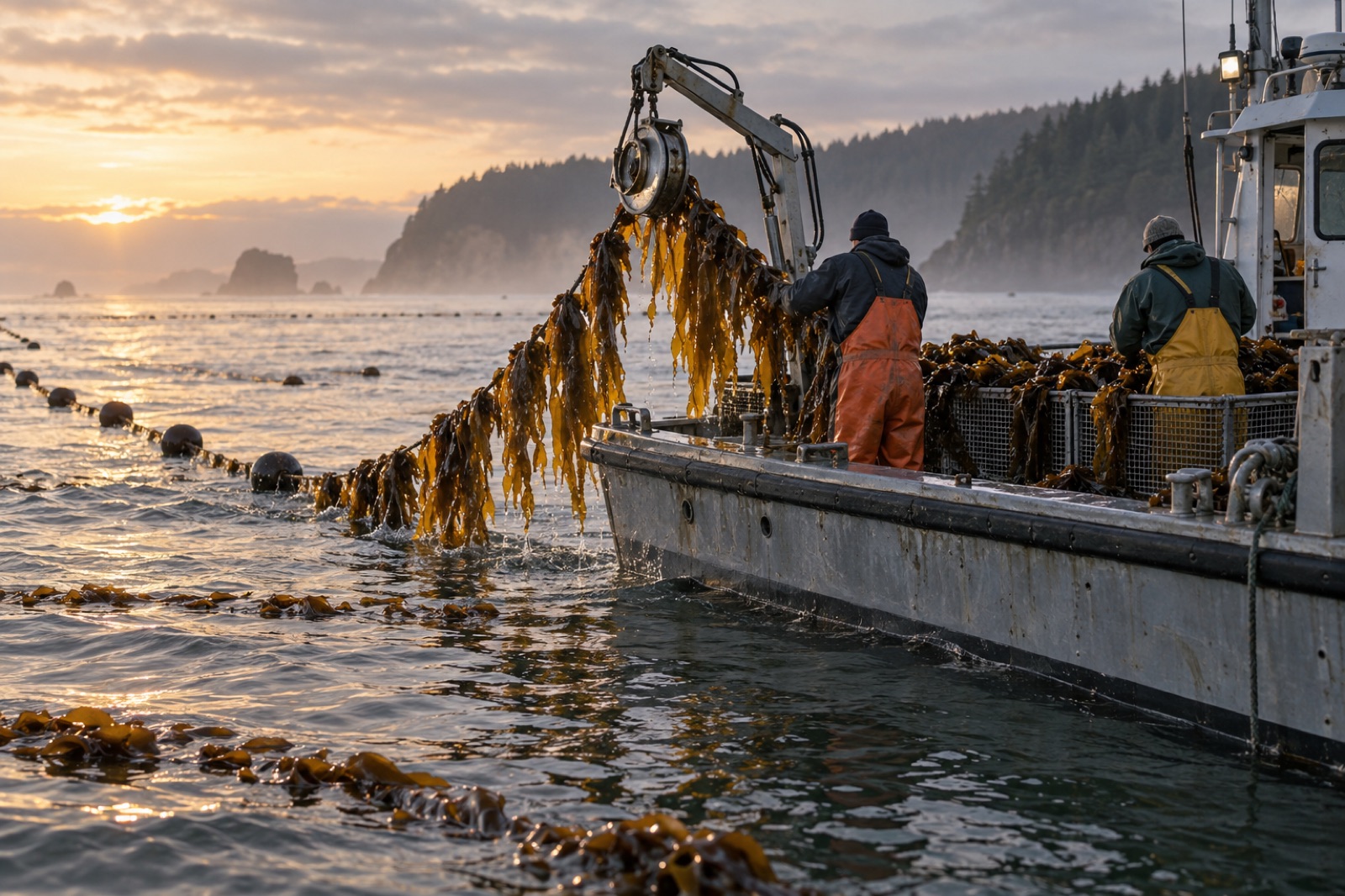
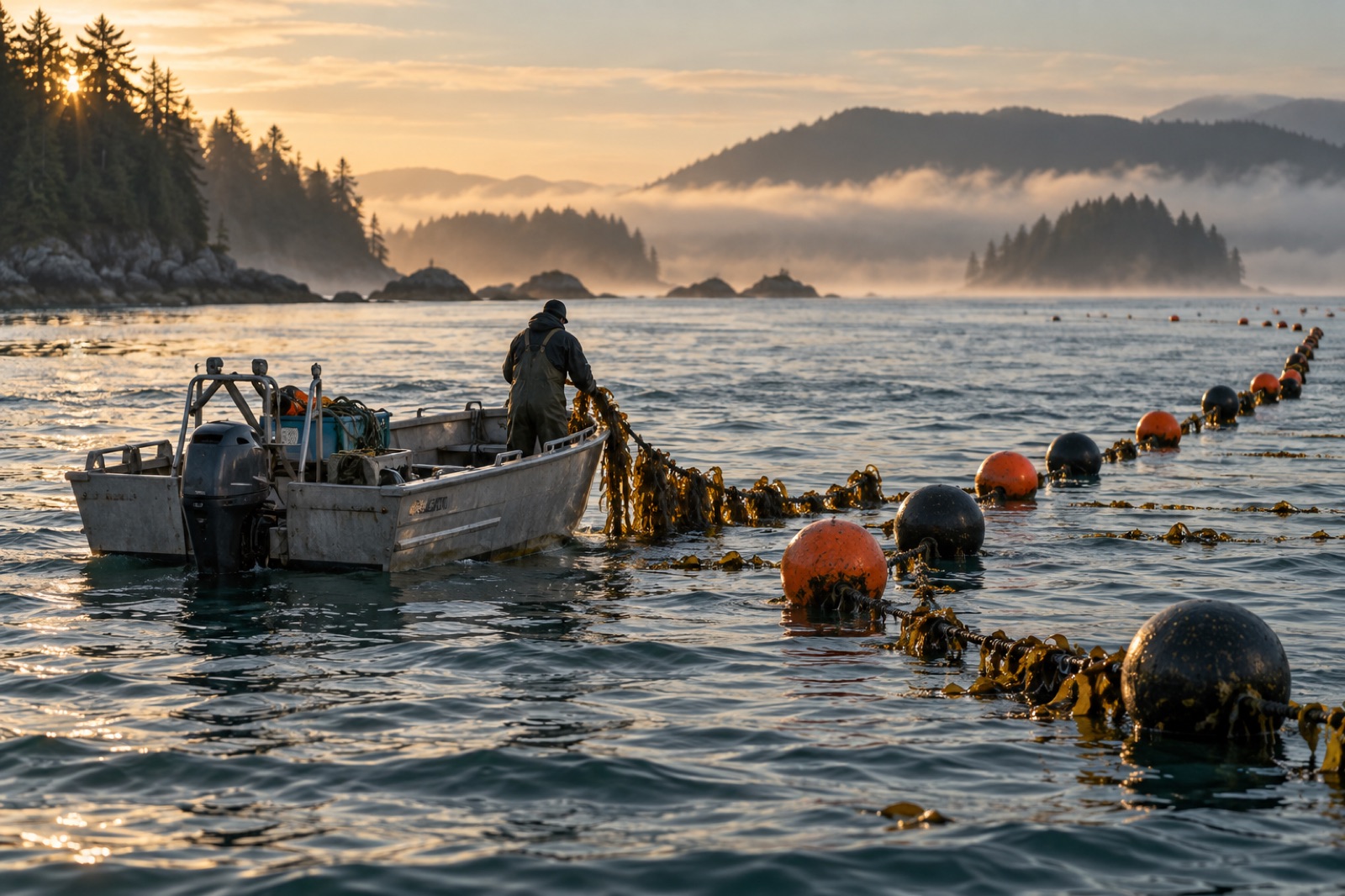
Every kelp farm starts the same way: crew leaning over the rail with sharpened knives, pulling seeded lines aboard one tired arm-load at a time. It works beautifully for two hundred metres of line. It starts to hurt at two thousand, and it breaks down entirely — physically, financially, in the staff room — somewhere past ten thousand. The question every growing farm eventually faces is not whether to mechanise but which part of the harvest to mechanise first, because full automation is expensive, and partial mechanisation done well buys you most of the gain for a fraction of the price. This guide walks the ladder: the rungs between hand-cutting and a purpose-built automated harvest system, in the order most farms should climb them.
Why mechanisation is really about timing
Wet kelp is roughly 85–90% water, and seaweeds like sugar kelp or kombu give you a quality window measured in weeks before spring warming turns the blade slimy or fouled (see harvest timing). The farm's entire economic year compresses into that window. Hand-harvest setups plateau at one to three wet tonnes per crew-day on typical small-boat layouts; a mechanised line puller can triple that, which means the same crop lands inside a shorter, fresher window and the shore crew spends its season grading good kelp instead of racing against spoilage. Mechanisation, in other words, buys time quality, not just labour savings.
There is also the body count to consider. Kelp harvest injuries are overwhelmingly the unglamorous kind: strained backs, compressed fingers, knife slips on a wet deck. The gear on the ladder below exists as much to keep crews intact as to keep throughput up — worth remembering when you price it.
Rung 1: The powered line puller (your first machine)
The single most cost-effective piece of mechanisation in seaweed farming is a powered hauler — the same pot hauler or capstan a lobster or crab fisher uses to lift strings of gear. Bolted to the rail or mounted on a davit at the working side, it takes over the brutal job of hoisting drippy rope.
What to look for:
- Pull rating of at least 250–500 kg working load. A laden 100-m grow line with kelp, fouling and current drag can weigh several times the rope's nominal rating. Undersizing the hauler burns clutches and crew patience in equal measure.
- A sheave or cathead that suits your line diameter, so the rope feeds without pinching seeded twine.
- Foot or lever speed control so the operator has two hands free for guiding line.
- Hydraulic drive if the vessel already has a hydraulic circuit; electric for small boats. A 12/24-volt hauler that plugs into a workboat's system can be retrofitted for surprisingly little money.
Crucially, the hauler changes the crew's job description from pulling to management. One person runs the gear; one or two handle knife work and bin filling at the rail. Kelp cut at sea drops straight into bulk bags or mesh totes — the deck layout guide covers how to arrange the choreography so nobody crosses loaded lines.
Rung 2: Powered reels and stripping drums
Once lines come aboard whole (rather than being stripped at sea), speed is governed by two machines:
- A powered line reel or spool. Hydraulic or electric drums wind a hundred metres of laden longline in minutes, freeing the crew to keep pace. A tension-controlled reel that maintains a consistent wrap also tames storm-tangled lines — the kind that defeat human hands.
- A stripping drum or frame. Where old-fashioned crews slid blades off rope by hand at a trestle, a rotating drum with rubber fingers or a guided blade head strips seeded lines mechanically as they pass. Throughput on an honest working drum is roughly three to five times hand-stripping, and the output is gentler on the kelp than you'd think when it's tuned right.
The plumbing matters here: hydraulic power packs sized in the 10–20 kW class, hoses rated for deck conditions, relif valves set deliberately. A small, well-plumbed boat beats a big, lash-up one.
Rung 3: The working boom and crane
By the time a farm regularly lifts whole lines, nets, settling bins or palletised bulk bags, it needs a proper crane. The options scale with ambition:
- A-frame or davit with the line hauler for routine in-season pulls.
- A 2–5 tonne-metre hydraulic knuckle-boom crane for general farm work — sets and recovers anchors, lifts tote loads, moves machinery at fit-out.
- Deck winches with powered gypsies for heavy mooring work — though that's usually the territory of large farms, or shared workboats hired for the season.
The crane is where mechanisation crosses into boat conversion — the point most farms choose a slightly larger, beamier hull. A 9–11 m workboat with a flat deck forward, 2-tonne SWL crane and deck-mounted hydraulics is the classic mechanised kelp boat, and it does nearly everything a far bigger vessel will.
Rung 4: Cutting heads — only when the volume justifies them
Powered cutting — hydraulic sickle heads, reciprocating blades, disc cutters — sits on the boundary between partial mechanisation and the genuinely automated systems such as the pump harvesters and boom-cutters described in automated seaweed harvest. The honest advice from operators is to resist this rung until you truly need it:
- Cutting heads foul on storm-twisted growth and serrated holdfast bolts.
- They demand a level of hydraulic discipline, deck water management and maintenance routine that only pays at high daily tonnage.
- They tend to shift the bottleneck to the next problem — handling and cooling the crop you've just dumped aboard — which is a bad bargain until harvest logistics and cooling are resourced to match.
Many mid-size farms find their ceiling is comfortable at rungs 1–3 for years, hiring in a bigger mechanised boat for their peak two weeks.
The economics: when a rung pays
Mechanisation decisions should be made on arithmetic, not gadget appeal. A back-of-envelope framework that survives contact with actual farms:
- Count what the bottleneck costs today. If hand-limited harvest forces you to waste 20% of the crop past its prime and pay double crew days, put a currency figure on that.
- Price the next rung fully. Not just the hauler — mounting, hydraulics, spares, an extra fuel tonne, the crew day spent fitting it.
- Compare against tonnes shifted inside the window. A €4,000 hauler that moves another ten tonnes of blade into the fresh market easily pays in its first season on a hectare farm. A €60,000 crane conversion pays slower and needs multi-farm or multi-year horizons to make sense.
- Value the crew's spines. Insurance, absenteeism and hiring are the invisible line items of mechanisation; farms that track them rarely regret a hauler.
It's also worth remembering that mechanisation reshapes your recurring costs: hydraulic seals, hose sets, filters, deck plating repairs. Those are not arguments against; they're simply the price — and a well-kept machine still costs less per tonne than a well-paid crew working at three times the salt.
Safety: mechanisation done well and badly
Machines remove some hazards and create others. The recurring lessons from fleets that run kelp gear well:
- Guarding and E-stops on every powered drum and sheave. Lines under load can pull a gloved hand in faster than a person can react.
- Load discipline. Rigged lines and cranes are marked with safe working loads; crews treat them as ceilings, never suggestions.
- Deck discipline. Clear trip paths, no riding loads, no one in the bight of a line, and a knife protocol that matches farm safety protocols.
- Two-up operation. Mechanised systems run with at least two people; solo operation of powered drums at sea is where close calls are born.
A mechanised deck run well is calmer than a hand deck — less shouting, less wrestling, more time spent watching the work. That calm is the sign you're doing it right.
Choosing your place on the ladder
The ordering most mid-size kelp farms end up at:
- Hand knives and good bins (0–1 ha)
- + Powered line hauler (1–5 ha)
- + Powered line reels and stripping drum (3–10 ha)
- + Deck crane and a bigger workboat (5–20 ha)
- Cutting heads and possibly pump or boom systems (20+ ha, or shared services)
Skipping rungs is possible — some farms lease rather than buy; some co-ops pool machinery across several farms — but each skipped rung costs more in difficulty than it saves in moving fast. And remember that mechanisation lives or dies with everything else on the farm: line design that sorts tangles, hatchery seed that sets dense but even growth, a shore operation that can cool and grade at the pace the sea now delivers. The platform of mechanised seeding, disciplined gear design, and harvest machinery working together is where kelp farming's future is being assembled — not in any single machine, but in getting them to dance.
Key takeaways
- Mechanisation is a ladder; most farms are best served by climbing it rung by rung rather than leaping straight to cutting heads and full automation.
- A powered line puller is the single most cost-effective first step; it typically triples the daily tonnage a small crew can move and removes the worst of the physical strain.
- Powered reels and stripping drums take over the whole-line workflow; a deck crane marks the point the operation crosses into a purpose-adapted workboat.
- Cutting heads only pay once daily tonnage is high and hydraulics and downstream cooling can keep up; resist them earlier.
- Frame mechanisation economics on tonnes moved inside the quality window and crew wellbeing, not just labour savings.
- Guarding, E-stops, load discipline and two-person operation are non-negotiable on powered gear.
FAQ
What is the best first machine for a small kelp farm?
Almost always a powered pot hauler or capstan mounted at the working rail, sized at 250–500 kg working load. The capital cost is modest (often low four figures for an electric unit), the throughput gain is the single largest in mechanisation, and it immediately changes the crew's job from hauling rope to managing a flow. Everything else on the ladder assumes you've already made this step.
Do I need a purpose-built harvest vessel for a mid-size farm?
Not necessarily. Many 5–10-hectare farms run a converted workboat or landing craft with a 2–5 tonne-metre crane, a couple of hydraulic drums and a flat forward deck, hiring in bigger capacity for peak weeks or storm work. Purpose-built harvest boats become attractive when you're near daily operation across multiple sites, or when your harvest window is so tight that multi-year scheduling of contracted vessels becomes a risk in itself.
How do I decide between hydraulic and electric drive?
Match the vessel, not the internet debate. Small boats with simple systems run electric haulers and capstans happily; once you're fitting powered reels, drums and cranes, hydraulic drive wins on power density, durability and industry-standard parts and service. The breakpoint is usually at the second or third rung of the ladder, where a hydraulic power pack becomes the natural backbone.
Is mechanised harvest harder on the kelp than hand-cutting?
No — with well-tuned drums and sharp heads, mechanical stripping is typically gentler than tired hand crews at hour six. The damage tends to come from handling (dropping totes, dragging crop across decks) and delay (waiting for shore crews). Mechanisation done properly shortens the total chain from sea to cold room, which keeps quality higher, not lower.
Should I buy second-hand fishing gear for kelp harvest?
Often, yes; the seaweed industry runs on demobbed fish-farm and shellfish kit. A used knuckle-boom crane, hydraulic packs or line reels with service history can be excellent value. The risks are saltwear, unknown maintenance, and sheer capacity (beware gear rated "this side of tired"). Inspect drum barrels, seals and valves cold; check spool brakes; price in a full service before trusting it over the rail.
When does full automation actually pay over partial mechanisation?
Experience across the industry suggests the threshold lies somewhere in the dozens of daily tonnes — that is, above what a well-mechanised mid-size boat moves in a working tide. Below that line, partial mechanisation plus flexible hiring dominates. Above it, the economics of cutting heads or pump harvesters begin to close. The honest number depends heavily on your crop mix and markets, so benchmark against the cost-per-tonne arithmetic in the companion automation guide rather than a single headline figure.