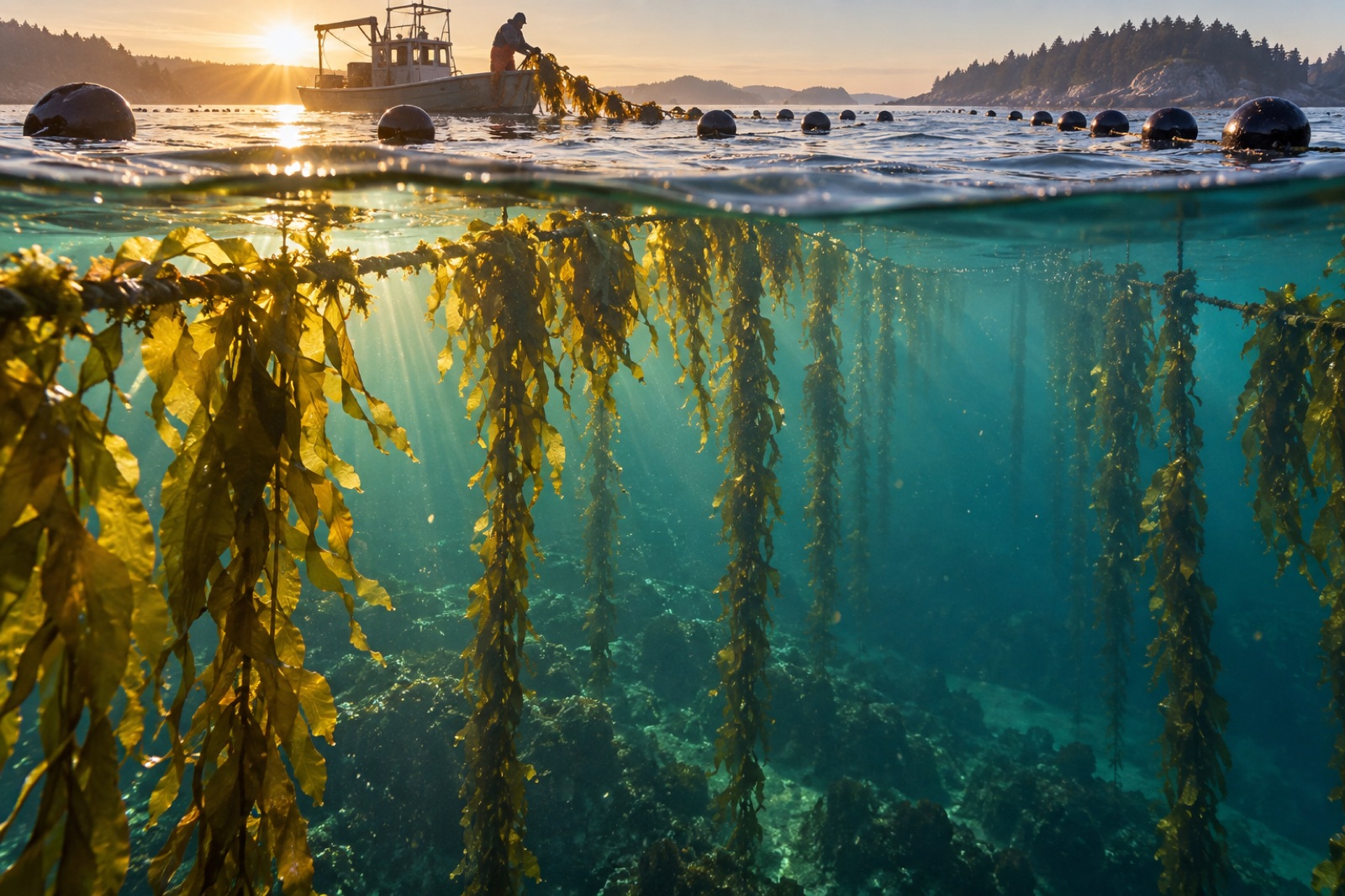
Kelp farming lore has a saying: you don't harvest kelp, you fight it. Wet blades weigh several times what dry ones do, lines come up heavy and tangled, and a disorganised deck turns a productive tide into a slow, dangerous pile of rope and weed. The good news is that kelp harvesting needs surprisingly little specialised machinery — especially at small-farm scale — but what it does need has to be right, and it has to be arranged right. This guide covers the working toolkit: cutting tools, line-handling gear, bins and hoists, and the deck choreography that separates a flow from a brawl. It pairs with the wider operational picture in harvest logistics and the equipment cost survey in kelp farm equipment.
First decide the method: cut at sea or lift whole lines
Every equipment decision flows from one upstream choice:
- Cut-at-sea harvesting. Crew strip blades off the line into bins or nets while the lines stay in the water for reuse. Lighter loads, faster cycles, more knife work. The dominant method for small farms growing sugar kelp or winged kelp.
- Whole-line harvesting. Lines are detached, reeled or coiled aboard, and stripped ashore under cover. Heavier gear requirements — you are lifting line plus multi-tonne wet biomass — but keeps the messy stripping operation on land where it can be clean, shaded and graded properly.
- Hybrid (most common). Marketable blades cut at sea; fouled or unmarketable material stripped and bagged separately; lines hauled home at the end of the season.
Write the choice down before buying anything: it decides your hoist size, your bin count and your deck layout.
Kelp blades at the holdfast are tough, fibrous and often fouled; the wrong knife turns a six-second cut into a thirty-second saw that wrecks wrists by mid-morning.
- Fixed-blade harvest knives with blunt safety tips are the workhorse. A 15–20 cm stainless blade, high-visibility handle (everything dropped at sea sinks), and a lanyard point. Serrated sections help with old stipes.
- Hook knives and line cutters for harvested-line management, kept in belt sheaths. Rope work is constant during harvest, and a stuck line under load needs cutting fast, not fumbled.
- Shears and scissors for fine-grade work — premium salad products and seed holding where a clean ruffle-level cut matters.
- Powered cutters (hydraulic sickle heads, submersible reciprocating cutters) enter the picture only at larger scales; at small-farm scale they cost more in maintenance and deck footprint than they return.
Sharpening discipline is an equipment category of its own: a whetstone and spare knife per crew member, swapped at every break. Dull knives are a safety issue — most harvest cuts happen when a slipping blade meets a bracing hand, which is why farm safety protocols spend so much time on cutting technique.
Line-handling gear: reels, rollers and haulers
Whether lines come aboard often (whole-line method) or occasionally (season-end), you need to move rope under load without tangling it:
- Reel stands / spoolers. A welded deck reel with a brake, turned by hand or a small hydraulic motor, coils a longline for transport home. A $300 used commercial fishing reel beats a $3,000 "purpose-built" spooler at small scale.
- Line rollers and fairleads. A gunwale-mounted roller (an inexpensive galvanised fitting) saves backs and lines alike; kelp longlines run under significant working tension and dragging one over a bare rail cuts both.
- Hydraulic pot/crab haulers. Borrowed from the trap-fisheries world, these grip and pull line under load — the single biggest gift mechanisation gives a kelp farmer. If your boat already has hydraulics, a hauler head is the first harvest investment to make. Our mechanised seeding guide covers the same crossed-over-from-fishing logic on the deployment side.
- Gloves that suit rope work: wet-grip palms, snug wrists, cheap enough to replace often. Crush, pinch and entanglement injuries are the quiet cost of hand-hauled lines.
Receiving and holding: bins, baskets and ice
What blades land in determines what they are worth at the dock:
- Food-grade ventilated totes or baskets (not solid fish bins for long holds) let water drain and reduce pile-anoxia at the bottom of the stack. One-way colour coding — "food" versus "seed" versus "waste" — is standard hygiene practice (see food-grade handling).
- Bin size discipline. Smaller bins filled fast beat big bins filled slowly: shallow piles crush less, cool faster and make landing-side grading practical.
- Ice and shade. A deck canopy and a crushed-ice plan separated from product contact. Even for product going to drying, harvesting cool buys hours of working quality during a long tide.
Deck layout: arrange the flow, then protect it
On a small workboat, a harvest transit touches roughly five stations in sequence: approach & hook, line brings-up roller, cutting position, bin landing zone, line return or reel. Lay the deck so product moves one direction only, never back across itself:
- Cutting position amidships or stern-side with the roller immediately below rail height; the harvester shouldn't carry a blade on a moving deck.
- Bins on the same side as cutting, staged in a line from empty (aft) to full (forward) so fulls are picked up by deck-hand without crossing the cutter's space.
- A marked foul-weather stow lane for knives, hooks and offcuts — the deck gets slick fast with kelp fluid, and a knife loose on a rolling deck is the classic bad day.
- One clean zone: bins for food-grade product never share space with fuel, lubricants, or discarded lines with fouling scrapings. Mark it with tape and defend it.
- Weight awareness. Wet kelp is deceptively heavy; full bins staged beside the rail instead of low and centre can change a small boat's stability noticeably in swell. Stage heavy loads low and amidships, and check your vessel's trim as the day builds — the same stability instinct the workboat selection guide asks for.
The small-farm harvest kit list
For a half-hectare to few-hectare family farm cutting at sea, a realistic working kit:
| Item |
Purpose |
Notes |
| Harvest knives ×(crew + spares) |
Blade cutting |
Stainless, blunt tip, visible handle, lanyards |
| Hook/line knives + belt sheaths |
Rope work |
One per crew member, worn |
| Whetstones & spares kit |
Edge maintenance |
Swap knives at every break |
| Gunwale roller + fairlead |
Line handling |
Protects backs and lines |
| Pot hauler (if hydraulics exist) |
Powered line pull |
Best return on mechanisation at this scale |
| Deck reel (used fishing reel) |
Season-end line recovery |
Hand or small motor drive |
| Food-grade vented totes |
Product reception |
Colour-coded by grade/destination |
| Deck canopy |
Shade |
Protects grade during long tides |
| Weighing sling + spring/digital scale |
Batch records |
As important as any knife |
| First-aid extras & cut kit |
Laceration response |
Bleed-control kit reachable from the water |
Key takeaways
- Decide cut-at-sea vs whole-line harvest before buying equipment — every other choice follows from it.
- Sharp, blunt-tipped knives plus a sharpening rotation are a safety system, not just a productivity one.
- A gunwale roller and (if hydraulics allow) a trap-fishery-style hauler are the highest-value mechanisation for a small farm.
- Bins should be food-grade, ventilated, colour-coded and sized small enough to fill fast and grade fresh.
- Lay the deck as a one-way flow — roller to cutter to bins to stowage — and keep heavy loads low and amidships; food zones never share space with fuel or fouling waste.
- A serviceable small-farm harvest kit is built mostly from adapted fishing gear; spend on edges, rollers and bins before any purpose-built machinery.
FAQ
Do I need a purpose-built seaweed harvesting boat?
No — at small scale almost any stable workboat with open deck space can be configured for kelp harvest with a roller, bins and a bit of welding. Purpose harvesters with hydraulic sickles and conveyors only make sense above typical small-farm scale; see the vessel discussion in workboats for seaweed farms.
What's the first piece of mechanical equipment to buy?
If your vessel has hydraulics (or can take a small power pack), a pot/crab-style line hauler. It removes the heaviest, most injury-prone work — pulling loaded lines by hand — and costs far less than any kelp-specific machine. Failing that, a good deck reel for season-end line recovery pays for itself in saved rope and saved backs.
How many knives does a harvest crew need?
One primary plus one sharp spare per person, rotating throughout the day, plus communal hook knives for rope work. Kelp stipes dull edges quickly, and a rotation system means nobody ever fights a dull blade — the condition that causes most cutting injuries.
Can I use ordinary fish bins for harvested kelp?
For very short holds, yes; for anything longer, no. Solid walled bins trap drainage and the bottom layers go anoxic and sour fast. Ventilated food-grade totes that drain, staged in shade, preserve grade — and cleanability matters for food-grade certification either way.
Is mechanised cutting worth it for a two-hectare farm?
Generally not. Powered cutting heads carry acquisition cost, maintenance, deck footprint and safety complexity that small farms don't recover in time saved. The exceptions are farms harvesting very stemmy species or tight weather windows where a half-day saved a year justifies the iron — most small farms gain more from a hauler and good layout than from any cutting machine.