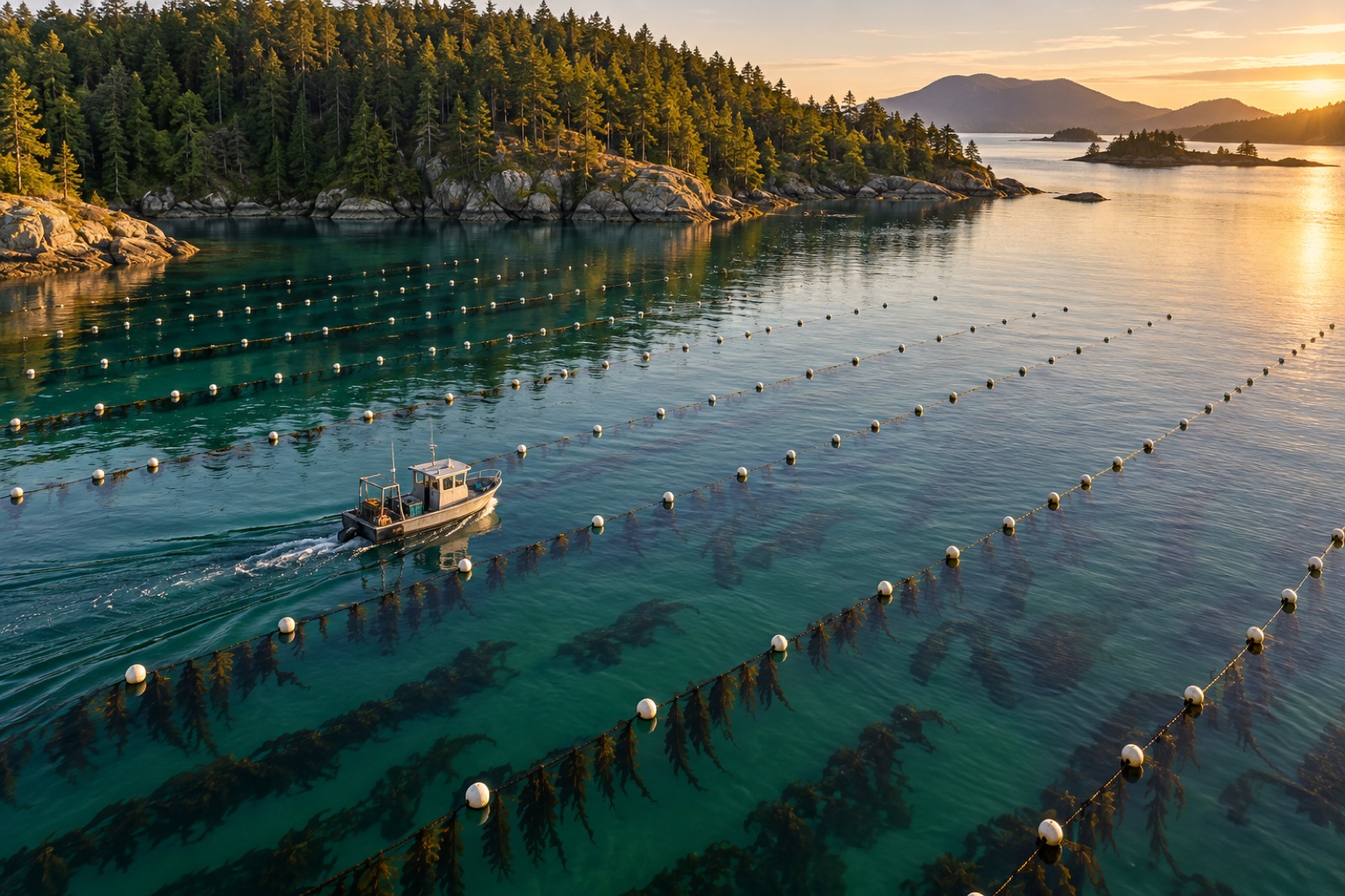
Kelp farming arrives on a coast carrying a rare reputation: an industry whose waste product is a cleaner bay. Fed aquaculture adds nutrients; kelp removes them. Trawling disturbs habitat; kelp builds it. The reputation is substantially deserved — and it is exactly why the places where the reputation doesn't hold deserve careful, honest attention. A kelp farm is still a structure inserted into a living system, and "mostly beneficial" is not the same as "no effects."
This article walks through what the science and farm monitoring actually show about large kelp farms' effects on their bays: light, flow, nutrients, chemistry, the seabed and wildlife. The consistent theme is scale-dependence — the same installation that enriches a ten-hectare cove can strain a hundred-hectare embayment — and the point is not to alarm but to design well. It is also the analytical frame behind how we monitor our own restoration-adjacent farms through Canopy Ledger.
Light: shading the water below
A kelp canopy is a light harvester — that is its job. Farmed kelp suspended near the surface intercepts sunlight that would otherwise reach the depths below it.
At small farm scales the effect is mostly trivial: longlines shade a tiny fraction of the water column, currents exchange shaded water constantly, and the blades' own motion keeps light flickering rather than blocked. But shade scales with density and coverage. Under very dense, shallow-suspended culture, reduced light beneath the farm can measurably lower photosynthesis in the water column and at the seabed — a concern where the seabed holds its own photosynthetic community, above all seagrass meadows, which are light-limited, slow to recover and often legally protected.
The design responses are well understood: site farms over soft sediment or rock rather than seagrass (a filter any decent site selection applies anyway), keep canopy density within the range the site's light budget supports, and remember the flip side — in bays suffering nuisance phytoplankton blooms from nutrient pollution, canopy shading and nutrient uptake combined are part of why kelp farms suppress those blooms. Light analysis, as with everything here, cuts both ways until scale and site are specified.
Flow: slowing the water that feeds everyone
Longlines, buoys and hanging kelp drag on the current. Inside a large farm, water moves measurably slower than outside it, and the wake extends down-current.
Slower flow inside the farm has mixed effects. It can trap fine sediment and let suspended particles settle where they otherwise would pass through. It changes how the farm's own crop gets fed — kelp takes nutrients from a thin boundary layer of water at the blade surface, and that layer only refreshes when water moves; our piece on turbulence and kelp explains the physics. Dense enough, a big farm can partially starve its own interior rows — a yield problem dressed as an ecology problem.
At bay scale, current modification becomes an ecological question when it alters flushing: the exchange of bay water with the open sea that resets oxygen, temperature and clarity. Farms sited across constricted channels, or covering a large share of a poorly flushed embayment, can extend water residence time — meaning whatever the bay accumulates stays longer. This is a main reason regulators look hard at farm footprint relative to basin size, and why spacing between farm blocks is a hydrodynamic decision, not just an operational one.
Nutrients: the headline effect, with fine print
The best-documented effect of kelp farming is bioextraction: farmed kelp draws down dissolved nitrogen and phosphorus from the water and exports them at harvest. In nutrient-rich, eutrophic bays — near river plumes, cities or fish farms — this is a genuine remediation service, quantifiable in tonnes of nitrogen removed per year, and a core argument for integrated multi-trophic aquaculture, where kelp is deliberately co-sited to mop up fed-aquaculture nutrients.
The fine print: uptake is only a service where nutrients were in excess. In naturally oligotrophic (nutrient-poor) waters, a very large farm's drawdown could compete with the phytoplankton base of the local food web — the same nutrient cycling engine that wild kelp forests rely on. The evidence that typical farm scales cause this in open coastal water is weak; currents re-supply faster than most farms strip. But it is the legitimate outer-edge concern of very large proposals in very clear water, and it is why baseline nutrient data — even a modest programme of field water testing — should precede scale-up, not follow a problem.
Chemistry: oxygen, pH and the carbon question
Photosynthesising kelp raises oxygen and draws down dissolved CO₂ by day, creating a localised halo of higher pH — measurable near dense canopy and one reason kelp culture is researched as a refugial companion for shellfish sensitive to ocean acidification. By night the same biomass respires, consuming oxygen and releasing CO₂. Over a healthy farm's day-night cycle the net effect on a flowing site is small; problems arise in theory where biomass density and residence time both run high, and decomposing losses (blades shed, fouling scraped off) add an oxygen demand on the seabed below.
The carbon question — does farmed kelp lock away atmospheric carbon? — is more contested than the marketing suggests. The standing crop is carbon stored only until harvest, decomposition or consumption releases it; durable sequestration depends on what fraction of farm carbon reaches deep water or buried sediment. Our blue-carbon explainer on kelp covers the accounting honestly. The short version for this article: treat farm carbon claims as a question of fate, not tonnage.
The seabed beneath the farm
Everything that lives on or falls from the lines eventually has a relationship with the bottom.
Deposition. Shed blade fragments, dislodged biofouling and faeces from the farm's resident grazers rain onto the sediment below. In moderation this is a food subsidy — benthic communities under farms often show enhanced abundance, and the process is just benthic-pelagic coupling with extra steps. In excess — very dense farms over slow-flushed, shallow sediment — organic enrichment can shift sediment chemistry and community composition toward fewer, tougher species, the classic signature of over-fertilised seabed.
Anchors and structure. Moorings disturb a small footprint of seabed at installation and can scour around their radius in mobile sediment. Trained monitoring treats this as measurable and manageable; it becomes significant on sensitive bottom — maerl beds, sponge gardens, dense seagrass — which is precisely why habitat surveys precede consent.
Wildlife: habitat, food and the entanglement question
Farms add three-dimensional structure to open water, and life notices. Lines and kelp hangs attract juvenile fish, grazers and their predators; farms behave in part like small artificial reefs and fish-aggregating devices, raising forage and fish density locally. Many growers farm alongside visibly richer bird and fish life than the empty water column offered before.
Two risks deserve plain statement. Entanglement: any rope in the ocean poses some risk to marine mammals and large fish. Kelp longline arrays — tensioned, well-marked, in defined blocks — are at the low-risk end of ocean rope, but the risk is not zero and grows with derelict or slack gear, which is why gear discipline and recovery of storm losses are genuine ecological practices, not housekeeping. (Wildlife interaction is treated no differently at our own restoration sites.) Biosecurity: farm structures are stepping stones for non-native fouling species, and moving equipment between bays moves passengers — the reason farm biosecurity belongs in the environmental ledger too.
Scale: why a bay cares about hectares, not harvests
The prevailing finding across the research and monitoring literature is that kelp farm effects are strongly scale- and site-dependent, with most documented effects — slower currents, nutrient drawdown, shading, deposition — becoming consequential only at large coverage of weakly flushed water, or over sensitive seabed. A useful mental model:
- Small farm, open coast, good flush: effects mostly local, often net-positive; the classic "kelp farm as bay cleaner."
- Large farm, well-sited: effects real but managed by design — spacing, depth, block layout, sensitive-habitat avoidance.
- Very large development, enclosed or nutrient-poor water, sensitive bottom: the regime where cumulative effects need basin-scale assessment and where "it's only kelp" stops being a sufficient answer.
Scale also flips some benefits into risks: nutrient removal that remediates a eutrophic bay at one size approaches competition with the plankton food web at another; structure that aggregates fish at one size begins to impede flushing at another.
Designing for net benefit
The practical template that emerges — and the one we apply to Harvest operations that fund restoration — is short:
- Survey the bottom first; put farms over habitat that tolerates them.
- Match biomass to flushing; let hydrodynamics, not optimism, set density.
- Rest the interior — spacing within farms is nutrient management for the crop and the bay at once.
- Baseline, then monitor — sediment under the moorings, light under the canopy, and a standing record of it all, because the bay's answer arrives in data, not intention.
- Recover your gear — nothing undermines a farm's ecological case like last year's rope.
Key takeaways
- Kelp farms' clearest effect is nutrient bioextraction — a remediation service in eutrophic water, and a benefit that weakens (eventually to a concern) only in naturally nutrient-poor systems at large scale.
- Shading and flow modification are real but scale-dependent: trivial at small coastal farms, requiring hydrodynamic design at bay-filling ones; seagrass seabed and constricted channels are the red flags.
- Farm canopies raise local pH and oxygen by day and consume them by night — small effects at flowing sites, worth monitoring where biomass and residence time are both high.
- Benthic deposition under farms usually enriches seafloor food webs; only very dense farms over slow-flushed shallow sediment risk classic organic enrichment.
- Farms act as fish-aggregating habitat; the honest risk ledger includes marine-mammal entanglement (managed by gear discipline) and biosecurity of fouling passengers.
- The whole question is scale and site: surveyed seabed, density matched to flushing, interior spacing and baseline monitoring are what keep kelp farming the bay-cleaner industry it claims to be.
FAQ
Do kelp farms harm seagrass meadows?
They can, and the two should be kept apart. Dense farm canopy reduces light to the seabed, and seagrasses are among the most light-limited habitats on the coast. Siting farms over soft sediment or reef — and regulators typically require habitat surveys to ensure it — avoids the conflict almost entirely.
Do kelp farms clean polluted water?
Yes, measurably, in nutrient-rich water: farmed kelp absorbs dissolved nitrogen and phosphorus and exports them at harvest, which is why kelp is co-sited with fish farms in IMTA systems. The cleaning credit is honest where nutrients were in excess; in naturally nutrient-poor water the same uptake is a draw on the local food web, not a favour.
Are kelp farms good or bad for wild fish?
Mostly good: farm structures aggregate juvenile fish and attract predators, and monitoring commonly finds elevated fish abundance at farms. Effects vary by region and scale, and farms are not a substitute for management of the fishery itself — but "habitat that pays rent" is a fair description of the typical finding.
Is farmed kelp a meaningful carbon sink?
The crop stores carbon only until it is used or decomposes; durable sequestration depends on what happens after harvest and what fraction of farm losses reach deep sea or buried sediment. Treat carbon claims as a question about carbon's fate. The honest accounting is in our blue-carbon explainers.
What monitoring should a large kelp farm commit to?
At minimum: seabed baseline plus periodic benthic checks under moorings and deposition zones, light and nutrient logging inside and outside the array, gear-loss recovery records, and wildlife-incident reporting. The data answer regulators' questions before they're asked — and make the farm's environmental story auditable rather than asserted.