Kitchen9 min read
Nori Beyond Sushi: Ten Uses for the Humble Sheet
Nori isn't just for sushi. Ten everyday uses for toasted nori sheets — from onigiri and furikake to butter, broth and cracking snack sheets.
Sofia Andersson ·
From oyster-shell hatcheries to graded sheets at auction: the full nori production system — conchocelis biology, net seasons, freezing and processing.
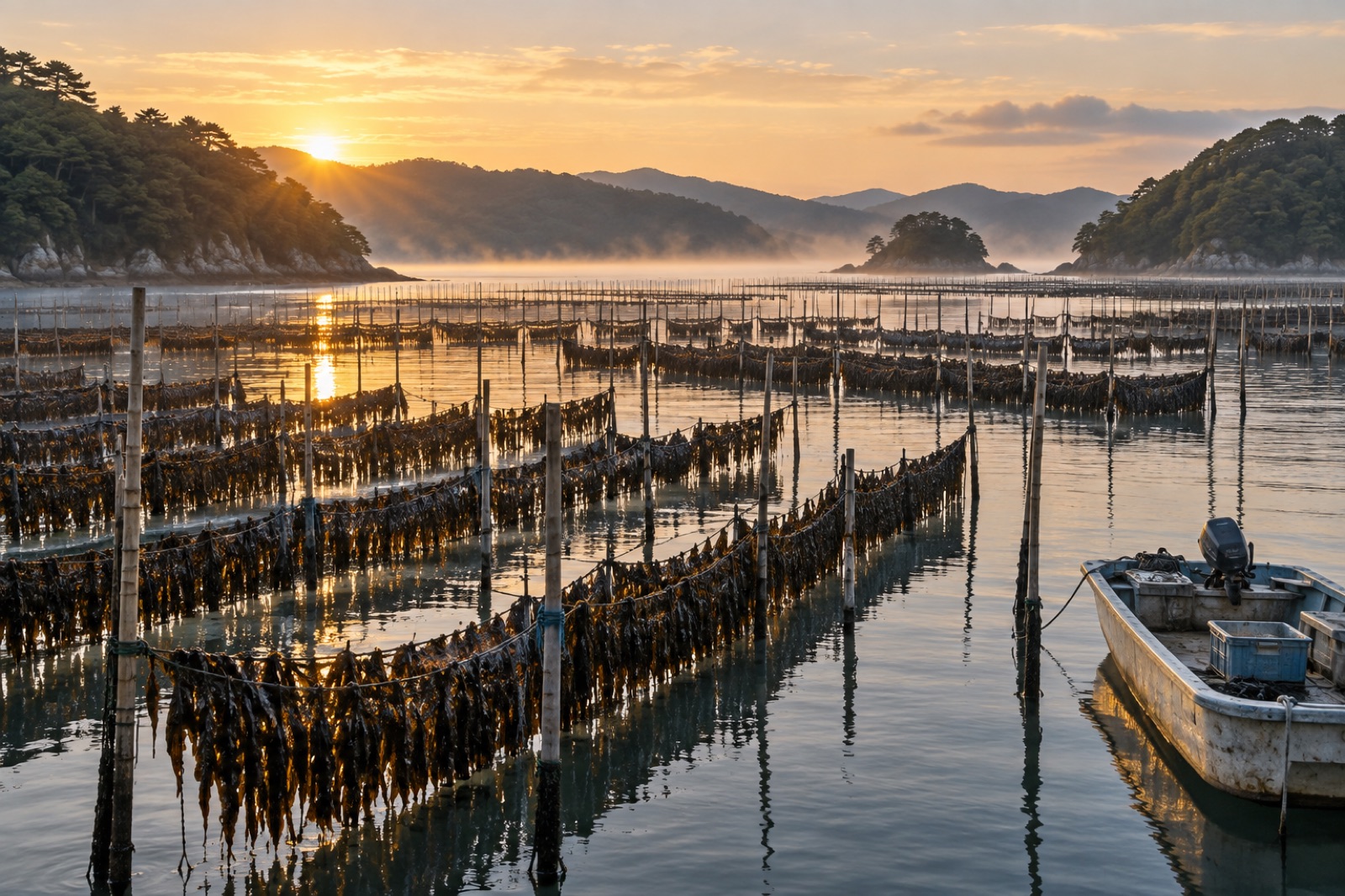
The next time you wrap onigiri or watch a sushi chef lean a sheet of nori over a flame, consider what you're holding: a single sheet of the highest-value seaweed product on Earth, backed by the oldest and most industrialised seaweed farming system ever built. Nori aquaculture — the cultivation of red algae in the genus Pyropia (formerly Porphyra) — accounts for a substantial share of the world's total seaweed aquaculture value despite covering a small fraction of its area. It is also the technology that quietly wrote the rulebook for every modern seaweed industry that has followed, from kelp hatcheries to seed-system thinking. Here is how a crop that was once pure chance became a precision industry.
Nori species are red algae of cold-temperate coasts — chiefly Pyropia yezoensis and P. tenera in Japan, related species in Korea and China — whose edible stage is a thin, crinkled blade a few cells thick. What makes nori farming famous is not the blade but the discovery behind it: in 1949, the British phycologist Kathleen Drew-Baker demonstrated that the microscopically small, shell-boring filament known as Conchocelis was in fact the other half of the Porphyra life cycle. The "shell-boring seaweed" — filamentous and dull, living inside oyster shells — was the sporophyte; the prized blade was the gametophyte.
That single piece of biology turned nori from a lottery into a factory. Fishermen had centuries of tradition setting bamboo and later nets in autumn bays and waiting for the blades that blew in; after Drew-Baker's work, hatcheries could culture the conchocelis stage on actual oyster shells under controlled light and temperature, watch it release spores (conchospores) on command, and seed nets deliberately. Within twenty years, wild-luck nori gathering was a precision seeding industry, and Drew-Baker is honoured in Japan with monuments and a festival — a rare scientist whose discovery built an entire sector.
Modern nori science continues to refine that pipeline: selective breeding has produced cultivars tuned for colour, blade strength, flavour compounds and early-season growth; cryopreserved cultivar banks guard the genetic stock the same way kelp gametophyte banking secures brown-algal seed.
The nori year in Japan and Korea follows a calendar tuned to falling autumn water temperatures:
Nori's site logic is unusual: it wants estuarine influence. River-borne nutrients, moderate salinity variation, gentle currents and cold-dry wind exposure (in pole systems, blades are deliberately lifted above the waterline daily to harden them and shed competitors) all shaped the classic geography of Japanese nori bays. Because Pyropia blades are only cells thick, they tolerate emersion better than almost any farmed seaweed — a trait the whole pole-and-dry system exploits.
The transformation from slimy wet harvest to crisp black-green sheet is where nori becomes the most processed of farmed seaweeds. Within hours of landing, blades are machine-washed, chopped, slurried in fresh water and metered onto screens set into bamboo mats — the same sheet-forming logic as papermaking, mechanised into lines that run continuous-press dryers. The output: uniform ~19 × 21 cm sheets at roughly three grams each, bundled in tens.
Quality control is relentless and granular. Sheets are graded on colour (the prized deep black-green with lustre), gloss, uniformity and thickness, holes or tears, and aroma — the volatile compounds that bloom on toasting and drive what nori is actually for in the kitchen. Early-season, first-harvest sheets — the thinnest, most delicate, most aromatic — command auction prices many times that of late-season grade; buyers roast and evaluate samples face to face, in an auction culture that resembles specialty coffee or fine tea more than commodity seafood. The entire grading discipline — working systematically from moisture and colour to what the buyer tests — mirrors the general frame in seaweed quality grading, but compressed into a single refined product.
Nori farming is capital-intense at its ceiling and entry-barred at its floor. A producing operation expects mechanised harvesters, drying lines, cold storage and seed supply — while in Japan, entry itself flows through fishery cooperative rights tied to specific bay areas. This produces a striking industry shape:
For anyone building seaweed farm economics, nori is the industry's cautionary tale in reverse: it shows what the value chain looks like when a crop has centuries of market demand, fully industrial processing and an organised buyer base — most newer seaweed regions have demand and neither of the other two.
No. Nori species (Pyropia) are red algae, a lineage distant from the brown kelps — thin blades of a few cells, rather than structured forests with holdfast, stipe and blade. The pigment difference is real biology, not just looks: why seaweeds are green, brown or red explains the families better than any label.
Before it, nori growers set nets and waited for spores from no one knew where; after it, hatcheries could induce spore release on schedule and seed nets deliberately. It converted a gambling fishery into agriculture — and remains the founding template for every modern seaweed hatchery.
Nets carrying young nori are lifted from the water, carefully dried to a steady moisture, and held deep-frozen; returned to the sea, the dormant blades resume growth. It lets farmers pause crops, skip bad conditions and stagger harvests across a season — a pause button almost no other farmed seaweed tolerates.
Grade, largely. First-harvest sheets make the thinnest, most aromatic, most lustrous nori, and grade differences within a bay are steep at auction; toasted aroma compounds live or die in those grade differences. Add Japan's organised cooperative auction system and you get real price stratification for what looks, to an outsider, like the same sheet.
The biology travels — Pyropia species grow on many cold-temperate coasts, and pilot farms exist in North America and Northern Europe. What's harder to transplant is the second half of the system: cheap mechanised processing, cultivar pipelines and an educated buyer market. The blades are the easy part.
Nori isn't just for sushi. Ten everyday uses for toasted nori sheets — from onigiri and furikake to butter, broth and cracking snack sheets.
Sofia Andersson ·
Seaweed grades are built on a handful of tests — moisture, ash, contaminants, colour and sensory score. Learn what buyers measure and how to grow and handle for top grade.
Naomi Reyes ·
An honest look at small seaweed farm economics: start-up and operating costs, realistic yields per line, kelp prices, and the levers that decide profit or loss.
Naomi Reyes ·