Farming10 min read
Selling Your Seaweed: Buyers, Grades and Honest Pricing
Who actually buys farmed kelp, how buyers grade and price it, what contracts look like, and how to avoid the most common — and expensive — selling mistakes.
Naomi Reyes ·
Seaweed's value chain from harvest line to buyer: how wet and dried kelp is priced, where margin leaks out, and how to keep more of the value on-farm.
Ask a room of new seaweed farmers what their crop is worth and you will get ten answers spanning an order of magnitude. The reason is that "seaweed" is not one product; it is the raw input to at least four different value chains — food, agriculture inputs, industrial extracts, and emerging materials — each with its own buyers, grades, moisture rules and margin structure. A tonne of kelp fresh off the line is the beginning of a chain, not an end of one.
Understanding where value is created after harvest — and where it leaks before it reaches you — is the difference between farming a commodity and running a business. This piece maps the chain from the moment a blade leaves the water to the moment money returns to the farm.
Everything after harvest is a race against biology. Fresh kelp is roughly 80–90% water and starts degrading within hours: blades soften, bacteria multiply, and the sugars that make kelp valuable start feeding microbes instead of buyers. Every value chain therefore begins with the same two steps:
From there the chain forks by end market, but the recurring pattern holds: each handling step adds cost, each transformation step adds value, and the farmer's share depends on how many steps the farm itself owns. The mechanics of the stabilisation fork are covered step by step in post-harvest processing.
The single biggest economic decision at the farm gate is whether to sell wet or dried.
Wet sales mean less work, less capital and a smaller margin. Chilled or frozen kelp moves to food processors within roughly a day of harvest; ensiled (acid-preserved) kelp moves to feed and biostimulant makers within days. Wet chains reward proximity — if a processor is within a few hours' drive, wet sales are viable. Beyond that, you are paying freight on water that is mostly water.
Dried sales mean capital, energy and control. Drying removes 85% or more of the weight, turning a perishable into a shelf-stable commodity that can wait for the right buyer and travel across the world. It also concentrates quality risks — a bad drying run can cost a season's grade. The trade-offs across sun, air, dehydrator and industrial drying are compared in drying methods.
The rule of thumb: wet chains pay for speed and trust; dry chains pay for consistency and paperwork. Most successful small farms end up doing both — wet into the local food economy, dried into the broader market, matched to which harvest days go well.
The highest-value end market per kilo and the most demanding. Human-food buyers want traceability, food-safety compliance, sensory quality (colour, texture, clean flavour) and reliable spec sheets — iodine, heavy metals and microbiological results from accredited labs. Food-grade handling starts at the cutter's knife, not the lab; the standard is set out in food-grade seaweed at the farm gate. Within food, price micro-tiers exist: whole-leaf restaurant grades, salad grades, flake and powder grades, and flavour ingredients for dashi and seasonings.
The biggest buyers of volume in Western markets. They care about consistent mineral and carbohydrate profiles and, above all, dependable tonnage at a known dry matter. Quality bars are lower than food but logistics are brutal: they buy by the truckload. The kelp biostimulant article covers what the crop chemistry demands.
Carrageenan, agar and alginate extractors are industrial-scale buyers typically fed by tropical red-seaweed production and large wild harvests rather than small temperate farms — but kelp meals for alginate blending are an opening for consistent regional supply.
Methane-reducing feed additives (see farming Asparagopsis), bioplastics, and fermentation feedstocks are young chains with pilot-scale buyers. Prices can be excellent; volumes and contract reliability are not yet. Treat them as upside, not base load.
Every chain prices against a specification, and nearly every specification includes two hidden traps:
Moisture basis. Dried seaweed is quoted at a reference moisture level, commonly around 12–15%. Delivering at 20% means the buyer is paying seaweed prices for water — and will discount you accordingly or reject the lot. A moisture meter is the cheapest margin-protecting instrument on a farm.
Contaminant limits. Iodine ceiling, arsenic (total and inorganic), cadmium, microbiology. Different markets regulate these differently, and food buyers enforce them contractually. One lot over a limit can end a relationship. Regular testing per harvest batch is not optional in food chains — it is the cost of admission.
The negotiating position improves dramatically the moment you hand a buyer a spec sheet from your own farm's tested batches rather than asking what they'd like. Specs are the language of the chain; speaking them converts you from vendor to supplier.
Rather than chase a universal price per tonne — there isn't one — think in spreads. Fresh wet kelp generally sells at the lowest per-tonne figures because the buyer pays for stabilisation and risk; dried food-grade product sells at many multiples of the wet price; and the same dried biomass in a lower tier (meal for biostimulants) sits between. Processing losses are substantial: a dried tonne typically represents something like eight to twelve wet tonnes, so apparent price multiples shrink fast when expressed per wet tonne harvested.
The honest framework is margin per wet tonne harvested, net of everything your side of the gate costs: drying energy, labour, packaging, freight and testing. Run that arithmetic per chain before committing your season — the costing structure in seaweed farm economics is built for exactly this question.
The same handful of leaks drains profit from nearly every first-generation farm:
The farms that keep the most value share rather than build. Co-operative drying hubs, shared blast freezers, pooled laboratory testing and collective freight get small farms over the quality-and-volume thresholds that individually they cannot reach; the co-op model is explored fully in community-scale seaweed farming. Forward contracts with agreed specs and a harvest-window split — some early, some late — protect against the season-end slump.
At the industrial end of the spectrum, vertically integrated operators close the loop differently: Tidewright's own Harvest product line keeps food, biostimulant and bioplastic processing beside the farms so that restoration funding isn't hostage to the spot market — one working answer, at scale, to the value-leak problem every small farmer solves at their own scale.
Wet, usually, if a buyer exists within a few hours' drive — it postpones the drying capital until the market is proven. The moment you have drying infrastructure or a co-op hub, split the harvest: sell the premium wet window locally and put the balance through drying for the wider market and the shoulder season.
Start from the chain backwards: identify two processors or wholesalers who already buy your species or a close relative, ask for their spec sheet and intake calendar before your seed goes in the water, and treat that document as your production target. Trade fairs and grower associations matter less than one honest conversation with a buyer's intake manager.
Yes — species, end use and region all move it. As a general pattern, food species with established culinary demand (kombu-type kelps, dulse, nori) command higher per-kilo prices than bulk biostimulant stock, but always against the local processing reality: a buyer on your coast beats an ideal price an ocean away.
At minimum: harvest date and site, batch weight and moisture at packing, and handling history (chilled/frozen/dried and when). For food chains add lab results per batch — iodine, heavy metals, micro — plus your food-safety plan reference. Buyers repackage lots into their own traceability systems; make yours slot straight in.
Some farms do well with direct food sales (stews, flakes, dashi kits) but it converts a farm into a food brand with packaging, marketing and compliance overhead — a different business that happens to grow kelp. As a supplement to contracted volume it can raise blended margin nicely; as a sole strategy it starves most first-generation farms.
Who actually buys farmed kelp, how buyers grade and price it, what contracts look like, and how to avoid the most common — and expensive — selling mistakes.
Naomi Reyes ·
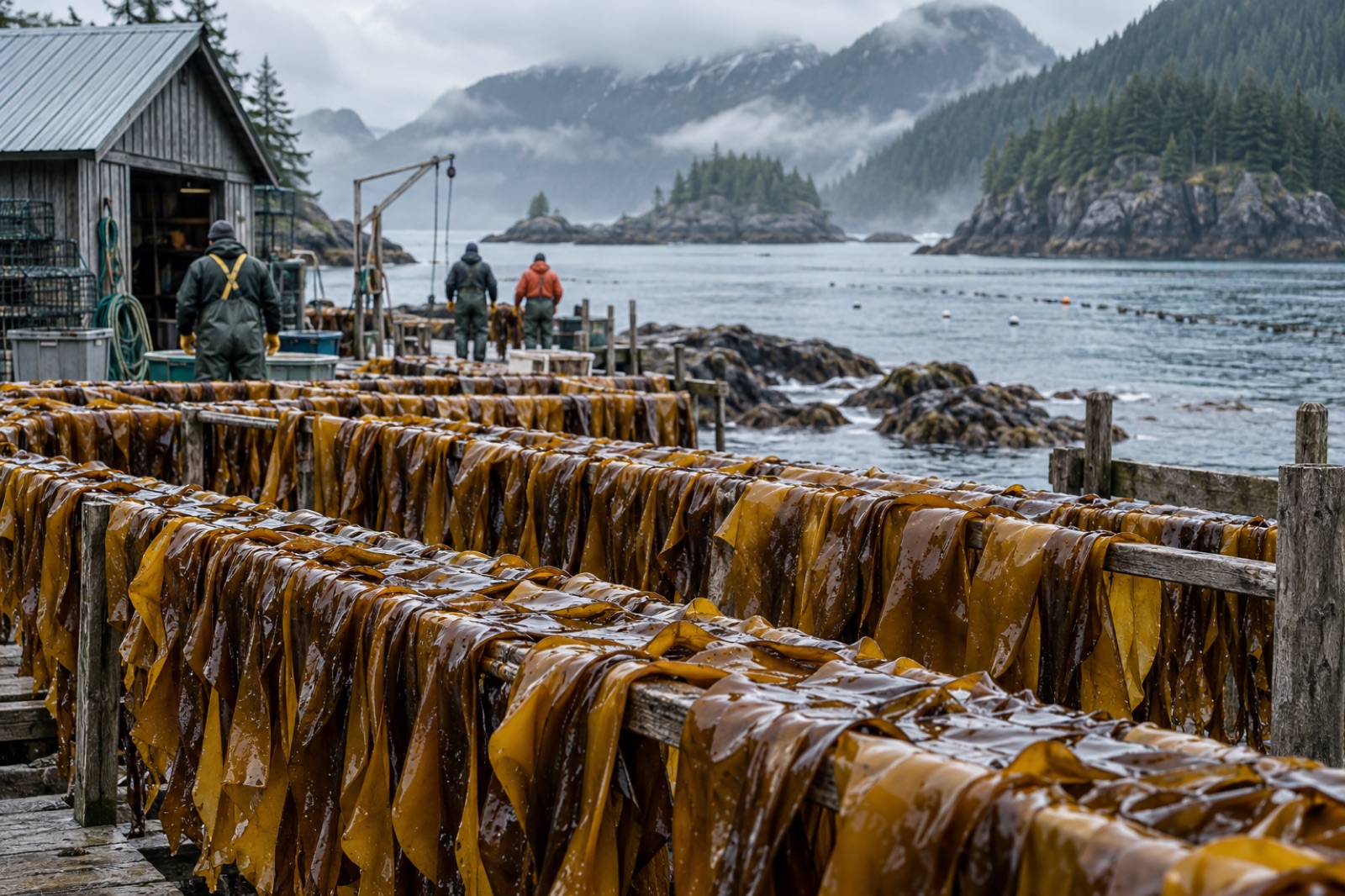
What to do with freshly harvested kelp: a practical comparison of drying, blanching, freezing, fermenting and milling — shelf life, quality, cost and best-fit markets.
Naomi Reyes ·
An honest look at small seaweed farm economics: start-up and operating costs, realistic yields per line, kelp prices, and the levers that decide profit or loss.
Naomi Reyes ·