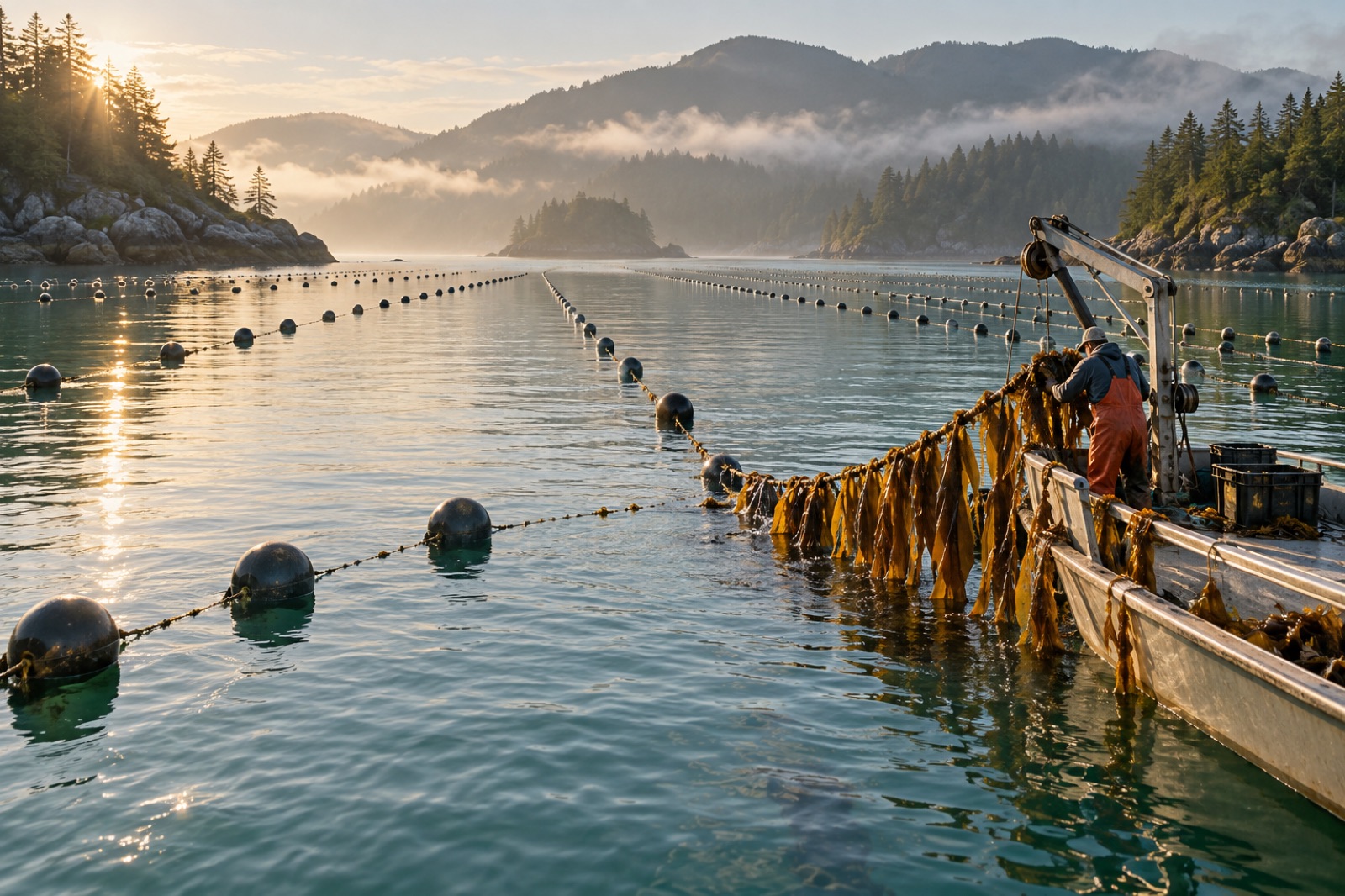
Most writing about seaweed farming assumes you want to start a business. But across cold-water coastlines, a quieter model is taking hold: the farm that belongs to nobody and everybody — a crew of fishers, retirees, teachers and divers tending ropes they own together. Community-scale seaweed farming trades scale for something the industry badly needs: local legitimacy, shared risk, and a reason for a harbour town to want green lines in its water.
This guide lays out the three dominant models, what they cost, where they trip over permits and personalities, and how to decide which one fits your community. If you're weighing whether to farm at all, pair this with our practical beginner's guide to starting a small seaweed farm.
Why community scale works, and where it doesn't
Seaweed aquaculture has an unusual economic shape. The expensive parts — leases, drills, work floats, drying space, a hatchery relationship for seed — benefit enormously from sharing. The cheap parts — wrapping line, hauling slippery kelp off a rope in February — just need hands, and communities have hands.
Three things make community models viable where a solo operation might struggle:
- Cost spreading. One auger-style anchor drill serves a dozen growers. One drying shed with a dehumidifier serves the whole co-op. Per-kilogram capex drops fast when infrastructure is pooled.
- Risk spreading. A bad season or a storm-damaged site is survivable when it's one line among six the group owns, rather than one person's entire livelihood.
- Social licence. A farm owned by twenty local families clears public consultation more easily than one owned by a company with a distant PO box. Harbours are political places.
Where it doesn't work: community farms are nearly useless at chasing commodity prices. Bulk dried kelp for biostimulant extraction is a volume game with thin margins — see the honest arithmetic in Seaweed Farm Economics. Community farms win on high-value, low-volume product: fresh local food, restaurants that can name the grower, community events, seed services to other farms.
The three models
1. The kelp allotment
The most informal model. A single community body — often a fishing co-op, a harbour trust, or a recursion fund grouped around a retiring licence — takes out one aquaculture lease and subdivides it like garden allotments. Each member tends their own marked lines within the shared footprint.
Best for: groups that mostly want to grow food for themselves and learn. Low paperwork, low ambition, high forgiveness for mistakes.
Watch out for: the lease holder still carries the liability. One member's derelict line is everyone's problem. Write the house rules — harvest deadlines, gear standards, biofouling checks — before the first rope goes in, not after the first argument.
2. The cooperative farm
The classic model, adapted from shellfish and dairy. Members own shares, elect a committee, farm a single common site, and sell under one brand. Revenue is split by labour contribution, share, or both.
Best for: groups that want real income. A co-op can hire one paid farm manager (the single best investment most co-ops ever make), negotiate collectively with buyers, and fund shared equipment from revenue.
Watch out for: co-op governance is a skill, not a mood. Adopt a simple written constitution early; use model rules from existing fisheries co-ops in your jurisdiction rather than inventing your own. Decision rights, out-of-hours authority, and the exit/succession rule (what happens when a member wants their share back) are the three clauses that save co-ops.
3. The shared-farm CSA
Community-supported agriculture, transplanted to the water. Households pay upfront for a "share" of the season's harvest — fresh or dried kelp delivered fortnightly in season — and optionally swap some of the cost for a harvest-day commitment.
Best for: communities with strong local food culture and a few skilled growers. It guarantees a market before the first spore is settled, which changes the whole risk profile.
Watch out for: CSA subscribers are buying a promise, and an early-season equipment failure generates refunds, not profit. Start with a modest share count and oversubscribe deliberately in year one.
Permits, licenses and the community angle
Every model needs the same underlying permissions: a lease or licence for the site, seed source approval, and food-safety registration for anything sold. The details vary enormously by jurisdiction and are covered in depth in Seaweed Farm Permits: Navigating Leases, Licences and Consent — read it before doing anything else.
The community versions bring two twists:
- Who is the licence holder? A single natural person (fragile; what happens when they move?), an incorporated co-op (robust but takes months and costs legal fees), or an existing community body like a harbour trust (fastest if one exists). In most jurisdictions a formal entity is worth the wait.
- Site politics. In adjacent residential or valued recreational water, an application backed by a local school, the harbour trust and ten families tends to land differently than an application backed by one stranger. Nobody is bribing anyone; you're just already a known and trusted neighbour.
Where Indigenous communities hold sea-country rights, the model changes entirely — this is a partnership, not a permit question. Tidewright's own community partnerships follow the careful dibs-and-obligations approach described in our Reef Partners community programs, and the same respect-first sequence applies to any community farm: talk first, apply last.
Shared gear: the purchase that makes or breaks a co-op
The gear list for a small farm — anchors, drill, ropes, floats, work float or boat access, drying racks — is detailed in Kelp Farm Equipment: What You Need and What It Costs. When a community buys together, the sensible orders are:
- One good anchor drill and compressor before any ropes. Borrowing badly every planting week kills volunteer enthusiasm faster than weather.
- One communal drying solution — a converted shipping container with a dehumidifier and racks is the classic answer. Drying is where community farms succeed or become compost scandals.
- Small boats: many, small, owned by members. One co-op boat is a scheduling nightmare; six dinghies with outboards are a fleet. Insure them separately, maintain a simple booking sheet.
A rule of thumb from the co-ops that work: buy infrastructure together, let people own their consumables (seeds, lines, gloves). It's cheaper and it keeps the shed from becoming somebody's storage unit.
Labour, training and safety
Community farms run on volunteer labour bounded by one hard truth: harvesting wet kelp is slippery, cold and occasionally sketchy near structure. The groups that thrive treat this as a training program, not a volunteer picnic.
Minimum training for every pair of hands that works the lines:
- Boat and wetsuit/drysuit basics appropriate to your waters; a VHF radio course never wasted anyone's afternoon.
- Line handling, knife safety and the accurate, slightly boring discipline of checking the bearing before a haul.
- One person per working day trained to first-aid-at-work level and actually carrying a first-aid kit.
The silver lining: this training compounds. After two seasons, community farms commonly have a member fluent enough in sorus collection and seeding to run their own mini-hatchery trials — and the way from hobby to farm business gets walked in our guide to seaweed seed stock: from spores to seeded line.
Selling together
A community farm's biggest commercial advantage over a solo grower is that it can promise a buyer something a solo grower cannot: continuity. If one member's lines are frosted by a late chill, the co-op still has harvest to deliver. Build the product mix around that:
- Fresh blanched kelp to local restaurants and seafood retailers — shelf life in days, price in multiples of dried bulk.
- Frozen or dried product for a CSA share, farm-gate stall or local market — the kitchen uses of edible seaweeds are the best general reference for translating your species into demand.
- A seed or equipment angle — once the hatchery relationship matures, many co-ops sell settled line or running-time on their drill to neighbouring growers.
The trap to avoid is ambition: the co-ops that last sell one product well before they sell five. The co-ops that wobble tend to launch a dried snack line, a skincare brand and a catering business in the same spring everyone was meant to be hauling.
The social contract that makes it last
Every enduring community farm we know of has an unwritten clause. The farm is for the community, not just of it. That might mean:
- A portion of harvest to a food bank or school canteen.
- Open harbour days where members give the curious a dinghy ride and a taste of blanched kelp.
- A youth apprenticeship — a paid weekend place for one local teenager each season, teaching line work and the watercraft that follows.
It reads like philanthropy and is really strategy. In ten years, the local councillor voting on your lease renewal will be somebody who ate your kelp as a student. Seaweed farming is a long game, and community is the longest game of all.
Key takeaways
- Community seaweed farms succeed by pooling infrastructure and risk, not by chasing commodity volume.
- Three models dominate: allotments (learning), cooperatives (income), and CSAs (guaranteed demand). Choose based on what your community actually wants.
- The licence is the hardest early problem; incorporate, write governance first, and talk to your neighbours and harbour trust before you apply.
- One good drill, one communal dryer and lots of small boats is the gear split that keeps volunteers showing up in February.
- Scope one strong product before you expand; co-ops die of ambition, not kelp pests.
FAQ
No — nearly all small farms buy seeded line from a hatchery rather than building their own. Setting one up is a serious project; treat it as a year-two decision after a successful first season on purchased seed.
How many people can realistically participate?
Allotment models can lean lightly into 10–20 active members if the governance is written down. Co-ops tend to find a stable operating size around 5–12 working members plus one paid part-time manager; beyond that, shift rotas and formal HR thinking.
Sometimes, and increasingly — but expect setbacks, design commitments (low-visibility buoys, seasonal marking) and several rounds of public consultation. Starting with the local school, sailing club and harbour trust is how the conversation changes.
What's the realistic income potential?
For a well-run co-op on a small footprint, an indicative range after two established seasons is modest supplementary income per member rather than a wage — think hundreds of dollars a month, not a household budget. The organisations that survive on community scale are those selling premium direct product, not commodity dried kelp.
How does this relate to Indigenous sea-country rights?
In many jurisdictions, aquaculture of culturally significant species on sea country sits within or alongside Native Title or equivalent rights. Community farms should approach Traditional Owners as partners and co-designers before any site work — a shared model can be a genuinely collaborative structure when founded on that relationship from day one.