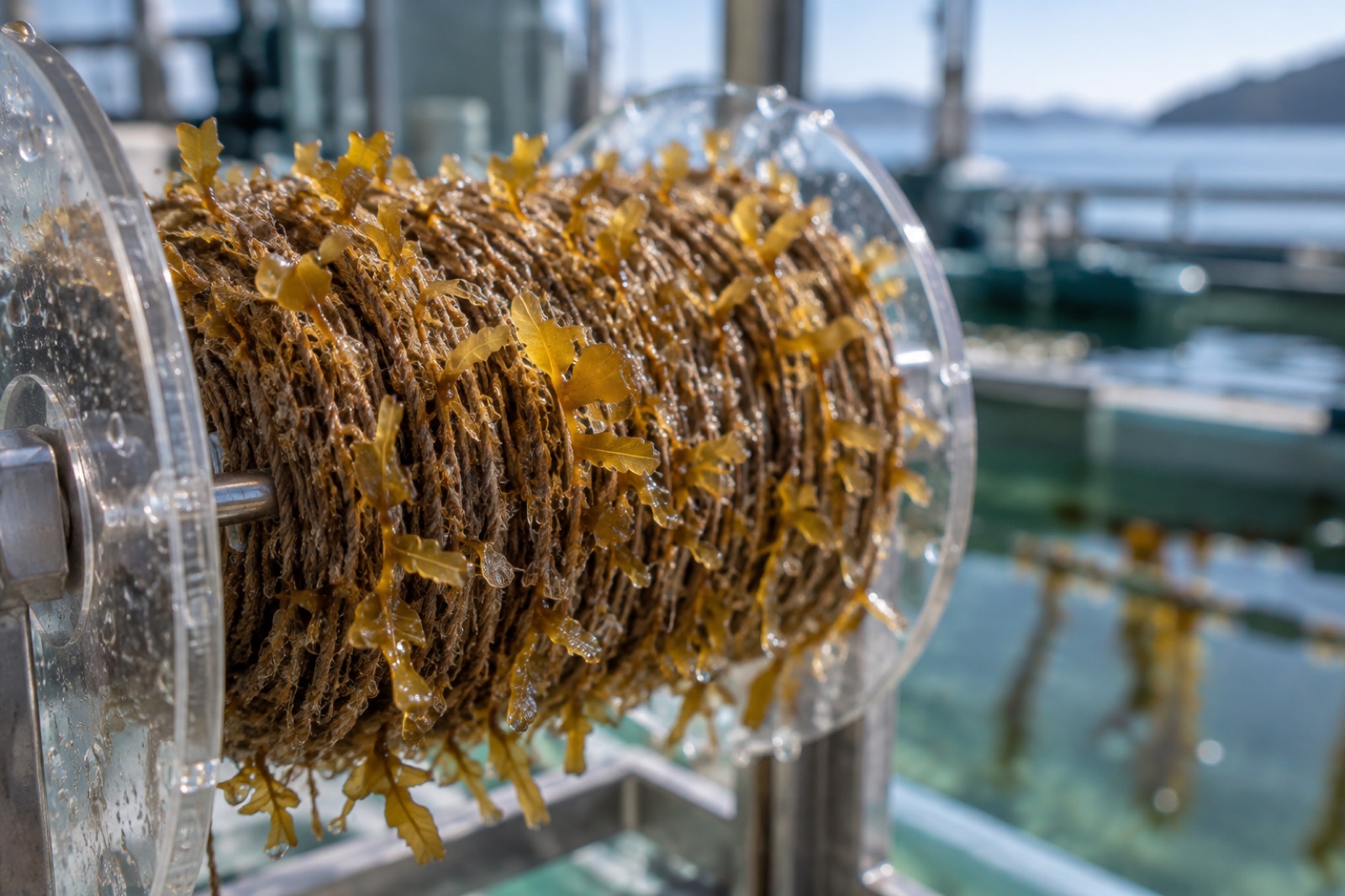
Every kelp blade on a farm begins life somewhere much more controlled than the sea. The nursery is the bridge between the hatchery's microscopic cultures and the open-ocean longlines — the place where seeded twine or spools grow their first centimetres into robust juvenile sporophytes that can survive a real ocean. There are two broad philosophies for building that bridge: a land-based tank nursery, where seeded material grows in filtered, managed seawater onshore; and an open-water nursery, where seeded material goes straight out to sea in a sheltered, tended structure. Neither is universally better. This guide walks through what each does well, what each costs, and how to choose.
What the nursery actually has to deliver
Before comparing systems, be precise about the job. A nursery's single deliverable is juvenile sporophytes of predictable quality, in predictable numbers, at a predictable date. Everything else — tank dimensions, lighting rigs, water chemistry, line handling — serves that. The nursery phase typically lasts four to ten weeks for kelps, taking gametophyte-seeded twine from invisible beginnings to visible sporophytes of 1–20 mm depending on species.
The quality test at nursery exit: uniform, dense sporophytes with healthy growing tips, free of fouling and disease. That quality bar is what the rest of this article keeps coming back to, because the two nursery types hit it in very different ways. For context on what good seeded twine should look like when it leaves, see making seed string.
Tank nurseries: control, at a price
A tank nursery is, in effect, an extension of the hatchery. Seeded twine is strung across shallow tanks or trays, usually vertically like looped lines on a comb, in continuously flowing or exchanged seawater. Light, temperature, nutrients and aeration are managed to hit the species' optimum. This is the default model in most Asian kombu and wakame industries and a growing standard elsewhere.
Strengths
- Maximum control. Light regime, nitrogen top-up, temperature buffering and water filtration all sit in your hands. Hatchery water quality explains why these are levers worth owning: sporophyte development is exquisitely temperature-sensitive, and a well-buffered tank can hold a steady 10–12 °C when the sea outside is lurching.
- High survival per unit of seed. A well-run tank nursery converts more of its seeded area into saleable juveniles than any open-water system. That matters because hatchery gametophytes are expensive (or slow) to produce.
- Earlier and cleaner seasons. You can start seeding when wild sori are unavailable, push the nursery phase through winter storms, and deliver juveniles to sea days or weeks ahead of the natural window.
- Biosecurity. Incoming water is filtered; staff and gear stay on shore. Tank systems are far easier to fold into the zoning model described in seaweed farm biosecurity.
Weaknesses
- Capital and operating cost. Land space, tanks, pumps, aeration, lighting (or greenhouse roof), backup power, and the labour to keep it all clean. This is the single biggest recurring cost in a land-based system and does not scale down gracefully for very small farms.
- Fouling and disease in closed volume. A tank is a warm, nutrient-dense petri dish if not managed. Diatom films, bacterial blooms and opportunistic grazers thrive exactly where you want juvenile kelp to — requiring frequent cleaning, water exchange and UV.
- Not a natural environment. Juveniles raised in still, buffered water are sometimes tender at outplanting, with thinner, less wave-hardened stipes. Farms that transplant directly can lose a discouraging percentage in the first weeks at sea.
Open-water nurseries: scale, at the sea's price
In an open-water (also called sea-based or field) nursery, seeded twine goes straight out to sea as soon as sporophytes are barely visible. The seeded lines hang from small, tended structures — a grid of small longlines, rafts or nursery frames in a sheltered bay — and are checked frequently. Japan's kombu industry has long used a version of this in sheltered coves; many Western operations do a hybrid of hatchery-phase-onshore, nursery-phase-at-sea.
Strengths
- Capital-light. No land, no tanks, no pumped seawater system. A nursery grid needs buoys, anchors, lines and a workboat — infrastructure a sea farm already owns. See kelp farm equipment for what that starter kit looks like.
- Wave-hardened juveniles. Sporophytes that grow in the sea develop the stipe strength and microbiome they'll need later. Transplant shock is minimal.
- Scales with the farm. Doubling nursery capacity is mostly a matter of adding another frame, not another building.
Weaknesses
- Lower and more variable survival. Storms, grazing, fouling and temperature spikes hit seeded lines directly. The same batch of seed that produced 90% survival in tanks might produce 50% at sea in a bad fortnight — and it's the bad fortnights that set your economics.
- Narrow seasonal window. You can only run the nursery when sea temperature and day length suit the species. In most temperate regions that's a tightening shoulder season, shrinking in warming years (see marine heatwaves 101).
- Harder biosecurity. Seeded twine exposed to the sea inherits whatever the sea is carrying that week. Fouling control is mostly manual wiping and depth management.
A side-by-side comparison
| Dimension |
Tank nursery |
Open-water nursery |
| Upfront capital |
High |
Low |
| Operating cost |
High (energy, labour) |
Low to moderate (boat time) |
| Survival per seeded line |
High, stable |
Lower, variable |
| Season length |
Extended, buffered |
Narrow, sea-defined |
| Juvenile hardiness at outplanting |
Can be tender |
Naturally hardened |
| Biosecurity |
Good, controllable |
Weak, sea-dependent |
| Scale-up path |
Construction-limited |
Roughly linear |
| Skill required |
Aquaculture technician |
Boat handling, observation |
Few real farms sit at either extreme; most successful operations blend.
Hybrid strategies used in practice
The most common working design is a two-stage hybrid: gametophytes are seeded and nursed in land-based tanks for the first four to six weeks (when the crop is at its most vulnerable and most in need of control), then the hardier juveniles move to a sheltered sea nursery or straight to the production site for hardening through the final weeks. Tidewright's Holdfast nursery system is built on exactly this logic — climate-controlled early stages onshore, ocean-hardened finish — because the evidence across sites is consistent that each metre of that gradient earns its keep at a different moment.
A second hybrid worth knowing is the direct-seeded farm, which skips a nursery structure entirely: seed twine goes from hatchery to a protected corner of the production farm itself, tended like a nursery but using farm infrastructure. This only works where the farm has a genuinely sheltered quadrant and the labour to visit it often.
How to decide for your farm
Run through these questions honestly:
- What is your production scale and growth plan? Under roughly a hectare, a tank nursery usually cannot pay for its own construction; a sea nursery or purchasing seedstock makes more sense. At multi-hectare scale, the marginal cost of tank-raised juveniles drops enough to matter.
- How reliable is your season? If your region's autumn seawater stays within the species' window for a dependable ten weeks, a sea nursery may suffice. If your coast is riding the kind of heat variability described in thermal refugia, tank buffering is increasingly a survival tool, not a luxury.
- How valuable is each unit of seed? If your hatchery's gametophyte output is the binding constraint (as it often is), high survival per seeded line matters more than low capital cost — favour tanks.
- What labour can you actually sustain? A tank nursery demands daily husbandry and system checks, year-round maintenance of pumps and lights; a sea nursery demands boat labour in weather windows. Recruit for the system you choose.
- Is biosecurity a regulatory or market requirement? If your markets, permits or customers demand documented clean seed (and increasingly they do), a tank-first system makes compliance dramatically easier. See seaweed farm biosecurity.
A reasonable starting rule for a first farm: buy seedstring from a professional hatchery for your first one or two seasons, run whatever nursery you can build cheaply, and only build a tank nursery once you've proven you can sell what you grow. There's no shame in paying someone else's specialists for the hardest, most technical stage of the pipeline while you learn the sea.
Key takeaways
- A nursery's deliverable is predictable juvenile sporophytes — quality, numbers and timing — not a particular tank shape or rope configuration.
- Tank nurseries trade capital and operating cost for control, high survival and a longer season; they are the natural choice where seedstock value is high and seasons are unreliable.
- Open-water nurseries trade control for low cost, natural wave-hardening and linear scalability; they work where seasons are dependable and husbandry labour is available.
- The dominant real-world model is hybrid: land-based early nursery, sea-based hardening phase.
- Very small farms are usually better off buying seedstring from a specialist and focusing capital on the sea farm itself.
- Climate variability is quietly shifting the balance toward tank buffering in the early phase almost everywhere kelp is farmed.
FAQ
Can I skip the nursery entirely and seed longlines directly at sea?
In principle you can put seeded twine straight onto production lines, and some low-cost operations do. In practice it only works in exceptionally benign sites with short exposure windows, and survival variability is high. The nursery exists because the first weeks of sporophyte life are when the crop is most fragile; skipping the phase concentrates risk exactly where it's worst.
How big a tank nursery does a one-hectare kelp farm need?
A useful rule of thumb is that one hectare of longlines needs a few tens of cubic metres of well-lit nursery tank volume for the nursery phase, operated in one or two batches. Exact figures depend on species and your line spacing, but the point is that the nursery is a small fraction of the farm by area — the constraint is the capital and husbandry quality, not scale.
Are tank nurseries only for kelp, or do they work for other seaweeds?
They work for most farmed seaweeds, and for some — Asparagopsis, dulse, some Ulva and Gracilaria strains — tank culture is the only realistic production route because their biology doesn't suit suspended longlines. Kelp is unusual among major farmed seaweeds in that open-water nurseries remain a viable mainstream option at all.
What's the most common failure mode of an open-water nursery?
Storms and biofouling, in that order. A nursery grid that isn't designed for the worst weather of its season — not the average — will eventually be tested and found out; storm-proofing a kelp farm applies doubly to a nursery full of fragile juveniles. Fouling follows closely behind: bryozoans and filamentous algae love nursery lines at exactly the moment the juveniles do.
If I can only afford one controlled stage, which should it be?
Spend it on the hatchery phase — the weeks from gametophyte to visible sporophyte — which has no open-water substitute at all. A nursery you can improvise in the sea; a hatchery with no climate control is not a hatchery. If you're building on a budget, see setting up a seaweed hatchery for where the money genuinely matters.